
Almost every part of a wind turbine ships in pieces. The tower arrives in sections and bolts together like oversized plumbing. The nacelle is basically a very heavy box. The blade is the exception: it’s a single molded piece of fiberglass, and on the newest machines it’s longer than the wingspan of any airliner you’ve ever boarded. You can’t fold it, which becomes a real problem when the last few miles to a wind farm are mountain switchbacks.
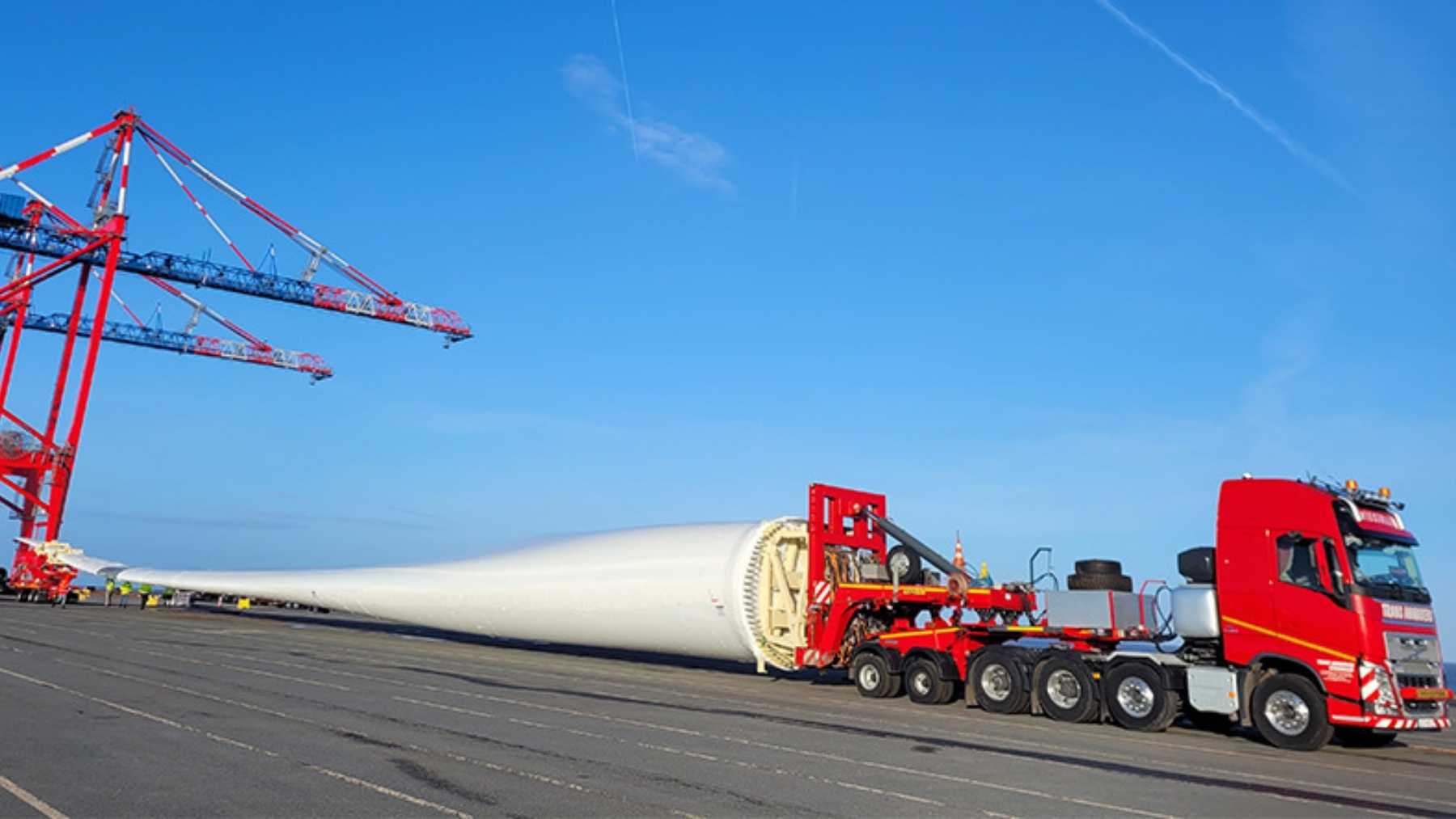
Germany’s answer to that problem is a machine called a blade lifter. It’s a self-propelled transporter that grips the blade by its root in a hydraulic mount and tilts the whole thing toward the sky, as steep as 60 degrees, so the tip swings over trees and guardrails instead of through them. Watching one crawl uphill with 279 feet (85 meters) of blade pointing at the clouds is quite something. It’s an impressive trick, right up until the hydraulics quit.
On August 27, one of those machines was working its way up the L 131, a mountain road in the Black Forest in southwestern Germany, with a blade raised to get through an S-curve above the village of Schweighof. At around 1:20 p.m., the hydraulics failed, and nearly 30 tons (about 27 metric tons) of blade came down on the transporter carrying it and on a support tractor driving ahead of it. According to the Freiburg police, nobody was hurt. The blade wasn’t so lucky.
So how does a 30-ton blade end up pointed at the sky in the first place?
So what exactly is a blade lifter?
Wind farms go on ridgelines because that’s where the wind is, and ridgelines come with the roads they come with. It’s the same problem that has 292-foot blades crawling through the Australian desert in daytime-only convoys, and it’s a big part of the reason road clearances quietly decide how tall turbines get. Lay a 279-foot blade flat on a conventional trailer and its tail end sweeps across the full width of every bend, plus whatever happens to be standing next to the bend. Tilt it up at the root and the same convoy suddenly fits inside a lane and a half. That’s the entire trick.
The catch is that the trick depends entirely on the hydraulics holding. Police say a technical defect in the transporter’s hydraulic system let the raised blade tip over in the S-curve, and it landed on the two vehicles moving it. What exactly broke is still under investigation, and as far as I can tell, nobody’s published a component-level answer yet. A representative from Enercon, the German manufacturer that built the blade, told reporters at the scene he’d never seen a technical failure like it, according to Cleanthinking, a German clean-tech outlet.
Cleanthinking also went looking for a national accident statistic on blade transports and found that nobody keeps one. So we don’t actually know how rare an event like this is. Rare enough that the Enercon rep was surprised, apparently.
Police put the damage at up to a million euros
Freiburg police estimate the damage at 700,000 to 1,000,000 euros, and that’s presumably mostly the blade itself, which was wrecked beyond any use. Nobody was hurt. Considering the blade landed on the two vehicles that were moving it, that’s arguably the best number in the whole story.
Recovery took the better part of a weekend, and if you’re wondering why, a wrecked 279-footer doesn’t just get winched onto a flatbed. Crews cut the blade apart where it lay, and the L 131 reopened on August 31, four days after the crash.
The mountain is getting five 819-foot turbines
The blade was headed for the Sirnitz/Dreispitz wind farm, which Badenova, the regional utility in Freiburg, is building on a ridge between Müllheim and Sulzburg at elevations between roughly 2,600 and 3,600 feet.
The machines are Enercon E-175s, and they’re enormous. Each one tops out at 819 feet (249.5 meters), which makes every single turbine taller than the Gateway Arch in St. Louis. The 175 in the model name is the rotor diameter in meters, so each machine sweeps a circle of moving blade roughly 574 feet across. Five of them together add up to 35 megawatts. Badenova expects around 71.5 million kilowatt-hours a year from the farm, enough electricity for roughly 50,000 people.
Getting the parts up there is a logistics project in its own right. The blades came up the Rhine by barge, moved by road to a staging yard in Müllheim-Niederweiler, and make the final climb one at a time on the blade lifter. The farm needs 15 blades in all, three per turbine. The one in the S-curve isn’t part of the count anymore, so presumably one extra climb is now on a schedule somewhere. Germany’s wind business has had a rough year for blades in general; a broken one idled 64 turbines in the North Sea this summer.
A month later, the blades are moving again
Nothing moved for a month. Badenova said in late August that it couldn’t yet judge what the crash would do to the construction schedule, which had the first turbines penciled in to start producing power around the turn of the year.
Now the investigation’s wrapped up, and Enercon has announced that the transports from Niederweiler are back on, with the company telling the Badische Zeitung that safety has top priority on the resumed runs. I can’t find a public count of how many of the 15 blades had already made it up before the crash, so I can’t tell you how many climbs are left. More than a few, from the looks of things.
The first transport since the accident is scheduled to leave Niederweiler on Monday, September 28, at around 9 a.m., and Enercon says the blade lifter itself will be back on the L 131 on Wednesday.