
- 2 MONTHS AGO · ENERGYA spring inside a nuclear plant breaker got acrylic paint instead of dye, the paint can flake into the contacts, and a breaker that still opens on demand may refuse to close, the move that powers the emergency pumps, so 13 plants from New Hampshire to Arizona have to check theirs
- 1 MONTH AGO · ENERGYA 1,600-megawatt reactor on the French coast shut down at three minutes to midnight for a year of work, 20,000 separate tasks that include trading its steel lid for a new 109-ton one that reached the plant by river barge, cargo ship and road convoy
- 2 DAYS AGO · ENERGYA 216-foot steel vessel 60 feet high is being assembled nearly a mile underground in South Dakota, one of two tanks that will take 2,600 beams lowered one by one down a shaft and will each hold about 17,000 tons of liquid argon at about 300 degrees below zero
- 5 HOURS AGO · ENERGYA copper mine with no pit and no shaft is running southeast of Phoenix on about 145 wells that push weak acid through broken rock as deep as 1,200 feet and bring the metal back up dissolved in it, built to turn out 85 million pounds of cathode a year from a deposit sized for 22 years
- TODAY · THIS ARTICLEA 21-foot-wide shaft has reached 5,203 feet under a Quebec gold mine whose open pit had part of its north wall move this summer, and its 305-foot headframe is now trading the sinking gear for a production hoist sized for about 22,000 tons a day, with shaft hoisting due next spring
Gold rushes are supposed to involve a pan, a creek and a guy with a beard, or at least that’s how the old Westerns tell it. The modern version in Quebec looks a lot more like an elevator job. A really big one.
Agnico Eagle, the Toronto-based gold miner, says it finished the first phase of sinking the production shaft at its Odyssey mine on July 9. The shaft is 21 feet across, it’s lined with concrete, and it now goes down 5,203 feet. That’s just shy of a mile, straight down.
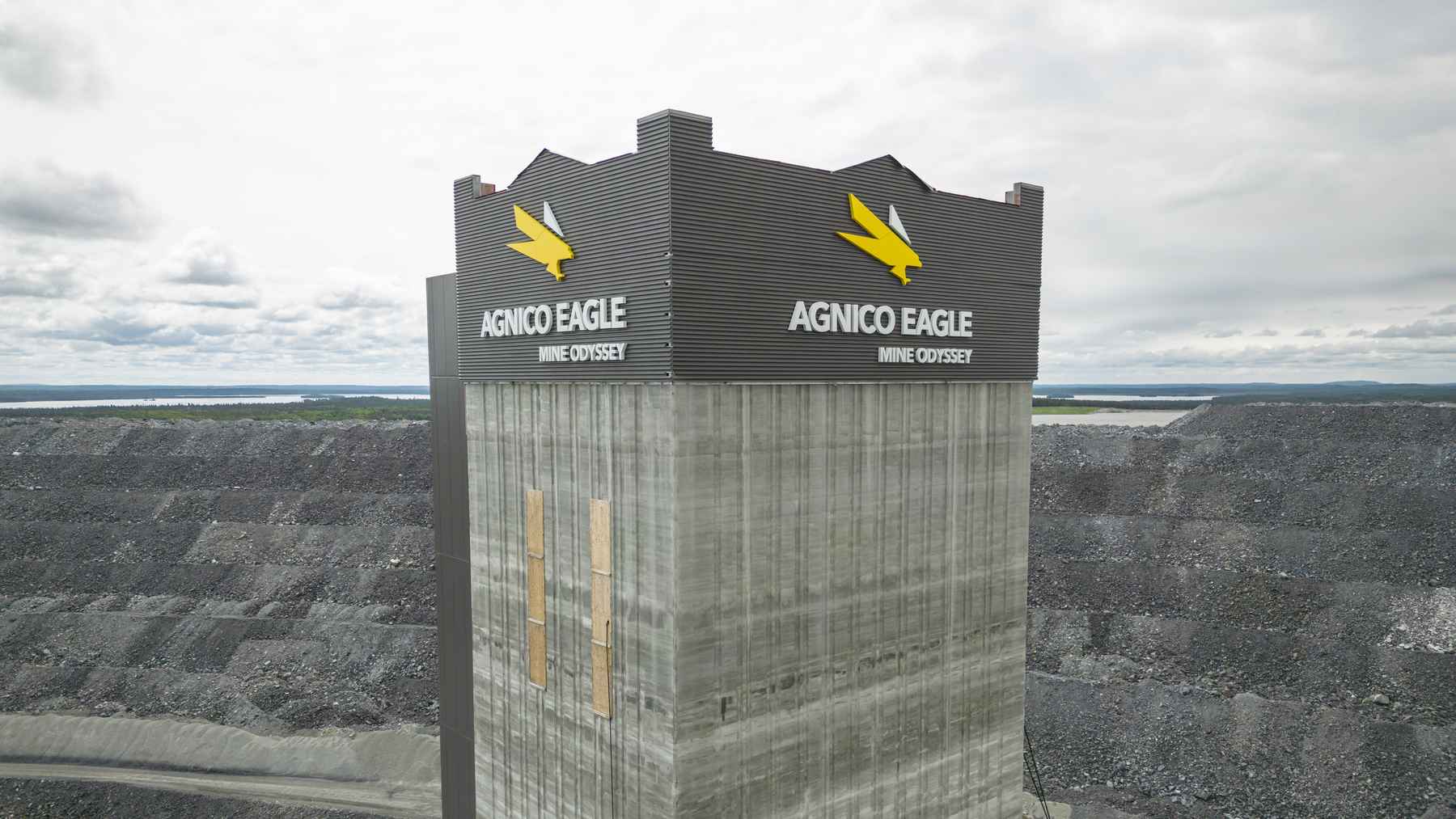
Odyssey sits a little under 2 miles east of the town of Malartic, and it’s the underground part of the Canadian Malartic mining complex. But the bottom of the hole is only half of it. The other half is happening up top, where the tower over the shaft is being refitted for a completely different job.
So what’s a headframe, anyway?
A headframe is the tall tower you see standing over a mine shaft. It holds the big wheels, called sheaves, that the hoist ropes run over on their way down the hole, so it’s basically the top half of an elevator.
A skip is what hangs off the end of those ropes. It’s essentially a steel bucket that gets filled with broken rock at the bottom, rides up the shaft, dumps its load at the top and heads back down for more. Think of it as the elevator car, except it’s one you’d never want to ride in.
Odyssey’s headframe stands about 305 feet tall, according to the construction milestones on Canadian Malartic’s Odyssey page. The same page lists a total height of about 315 feet in a section on the concrete pour, and I couldn’t find anything on it explaining why the two figures don’t match. My best guess is that one of them counts something the other one doesn’t, but that’s all it is. A guess. Either way, it’s a pretty serious tower, and the page says the concrete went in around the clock for 20 days, about 5,200 cubic yards of it.
The headframe is switching jobs
While a shaft is being sunk, its headframe is usually rigged for the dig itself. It lowers people and equipment, and it pulls out the rock they break as the hole gets deeper.
Once the hole’s deep enough, that rig has to come out so the permanent gear can go in. In its third-quarter report on October 28, Agnico said “preparations for the headframe changeover to the production hoist continued,” and that included putting in the production sheaves and taking apart the sinking infrastructure. The company also says workers finished excavating level 158 in August, and that the first loading station, where broken rock gets fed into the skips, is still under construction.
So what’s the production gear going to handle? Agnico’s 2023 update on the project (there’s a copy on the SEC’s website) called for two 57-ton skips and a hoisting capacity of about 22,000 tons a day. That’s capacity, though. It doesn’t mean 22,000 tons of gold-bearing rock will come up every single day, since any mine sends some waste rock to the surface too, and it’s safe to assume this one won’t be any different.
So why dig a shaft when there’s already a ramp?
Odyssey isn’t sitting around waiting for the shaft to start mining. Its main ramp, which is basically a tunnel that winds its way down so trucks can drive in and out, had reached 4,042 feet by September 30. Agnico says Odyssey mined a record of about 431,000 tons in the third quarter.
So why spend years digging a giant hole right next to it?
Because hauling every ton up thousands of feet of ramp is a long, slow drive, and it only gets longer the deeper you go. A skip just goes straight up. That’s pretty much the case for a shaft right there, and it’s why you’ll find these things all over hard-rock mining country. We’ve written about a couple of them, from a shaft sunk 8,530 feet under Ontario from the bottom of an old mine to a 22-foot-wide one near Sudbury that’s down to 5,265 feet.
Odyssey has been a test bed for smarter trucks, too. Epiroc, the Swedish equipment maker, says it developed and tested autonomous truck haulage underground at Odyssey.
The ramp is also being pushed deeper, toward where the shaft will eventually bottom out. And that matters, because the shaft isn’t done. Agnico plans a second round of sinking from 2029 to 2031, taking it to a final depth of 6,135 feet. That’s roughly another 930 feet of hole.
Agnico hasn’t settled whether Odyssey gets a second shaft, either. The company says it’s still working out the best mining rate for East Gouldie, the deposit this shaft is meant to serve, and that’ll determine how big a second shaft would be and where it’d go, if it happens at all.
Part of the open pit’s north wall moved this summer
Up on the surface, the summer was a little less smooth. On July 1, a section of the Barnat pit’s north wall shifted. Barnat is the open pit Canadian Malartic is still mining, and Agnico’s term for what happened is localized rock mass movement, which is mining-speak for part of the pit wall moving.
Mining in the pit stopped, then resumed on September 27 after remediation work. Agnico expects the whole episode to knock 60,000 to 80,000 ounces off Canadian Malartic’s gold output over the back half of this year, and as much as 150,000 ounces a year off it in 2027 and 2028. Those are pretty big numbers for one stretch of one wall.
The company believes Odyssey’s construction and output plans won’t be affected by what happened to the wall. That seems reasonable enough, given Odyssey’s ore comes from underground and not out of that pit.
If the schedule holds, Agnico says the first East Gouldie ore should come up Odyssey’s shaft in the second quarter of next year, less than a year after the sinking crew reached 5,203 feet.
 A Wisconsin research farm grows hay under 5,424 solar panels on 16 acres, and the first two cuttings in their shade came in at 77 and 82 percent of the open field, but after a drought the third one outweighed the full-sun plot by more than a fifthEnergy · 2 hours ago
 A 590-megawatt reactor on the Lake Michigan shore shut itself down from full power at 5:12 in the morning when its main generator locked out, its leftover heat went out as steam through valves that vent to the open air, and three days later the 56-year-old unit was still at zeroEnergy · 11 hours ago
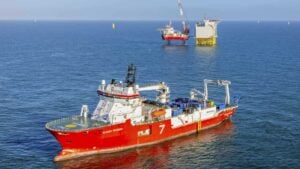 A 426-foot ship built to lay internet cable across oceans can now carry about 4,400 tons of power cable on two giant turntables, and it has started unspooling 311 miles of it across the seabed of a British wind farm to plug 197 turbines into two converter stations out at seaEnergy · 1 day ago