
Driving the supply truck has never been the glamorous part of a war. It’s often been one of the more dangerous parts, though. Roadside bombs made convoys a favorite target in Iraq and Afghanistan, and in Ukraine, cheap drones have made pretty much any truck on an open road worth shooting at.
So you can see why armies keep trying to get the driver out of the cab. Ukrainian units already do it, sending ground drones to the front with ammunition, food and fuel, and using them to bring the wounded back. The biggest of those, the Protector, is rated for about 3,260 pounds in its latest version, according to its maker, Ukrainian Armor.
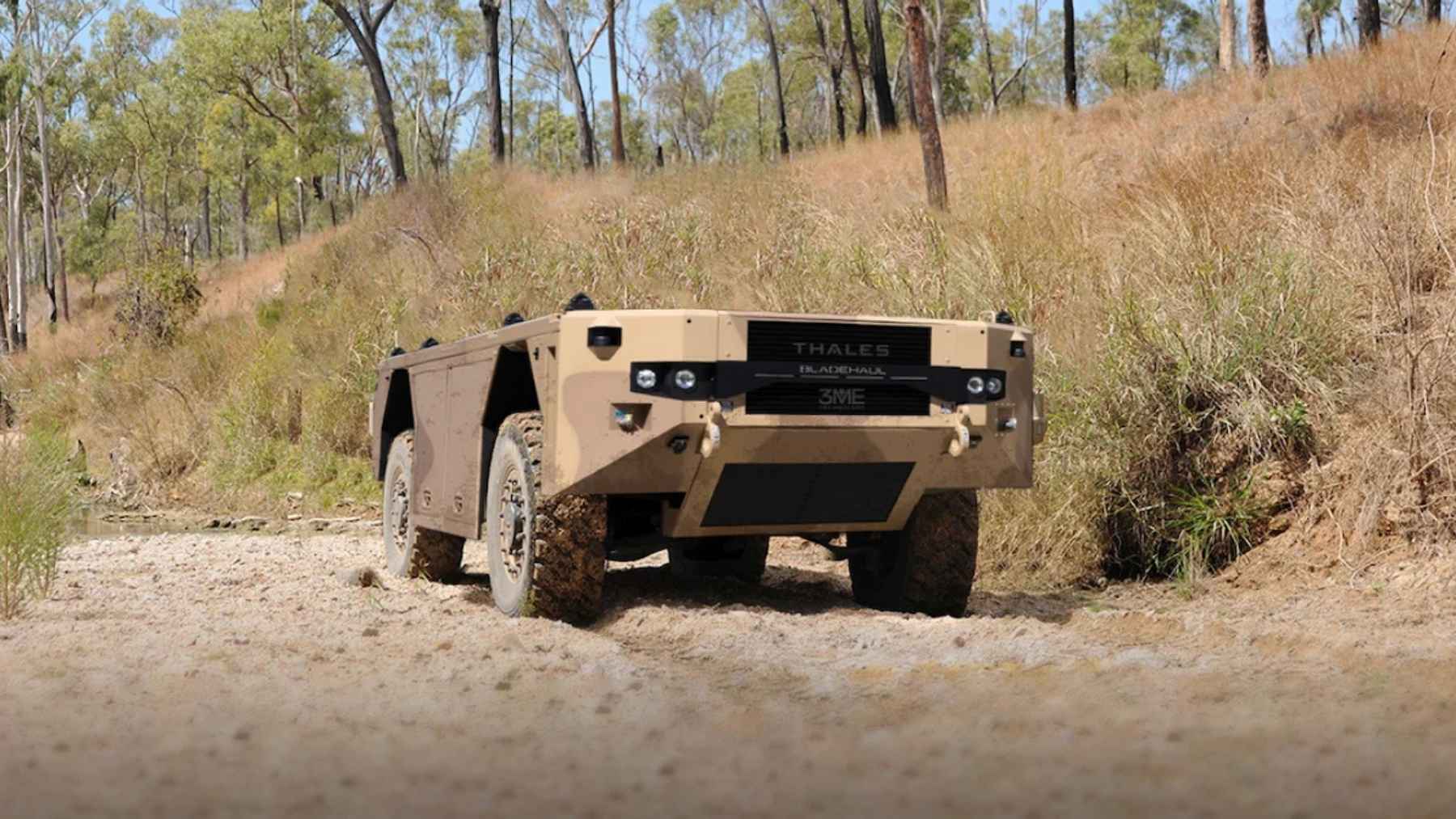
Thales Australia’s new ground drone is in a different league. It’s called BladeHAUL, and it’s built to carry about 22,000 pounds, nearly seven times the Protector’s 3,260. It’ll also take a 20-foot shipping container, clamped into locks on its deck.
It was unveiled on October 6 at Land Forces, a big land-warfare trade show that was held in Perth for the first time this year. It’s a joint project with 3ME Technology, a company from Newcastle, New South Wales, that builds batteries and hybrid systems for heavy vehicles. According to its builders, BladeHAUL can carry more than any ground drone Australia has in service or in the works.
So what is BladeHAUL, exactly?
In military-speak, it’s an uncrewed ground vehicle, or UGV. Basically, that’s a drone that drives instead of flying, and this one can be steered by remote control or left to drive itself.
It’s derived from the Bushmaster, the boxy armored troop carrier Thales has been building in Bendigo, Victoria, for more than 20 years. More than 1,300 have come off that line so far, and Ukraine is one of nine countries that use them.
BladeHAUL shares the production line and is built around the Bushmaster’s structure and off-road hardware. 3ME supplies the hybrid drive, the batteries and the vehicle controls, and the truck’s put together in both Bendigo and Newcastle.
If you’re going to build a drone truck, frankly, that’s a pretty sensible way to do it. Bendigo already knows how to turn out a tough 4×4 in volume, so from the looks of things, most of what’s new here is the electrical side and the software.
Thales seems proud of the homegrown angle, too. Jeff Connolly, who runs the company in Australia and New Zealand, called BladeHAUL “a clear example of Australian innovation delivering Australian capability.” That’s a lot of “Australian.”
So how big is it?
Its builders haven’t said. I couldn’t find a length or a weight for BladeHAUL anywhere, which is a slightly odd thing to leave out when a truck’s whole pitch is how much it can carry.
If you want a ballpark, the closest thing we’ve got is the Bushmaster. Thales rates the current Bushmaster at about 37,500 pounds fully loaded, on a body about 23.6 feet long. BladeHAUL’s 22,000-pound payload works out to roughly two and a half times the 8,800-plus pounds Thales lists for the Bushmaster.
Thales says BladeHAUL fits in a C-130, the propeller-driven cargo plane the US military has flown for decades, as well as the bigger C-17 and Europe’s A400M. A Bushmaster rides in a C-130 too, so I’d guess the new truck isn’t wildly bigger than the vehicle it’s based on.
Why does a drone truck need such a big battery?
BladeHAUL runs on a 660-volt hybrid system with a 110-kilowatt-hour battery, and it’s good for more than 370 miles. Thales vice president Andrew Downes confirmed those figures to Defence Connect at the show.
That’s a fairly normal battery by electric-pickup standards. Ford offered the F-150 Lightning with 98 or 131 kilowatt-hours, so BladeHAUL’s 110 lands right between them. It’s just bolted to something that’s meant to carry 11 tons.
It’s the same basic idea as the hybrid in your neighbor’s driveway, scaled up for a lot more weight. A diesel engine and a big battery split the work, and I’d assume the diesel handles most of it on long runs, since 110 kilowatt-hours on its own won’t get a truck this heavy anywhere near 370 miles.
I haven’t seen a figure for how far it goes on battery power alone, or whether that 370-mile range assumes a full load. The company says the truck can also be built fully electric, though no one’s published a range for that version yet.
So why bother? Because BladeHAUL is being pitched as a power source as much as a hauler. Park it next to a field hospital or a communications setup, and it can keep them running, or it can just sit there as a standalone generator.
That’s arguably the more interesting half of the pitch. Armies run on electricity these days, between the radios, the radars, the laptops and the chargers for all those drones, and a lot of that power still comes from generators someone has to drag out to the field and keep fueled.
Figures: Thales, Defence Connect, Ukrainian Armor, Ford. Payloads converted to pounds.
It’s got a long list of side jobs
Hauling cargo and powering a camp are the main gigs, but its builders have a whole list of extras in mind. They want BladeHAUL carrying deployable command posts, surveillance gear and equipment for knocking drones out of the sky. They’re also talking about radar, air defense and a coastal defense version. For clearing mines, it could push rollers or a plow-style blade up front, according to Defence Connect. Then there’s maritime strike. That basically means hitting ships from land.
Neither company has spelled out what a maritime strike setup would carry. Defense Express, a Ukrainian defense outlet, says the payload makes BladeHAUL a candidate platform for weapons like anti-ship missile launchers, and I’d call that a fair read. The US Army is already working on a hypersonic missile that fires out of a box on the back of a truck, so a launcher on a drone truck isn’t much of a leap.
The Australian Army gets the first crack at it
So how much of the driving does BladeHAUL actually do on its own? It’s supposed to work either way, remote-controlled or autonomous. But later that same week, Thales Australia announced it was teaming up with Deakin University to develop and test the truck’s autonomy, so I’d call the self-driving side a work in progress.
That’s not a knock on it. Pretty much every driverless truck is a work in progress. And Australia’s mining companies have been running driverless drill rigs from control rooms in Perth for about a decade, so the country’s engineers aren’t exactly new at this.
The two companies also want BladeHAUL at the next Talisman Sabre. If that name’s new to you, it’s Australia’s biggest military exercise, and it’s planned jointly with the United States. The next one is in 2027, and Australia’s Department of Defence expects it to be one of the most complicated it’s ever put together.
Which means that if things go according to plan, US troops could end up working alongside one.
As far as I can find, there’s no price on BladeHAUL yet, which seems about right for a truck that’s still waiting on its first Army trial. It was unveiled in Perth on October 6, and Thales expects the Australian Army to start those trials in the new year.