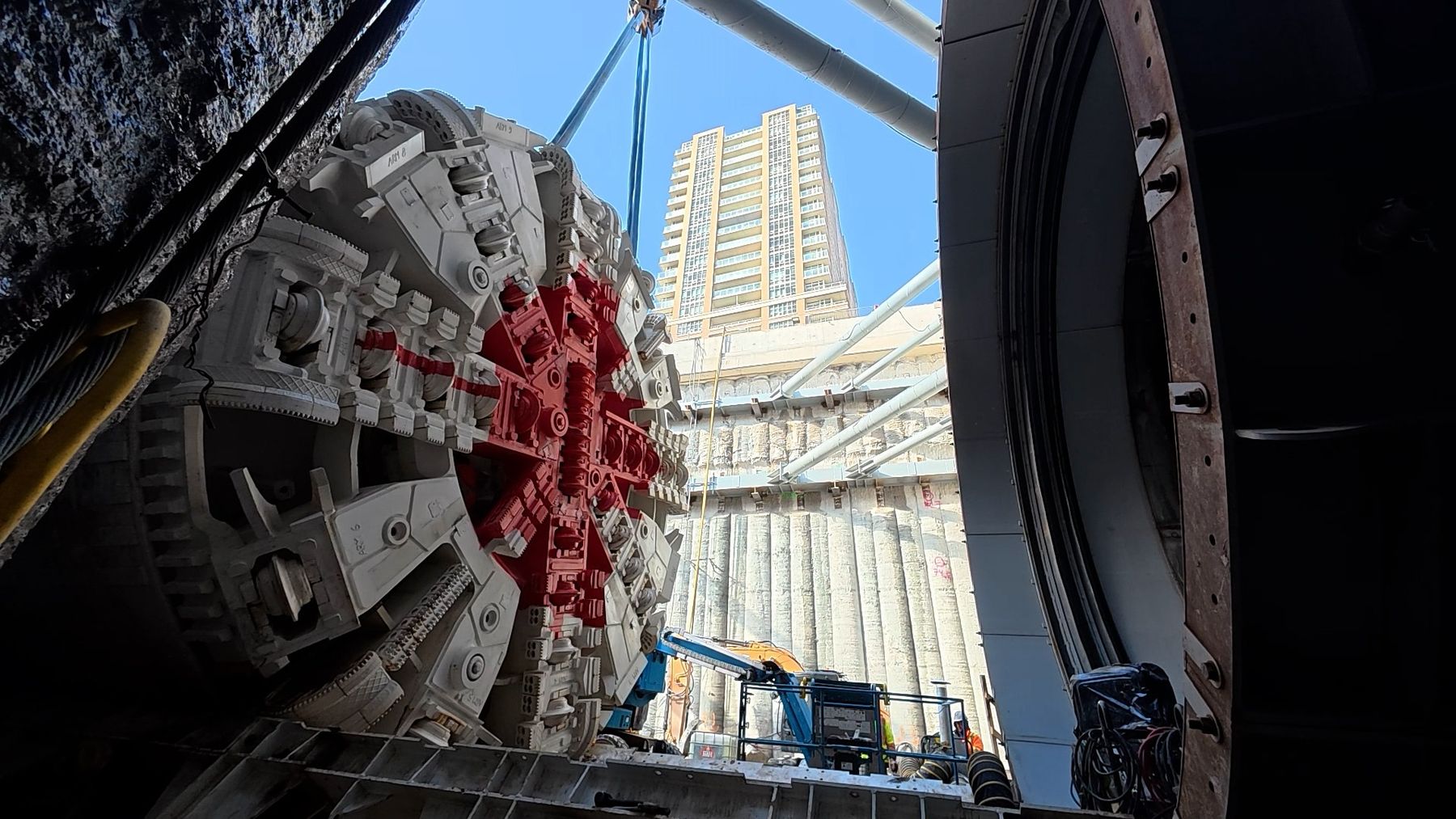

Tunnel boring machines spend almost their entire working lives where nobody can see them. You hear about one on launch day, when a few politicians line up in front of a giant cutterhead for photos, and then it disappears underground for months.
So when one of them actually shows up somewhere, it’s kind of a big deal. On November 6, the Ontario government said Libby, the first of two machines digging the new Ontario Line subway under downtown Toronto, had broken through into the future King West Station.
We looked at Libby and its twin, Corkie, back in July, when both were still early in their drives. This is the first time either of them has come up for air. Sort of.
So what happened at King West?
Libby started tunneling in April from a launch shaft in Liberty Village, right next to Exhibition Station. According to the province’s announcement, it’s since covered about 4,265 feet, a little over three-quarters of a mile, and set roughly 780 concrete rings in place behind it.
Then it reached the station site at King Street West and Bathurst Street and ground its way in.
The province is careful with its wording here, and I’m going to be too. King West is the first station any TBM has reached on the Ontario Line. It isn’t Toronto’s first tunnel by a long shot, and we’ve already covered another big Toronto borer, Diggy Scardust, on the Scarborough Subway Extension.
So how do you break into a station that isn’t finished?
Well, the station mostly does exist, at least as a hole. Crews dug the King West station box down from the surface first, and Metrolinx said back in April that the King and Bathurst site was already fully excavated. That means Libby wasn’t building a station when it arrived. It was chewing through the last stretch of ground and wall into an empty space that was already waiting for it, which is what tunnelers call a breakthrough.
What are 780 lining rings, anyway?
A TBM doesn’t just make a hole. It builds the tunnel walls as it goes.
Behind the cutterhead, the machine sets curved precast concrete segments into place until they form a complete ring. Then it pushes itself forward off that ring with hydraulic rams and starts on the next one. Metrolinx says the machines also pump grout into the gap between the segments and the surrounding earth, which locks the lining in place and helps keep groundwater out. Repeat that a few hundred times and you’ve got a finished tube. It’s basically a factory that lays its own floor as it drives.
So those roughly 780 rings are the actual tunnel lining, the walls trains will eventually run past. If you divide the province’s approximate distance by its approximate ring count, you get something like 5 1/2 feet of tunnel per ring. That’s my math on two rounded numbers, though, so treat it as a ballpark and not a spec.
How big is Libby?
Libby is an EPB shield built by Herrenknecht, one of two the German manufacturer supplied to Ontario Transit Group, the Ferrovial and Vinci joint venture building this stretch of the line. Herrenknecht’s data sheet lists each machine at about 22.5 feet across, with roughly 1,720 horsepower driving the cutterhead and about 5.1 million pound-feet of torque.
EPB stands for earth pressure balance. The chamber right behind the cutterhead stays packed with the dirt and rock the machine just dug up, and that mush is kept under pressure so the ground in front doesn’t slump into the hole. It’s a pretty sensible way to tunnel under a downtown full of buildings, streetcar tracks and people who’d rather their sidewalk stayed where it is.
Scott-Woods Transport, the heavy-haul company that moved the parts, says the cutterhead alone weighs about 167,551 pounds, or roughly 84 tons, and that hauling it and the rest of the components took around 44 specialized truckloads. The machines came over from Germany and landed at the Port of Oshawa last year, and the components were trucked through Toronto to the Exhibition site in February.
I’d love to give you Libby’s total weight and length, but I can’t find a number specific to this pair. The trucking company’s post only gives a general range for machines of this type, and neither Metrolinx nor Herrenknecht publishes a figure for these two, so I’m not going to pretend otherwise.
So what happens to Libby now?
Now that it’s in the station, the province says crews will test and maintain Libby before it heads on to the Chinatown Station site at Queen and Spadina.
The release doesn’t say how long that pause will last or exactly what the work involves. I’d argue a station is about the friendliest pit stop a TBM ever gets, though. There’s open space around the front of the machine for once, instead of solid rock in every direction.
Libby isn’t digging alone. Corkie, the second machine, is cutting the parallel tube right alongside it, and the province says it’s due at King West in December.
Together, the pair is boring roughly 3.7 miles of twin tunnels from Liberty Village to a portal at the Don Yard, according to Metrolinx. Along the way they pass through six underground stations: King West, Chinatown, Osgoode, Queen, Moss Park and Distillery District. Metrolinx says the tunnels run roughly 130 feet below the streets.
The names came from a public contest. Toronto transit fan Jason Paris picked Libby and Corkie as a nod to Liberty Village and Corktown, the neighborhoods at either end of the drive, and he’s also the guy who named Dennis and Lea, two of the machines that dug tunnels for the Eglinton Crosstown. Apparently Corkie got its “ie” spelling because Paris figured it sounded a little cuter. I can’t argue with that.
Metrolinx CEO Michael Lindsay says the project “continues to hit significant milestones every month.” Frankly, after decades without new subway tunneling under the core, you’d expect the people running it to be in a good mood about a breakthrough.
The rest of the Ontario Line is still under construction
Don’t go planning your commute just yet. The full Ontario Line runs about 9.7 miles from Exhibition Place to Line 5 Eglinton at Don Valley Station, and plenty of it isn’t underground at all. Work started earlier this year on an elevated section in the east end, along with four more stations out there. The November 6 release doesn’t give an opening date for any of it.
What it does give is the next milestone. The province says Corkie will reach King West in December, and once it does, both of the Ontario Line’s first two tunnels will have made it to their first station.