
HLV's pit uses three diffusers that move water slowly enough to keep the hot top layer from mixing with the cold water below.
One full charge stores about 18,000 megawatt-hours, and the pit can charge and discharge at 60 megawatts.
HLV says a leak in the pit's double liner can be fixed by a diver or by a robot.
The project costs about €33 million, and Finland's Ministry of Economic Affairs and Employment is covering about €7.7 million of it.
Ask The Box:
If you’ve ever jumped into a lake at the end of August, you already get the basic idea behind this one. A big body of water takes ages to warm up, and once it’s warm, it takes ages to cool back down. Most of us just call that a decent swim in September.
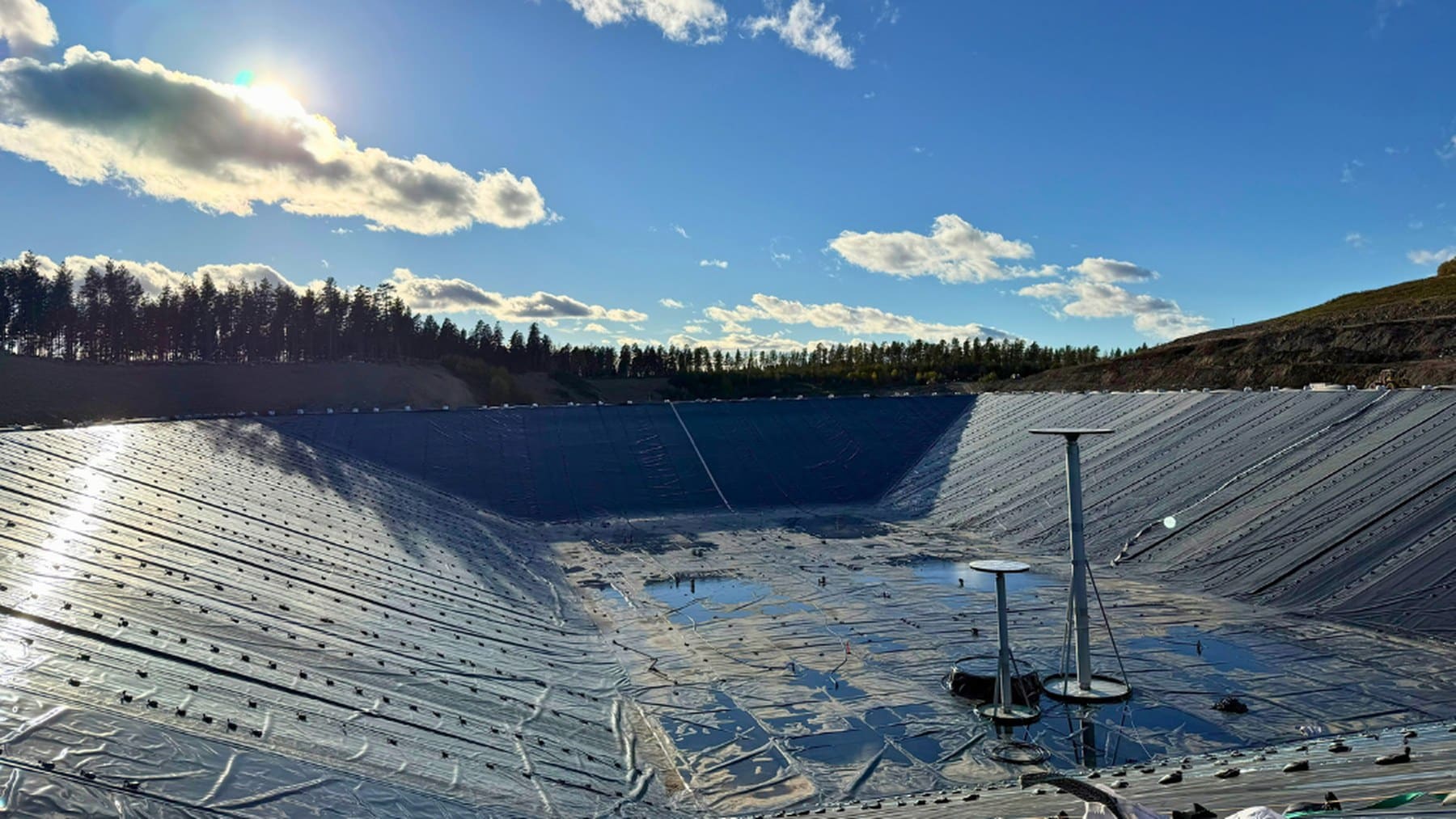
A heating company in Hyvinkää, a town in southern Finland, wants to turn that into a winter heating plan. Since early October, it’s been running ordinary tap water from the town’s water network into a lined former gravel pit in the Kulomäki area. The pit is about 66 feet deep, and when it’s full, it’ll hold about 100 million gallons.
The plan is to heat that water during the summer and pull the heat back out once the Finnish winter shows up.
The company is Hyvinkään Lämpövoima (HLV), which runs the town’s district heating. Right now, its project is basically a very large, very carefully lined hole that’s slowly filling up, and it’s going to stay that way until spring.
So why fill an old gravel pit with tap water?
District heating is a pretty simple setup if you’ve never lived with it. A central plant heats water and pushes it through insulated pipes under the streets, and homes and offices use that heat for their radiators and hot water. Boise runs a version of this with 177°F water that comes out of the ground already hot.
Most towns don’t get that lucky, so they have to make the heat themselves, and timing is the problem. HLV’s pitch is that heat is cheap to come by in summer, when demand is low, and needed most in winter, when demand peaks. A seasonal heat store is basically a giant thermos that lets the company move heat from one season to the other.
It works because hot water floats on top of cold water. HLV’s pit has three diffusers, which are essentially wide outlets that move water in and out slowly enough that the warm and cold layers don’t get stirred together. To charge the store, the system draws cold water off the bottom, heats it and sends it back in up top. In winter, it pulls hot water off the top layer to feed the town’s network.
The middle diffuser is reserved for a future heat pump hookup. HLV says it could also take in cooler waste heat, and it gives about 158°F as an example. The water in the pit is designed to sit anywhere between 104°F and 194°F, so the middle layer gives cooler heat sources a place to plug in.
So how much heat are we talking about?
Quite a lot, according to HLV. One full charge holds about 18,000 megawatt-hours, which the company says is enough to heat the domestic hot water for roughly 20,000 people for a year. The store can charge and discharge at 60 megawatts.
That yearly figure caught my eye. If I’m reading the two numbers right, 90,000 to 100,000 MWh a year works out to five or so full charges, so this isn’t strictly a fill-it-in-summer, drain-it-in-January kind of setup.
In its announcement, HLV says the store could cover up to almost a quarter of Hyvinkää’s yearly heat demand. Its project page goes a little further and says up to 25% of the town’s annual district heating demand. I’d stick with the more cautious version for now, but either way, that’s a pretty serious share for what’s essentially a pond with a lid on it.
The summer heat comes from boilers and factories
HLV plans to charge the pit with industrial waste heat from nearby businesses and with electric boilers. An electric boiler is pretty much the heating element in your kettle scaled up to utility size. It makes the most sense when power is cheap, which is exactly the kind of summer energy HLV says it wants to save for winter.
The company’s release also mentions data centers being planned for the surrounding area. HLV says their waste heat could feed the store all year round if they get built. It hasn’t said which industrial sites supply waste heat today, and it hasn’t published the capacity of its electric boilers either, which is a bit of a shame, because that’s the number that tells you how hard the pit can be charged on a cheap-power day.
The payoff, according to HLV’s project page, is that its network could cut fossil fuel use to practically zero in a year with normal weather. The release phrases it as dropping fossil fuels almost entirely. Either way, I’d assume a properly brutal Finnish winter could still send the old plants back to work. HLV puts the carbon cut at about 4,850 short tons of CO2 a year and the fuel savings at millions of euros a year.
There’s groundwater under all of this
The Kulomäki site is in a groundwater area, and HLV holds a final water permit that comes with monitoring requirements. If you’re wondering whether parking about 100 million gallons of water at up to 194°F on top of a town’s groundwater is a slightly nervy idea, HLV seems pretty aware of that too.
The pit has a double liner, and leak-detection wells can flag a problem in the membrane. HLV says a leak can be fixed by a diver or by a robot, which isn’t a sentence I expected to find on a heating company’s website. Any heat that does spread into the groundwater gets picked up by heat pumps and sent into the district heating network. The company calls that setup ATES, short for aquifer thermal energy storage. Basically, the heat that escapes gets recycled instead of wasted.
HLV has also put in 18 new groundwater monitoring pipes, and it’s tracking soil temperatures and nearby sensitive habitats. Rain that falls on the store drains into ditches around the embankments and soaks back into the ground. The company doesn’t spell out why it picked an old gravel pit in the first place, though I’d guess a site that was already a big hole saved a fair bit of digging.
The water’s going in now, but the heat isn’t
Earthworks started last November, and the embankments were finished in September. The liner and the technical installations went in between April and September. The district heating pipeline that links the pit to the network was built between April and August.
Filling started in early October and is due to run until the latter part of April. HLV hasn’t published a daily fill rate. I ran the rough math anyway, and spreading 100 million gallons over about 200 days comes out to roughly half a million gallons a day, on average.
Once the pit is full, HLV plans to build its permanent lid between April and October 2027. The lid measures about 738 by 541 feet, which is a little over nine acres, and HLV describes it as about five soccer fields. The company hasn’t said what it’s made of.
Heat charging can start in late summer 2027, and the store is due to go into full production in autumn 2027. Until then, it’s a very big pool of cold tap water.
The whole project costs about €33 million. Finland’s Ministry of Economic Affairs and Employment put in a grant of about €7.7 million from its program for large demonstration projects. Lassila & Tikanoja is the main contractor for the first phase through its L&T Teollisuuspalvelut industrial services unit.
“The start of the water filling is a significant milestone in the heat storage project,” HLV CEO Sanna Kytömäki said in the company’s October announcement (my translation from Finnish). HLV also said construction was halfway done, on schedule and without a single workplace injury.
Is it really the world’s largest?
HLV’s project page calls it the world’s largest pit heat store. The October release uses a narrower version and calls it the world’s largest heat store built in a gravel pit. The company also says it’s the first of its kind in Finland.
For a sense of scale, the best-known pit store is probably the one in Vojens, Denmark. State of Green lists it at about 53 million gallons, and it’s been running for more than a decade. Hyvinkää’s pit would hold almost twice that.
I couldn’t independently confirm that nothing bigger is operating anywhere, so I’d treat “world’s largest” as HLV’s claim rather than a settled fact. Heat stores come in a lot of shapes anyway, from stacks of carbon blocks heated to 4,352 degrees to holes full of water like this one.
If the schedule holds, HLV expects the pit to finish filling in the latter part of April 2027, with the first summer heat going in late that summer and full production starting in autumn 2027.
 A 375,000-pound turbine now spins inside a Tennessee dam in place of one that ran for more than 80 years, and a federal watchdog just found that 196 of the 240 welds on the ring guiding water out of it failed on a job where some welders weren’t qualifiedEnergy · 3 hours ago
 280 solar panels on trackers 15 to 16 feet up over a Spanish olive grove are built to tilt whenever the trees need shade, one rig for machines that shake each tree and one for harvesters that straddle the rows, and lying flat on a July test day they left the leaves underneath greenerEnergy · 5 hours ago
 A reactor coolant pump at a 759-megawatt South Carolina nuclear plant had its insulation burn past the 15-minute mark that forces an emergency declaration, and the site’s fire brigade put it out with a fire extinguisher 27 minutes after the first alarm, with output already at zeroEnergy · 6 hours ago