
- 3 MONTHS AGO · ENERGYA French reactor holds its water at 87 psi, the pressure in a road bike tire, heats it to 212 degrees, a pan boiling on a stove, and pushes it into the pipes a gas boiler would have fed, heating 20,000 homes off a core smaller than a cubic meter
- 3 MONTHS AGO · ENERGYA 46-ton steel cylinder rocks end over end in the Atlantic 17 miles off the French coast, sloshing a water pendulum that squeezes air through a turbine with no gearbox and no magnets in it, and all 200 kilowatts it makes are dumped, because no cable runs to shore
- 4 WEEKS AGO · ENERGYAn 876-megawatt Georgia reactor was running at full power when an electrical jolt knocked its turbine offline at 4:14 in the afternoon, so the unit dropped its own control rods and dumped steam into a donut-shaped pool under the containment, and the twin next door never felt it
- 4 DAYS AGO · ENERGYA 23-foot-wide steel platform on three 90-foot piles driven 45 feet into the bed of a Massachusetts canal lowers tidal turbines up to 10 feet across into a 4-knot current on a lifting arm, then raises them back out of the water so engineers can service them dry
- TODAY · THIS ARTICLEA 4-foot tidal turbine with three rubber blades developed with a French tire maker matched the output of turbines whose blades are turned by motors, and it did so because each blade flattens on its own as the water speeds up, cutting the jolts that wear turbines out by up to a third
Most big wind turbines have a trick you’d probably never spot from the highway. When the wind gets too strong, the blades twist on the hub so they catch less of it, and the machine doesn’t take more punishment than it was built for.
Tidal turbines do the same thing underwater. And underwater is a pretty miserable place to keep motors, sensors and bearings working.
So engineers at the University of Edinburgh tried something a lot simpler. Working with Michelin, the French tire maker, they built turbine blades out of rubber that bend on their own when the current picks up. The results were published in Nature on November 11, and from the looks of things the rubber did the motors’ job, at least in a test tank.
So what’s pitch control, and why does it break?
The system the rubber is trying to replace is called pitch control. It’s basically a set of motors, sensors and bearings in the hub that rotate each blade on its own axis, so the blade takes less load when the current gets too strong.
It works. But according to the University of Edinburgh, it’s expensive, it’s hard to maintain underwater and it’s one of the main reasons tidal turbines break down.
Think about what a repair involves. You can’t send someone up a ladder. The turbine sits on the seabed in fast-moving water, so I’d imagine every fix means a boat, heavy lifting gear and a lot of waiting around for the right weather. Anything that takes moving parts out of the hub is going to get attention from the people paying for those boats.
It’s also not the only odd rethink of the tidal hub we’ve seen lately. A concrete-bladed rotor reviewed by a federal lab in Colorado keeps its generators out at the blade tips and leaves the hub holding little more than a bearing.
How does a rubber blade do the same job?
Each blade is molded from what the paper calls a proprietary rubber mixture, poured around a steel spar. That spar runs from the root, where the blade meets the hub, all the way out to the tip. It keeps the front of the blade stiff. The back edge, which engineers call the trailing edge, is left free to flex.
Here’s where it gets clever. A turbine blade isn’t flat. It has a slight curve across its width called camber, and that curve has a lot to do with how hard the water pushes on it. When the current speeds up, the rubber trailing edge bends and flattens that curve, so the blade sheds load by itself without a single hinge or actuator.
The team says the idea came from fish and trees, which give way in a strong current or a gale instead of standing rigid against it.
There’s a second, sneakier benefit too. Rubber has a density pretty close to water’s, so the blades can be made neutrally buoyant, meaning they just hang in the water instead of sinking or floating, and the researchers say that also helps limit load swings. Frankly, I suspect that detail gets overlooked in most of the coverage.
Which also makes a tire company an arguably logical partner. Bertrand Daval, Michelin’s VP of research and development for composite solutions and a co-lead on the study, says the company’s specialty is how rubber holds up when it’s loaded hard, over and over, in rough conditions. That’s pretty much a description of life on a tidal turbine.
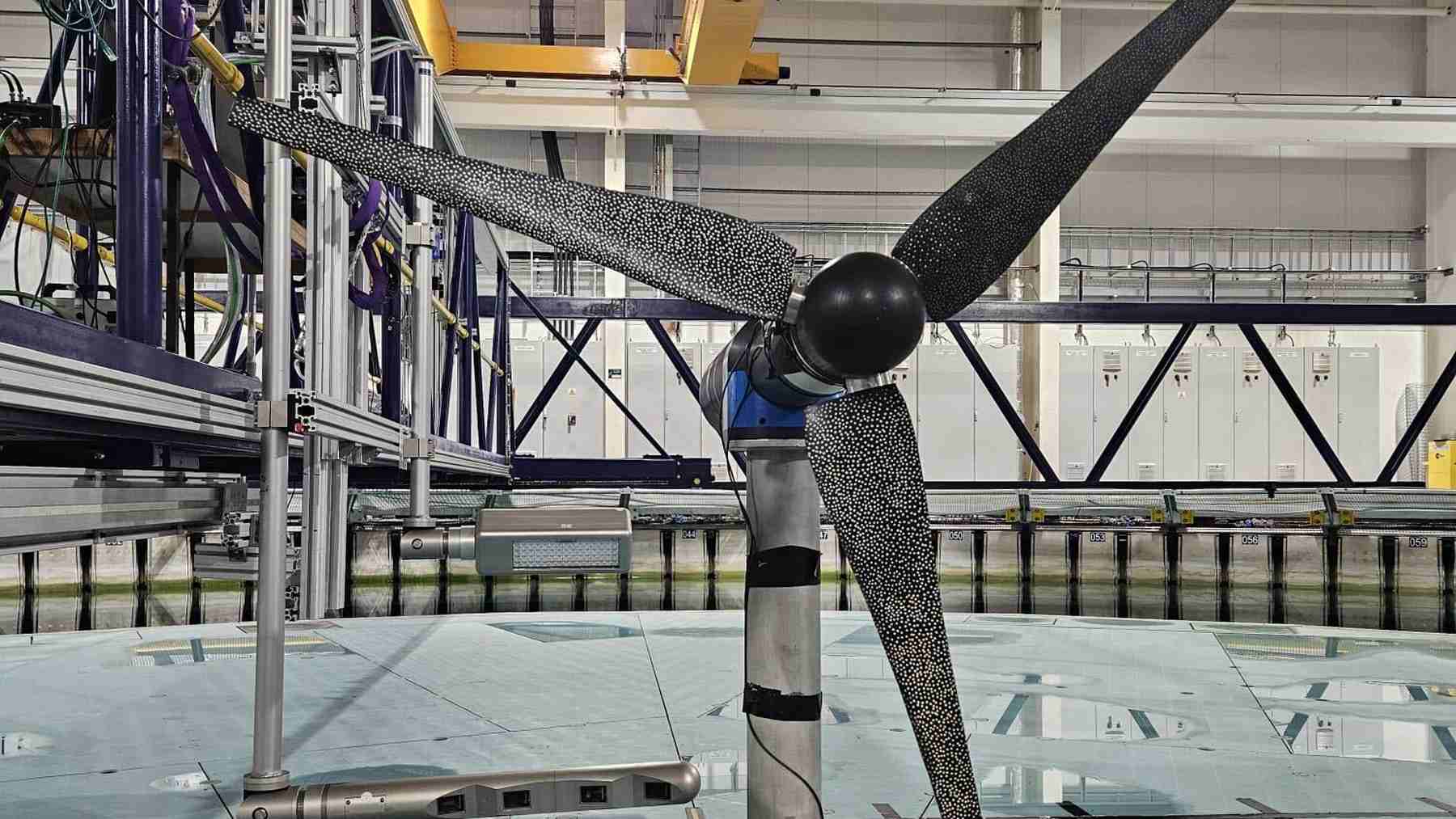
The test turbine is about 4 feet across
The rubber blades went on a three-bladed test turbine with a rotor 4.1 feet across. The team ran it at FloWave, the university’s circular test tank, which is 82 feet across and can recreate the kind of turbulence you’d find at a real tidal site. For these runs it was set to current only, with about 6.3 feet of water in it.
The water moved at roughly 1 to 2 mph, and the turbine ran at tip speed ratios from 3 to 9. Tip speed ratio is just how fast the blade tips move compared with the water, so if you see a ratio of 6, the tips are traveling six times faster than the current.
For a baseline, the team machined rigid blades out of stainless steel.
Did it really match the motorized blades?
Pretty much, with one caveat you should know about. The energy result isn’t a straight tank measurement. The team combined what it measured at FloWave with computer models covering a whole tidal cycle, and over that cycle the rubber-bladed turbine matched the energy output of a rigid, pitch-controlled turbine running in identical conditions. Everything so far has happened in the tank and on a computer, and the university describes the work as still at the research stage.
The load result is the one I find more interesting. The flexible blades cut the rapid, high-frequency load swings by up to 29 percent, according to the university.
That doesn’t mean the total force on the blades dropped by 29 percent. These are the quick jolts, the ones that come and go too fast for a pitch system to react to, and they’re the ones that cause fatigue.
Ever bent a paperclip back and forth until it snapped? That’s fatigue. No single bend breaks it. The repetition does. Turbine blades and the hardware behind them go through the same thing with every gust of turbulence in the water, so taking a chunk out of those jolts should, in theory, mean a machine that lasts longer.
Ignazio Maria Viola, a professor at Edinburgh’s School of Engineering who co-led the study, put it simply when he talked about the machinery tidal turbines carry to survive the sea: “Our blades do that job on their own.”
So what happens at full size?
We don’t know yet, at least not from real hardware. The team ran computer simulations of a turbine about 66 feet across, set up for a rated current of about 6.7 mph, and the university says those results point to similar effectiveness at that size. That 66-foot turbine exists only as a simulation.
Early calculations also hint that full-size rubber blades might outlast the 20-year service life people expect from today’s tidal turbines. I’d treat that as an educated guess at this point. It’s a pretty big claim to hang on a 4-foot rotor in a tank, and the team itself calls them early calculations.
There’s also stuff I can’t tell you. The university’s release doesn’t give a power rating for the test turbine, and nobody has put a dollar figure on what rubber blades would do to the cost of tidal power. The researchers’ argument is that simpler, tougher machines make cheaper electricity, and that seems like a reasonable bet. It’s still a bet.
Tidal power could use the help, though. Even a project like the six-turbine farm planned off Normandy, permits and all, was stuck waiting on a government tariff decree when we covered it.
Michelin has already filed for a patent on the rubber blades, and the University of Edinburgh holds related patents of its own. The paper, with Zhehong Zhang as first author, went up in Nature on November 11.
 A 21-foot-wide shaft has reached 5,203 feet under a Quebec gold mine whose open pit had part of its north wall move this summer, and its 305-foot headframe is now trading the sinking gear for a production hoist sized for about 22,000 tons a day, with shaft hoisting due next springEnergy · 13 hours ago
 A Wisconsin research farm grows hay under 5,424 solar panels on 16 acres, and the first two cuttings in their shade came in at 77 and 82 percent of the open field, but after a drought the third one outweighed the full-sun plot by more than a fifthEnergy · 15 hours ago
 A copper mine with no pit and no shaft is running southeast of Phoenix on about 145 wells that push weak acid through broken rock as deep as 1,200 feet and bring the metal back up dissolved in it, built to turn out 85 million pounds of cathode a year from a deposit sized for 22 yearsEnergy · 18 hours ago