
- 4 MONTHS AGO · INDUSTRYFour boring machines 498 feet long each will dig New York’s new rail tunnel in two pairs with different cutterheads, because a machine built for 35,000-psi volcanic rock is the wrong tool for the saturated mud waiting on the Manhattan side
- 4 MONTHS AGO · INDUSTRYBritain just ordered the largest boring machine ever put underground in Europe, a 5,500-ton German giant with a cutting face wider than a basketball court, built to dig both Thames tunnels alone and turn around at the far end
- 4 MONTHS AGO · INDUSTRYGermany just finished the machine for America’s widest subway tunnel, a 54-foot borer whose motor alone weighs more than 300 tons, and the five-mile San Jose tube it was built to dig is still on the drawing board with no sailing date booked
- 1 MONTH AGO · INDUSTRYA 2,200-ton boring machine named Roberta dug 3.6 miles of subway under Paris as Houda, was taken apart and shipped 1,370 miles to Italy and back for a rebuild, and now starts 4.3 miles of new tunnel with the 187-ton cutting wheel that came home by truck, ship and barge
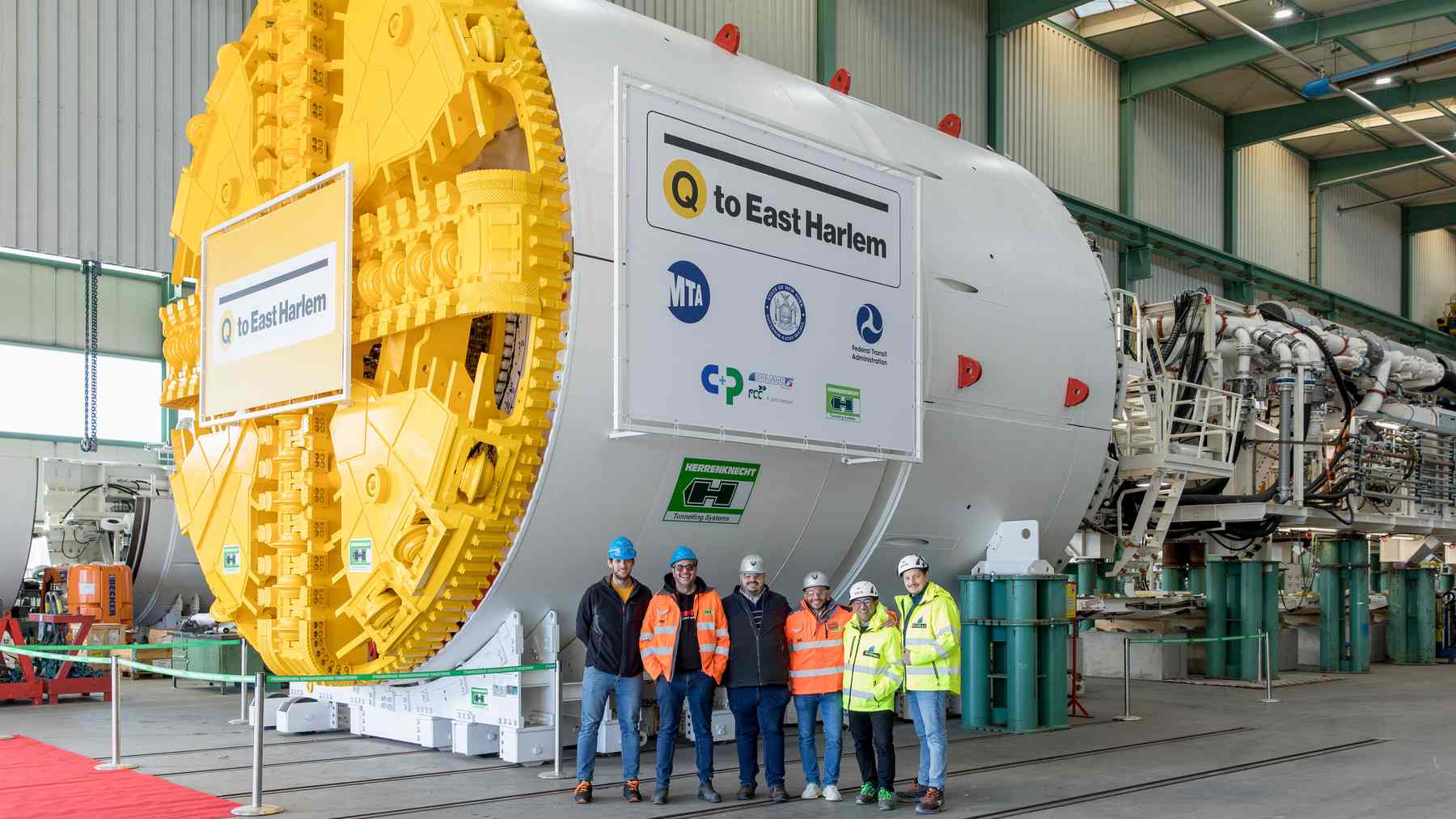
- TODAY · THIS ARTICLEA 700-ton boring machine with a cutting face 23.5 feet across just passed its factory tests in Germany and ships early next year to dig 1.6 miles under Manhattan’s Second Avenue, between 35 and 120 feet down, on a line that will also reuse a stretch of tunnel built about 50 years ago
If you’ve ever bought a bookcase that shows up flat in a box, you know how it works. The store sends you a stack of boards and a bag of screws, and putting it together is your problem.
Big tunnel boring machines do it backwards. The manufacturer builds the whole thing at the factory, switches it on, proves it works, and then takes it apart again so it can travel. That’s where New York’s next subway tunnel machine is right now.
The first of two machines built for Phase 2 of the Second Avenue Subway passed its Factory Acceptance Test at Herrenknecht’s plant in Schwanau, Germany, a few days before contractor Itinera announced it on November 5. Itinera calls the test “a key step ahead of the machine’s shipment to the United States,” and that shipment is due early next year.
We already wrote about this machine in July, when the MTA broke ground at 120th Street, so I’ll skip the century of Second Avenue Subway jokes and stick to what’s new.
So what’s a factory acceptance test?
Basically, it’s the machine’s final exam before it leaves home. The manufacturer bolts everything together on the shop floor and runs its systems, and the buyer gets to watch it work and sign off before anything is packed up.
It’s a lot easier to fix a bad hydraulic line in a German factory than deep under East Harlem. That’s pretty much the logic behind the whole exercise.
The machine that passed is about 404 feet long once it’s fully assembled, according to Itinera, and its cutterhead measures 23.5 feet across. If those two numbers look a little mismatched to you, there’s a good reason for that.
The spinning face at the front is what actually chews through the ground. Everything behind it is basically a rolling factory that hauls out the dirt and, as the MTA told Gothamist last year, puts the tunnel lining in as it goes. That tail is why a machine with a 23.5-foot cutting face ends up longer than a football field.
As for weight, Gothamist reported the machine at roughly 700 tons when the MTA board approved the contract last year. Neither Itinera nor TunnelingWorld gave a weight in their reports on the factory test, and Herrenknecht hasn’t announced one either. So for now, roughly 700 tons is the best public figure available.
Why build it just to take it apart?
So why go to all that trouble?
Because a machine that’s about 404 feet long can’t cross the Atlantic and then roll up Second Avenue in one piece. It comes apart into big sections that can be shipped and hauled, and those sections get lowered down a shaft and bolted back together underground.
In this case the shaft is at 120th Street and Second Avenue. That’s where Governor Kathy Hochul’s office says the machine will launch early next year, and it’s where the MTA’s project page has tunnel boring starting in 2027.
Taking apart a machine that just passed its exam sounds a bit odd, I’ll admit. But you’d much rather find a problem on a factory floor in Germany than after the thing is already in the ground in Manhattan.
It’s headed for 125th Street
Once it’s back together, the machine heads north. The MTA’s schedule has it boring from 120th Street and Second Avenue up to 125th Street and just past Lenox Avenue.
Hochul’s office describes the same finish line as 125th Street and Malcolm X Boulevard. If you don’t live uptown, that might sound like two different places. It isn’t. Lenox Avenue and Malcolm X Boulevard are the same street in Harlem, and it carries both names.
According to TunnelingWorld, the new tunnel runs about 1.6 miles and sits anywhere from 35 to 120 feet below Second Avenue. Hochul’s office rounds the whole extension to about 1.5 miles, so you’ll see both numbers depending on who’s measuring what. Either way, that’s a pretty big swing in depth for a run that short.
Itinera says the machine was designed specifically for Manhattan’s geology, and the MTA told Gothamist last year that the new machine handles softer soils better than the one used on the line’s first phase.
This is the first of two machines, and TunnelingWorld and Itinera both say so. Neither one spells out how the digging gets split between them, though, and I’m not going to guess.
Some of the tunnel is already down there
My favorite bit of this whole project is the old tunnel. Between 110th and 120th Streets, Hochul’s office says Phase 2 reuses a stretch of tunnel dug under Second Avenue in the 1970s. The city started building this line about 50 years ago, and then, as Gothamist tells it, the financial crisis hit and the work was suspended. The tunnel just sat there. Now it’s getting a second life.
TunnelingWorld reports that the contractor will outfit that 1970s stretch so it can hold the new 116th Street station, and the MTA expects that to save about $500 million. That’s arguably the best return anyone’s gotten on a hole in the ground in this city.
The contractor is Connect Plus Partners, which pairs Halmar International (Itinera’s US subsidiary) with FCC Construction. The governor’s office puts its tunnel contract, known as Contract 2, at $1.97 billion, inside a Phase 2 budget of $6.968 billion.
And the machines might not be finished once they reach Lenox Avenue. TunnelingWorld notes the MTA has put out a draft scoping document on a possible 125th Street extension, and says both machines could be moved over to dig it. That’s a “could,” not a plan. Still, it’d be a pretty sensible move, considering they’ll already be sitting under 125th Street by then.
One thing this machine doesn’t seem to have yet is a name. Tunnel boring machines tend to get one (Nora, the one that went under the Hudson, is a good example), but I couldn’t find one for this machine in anything published so far.
So the next time this machine makes news, it’ll probably be in pieces on its way across the Atlantic. Itinera says it ships to the United States early next year, the MTA has it boring north from 120th Street in 2027, and Governor Hochul’s office has Q trains running into East Harlem in 2032.
 A network of 1980s copper lines just got overloaded with data on Friday and produced the longest nationwide ground stop in 25 years, holding departing flights for more than four hours until it was lifted at 8:15 p.m. Eastern as old switches and routers fed inconsistent radar and radioIndustry · 5 hours ago
 A nationwide ground stop that held departing flights at U.S. airports for more than four hours has just been lifted after old switches and routers on the FAA’s copper-line telecom network got overloaded with data, federal officials say, and thousands of flights were canceledIndustry · 17 hours ago
 A 91-ton steel shield was moved overnight into an Italian highway tunnel damaged by fire, the old concrete roof is being torn out and poured again right above it, and the cars and trucks keep driving through the middle the whole time, as long as they stand under 14 feet tallIndustry · 17 hours ago