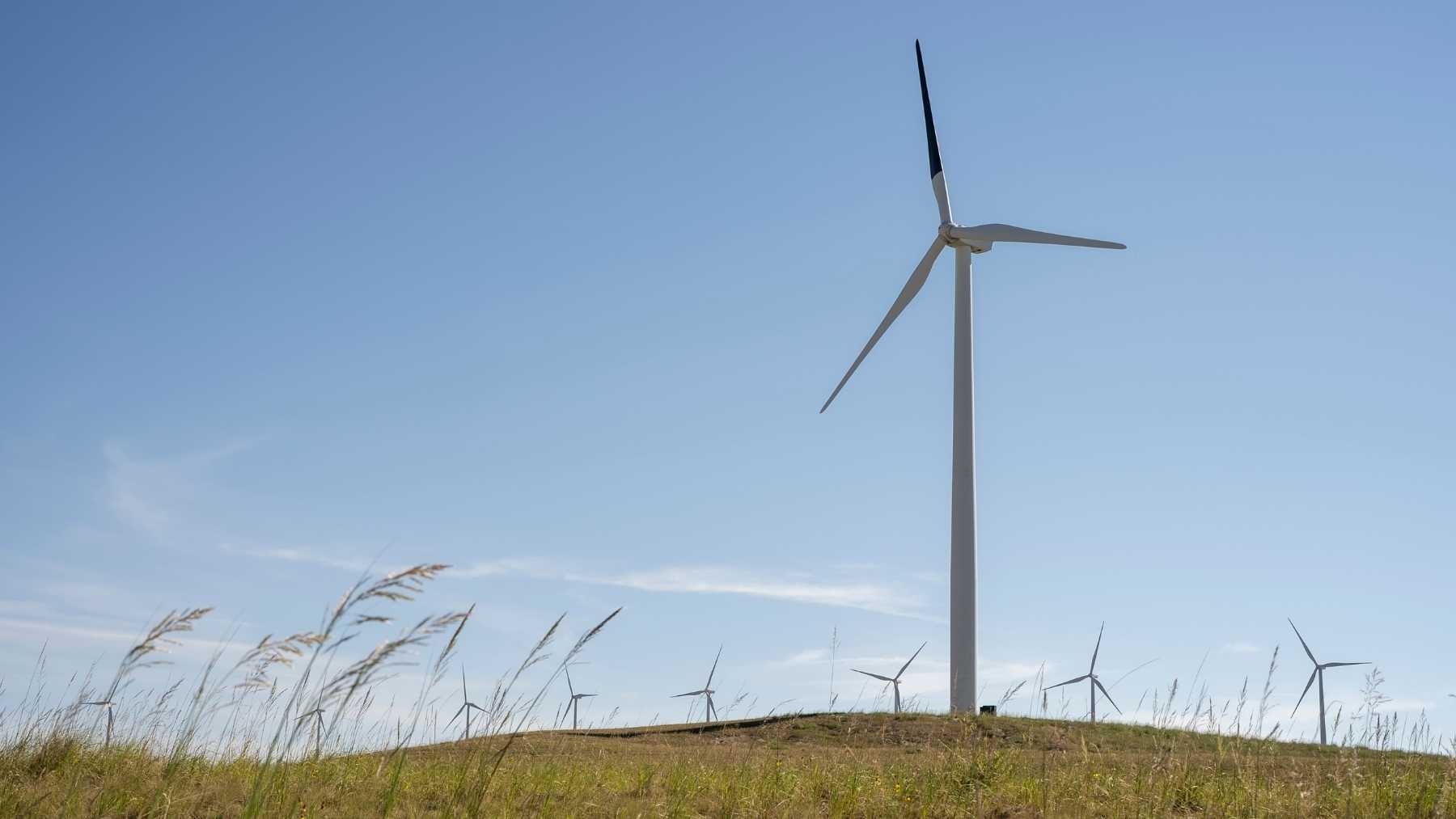

You have probably seen this one go around. A wind farm in Norway painted one of the three blades on a turbine black, bird deaths dropped by more than 70 percent, and the cheapest fix in the history of wind power turned out to be a bucket of paint.
The number is real. It is 71.9 percent, it is peer reviewed, and it has been sitting in the literature since 2020.
What gets left off the end of that fact is everything that happened next. Six years on, a commercial operator has finally committed to hanging a differently colored blade on a working offshore wind farm. The blade is not black. It is red, it is 379 feet long, and the company building it looked hard at black before deciding the thing would cook itself.
That is happening right now about 33 miles off the Dutch coast. Meanwhile the biggest attempt to repeat the Norwegian result sits in Wyoming, 36 turbines deep, running since 2023, and it still has not told anybody what it found.
The Norwegian number came from four turbines
Smøla is an archipelago off central Norway, and it is about as flat as a wind site gets. The highest point on the main island is 226 feet. Statkraft planted 68 turbines on it between 2002 and 2005, on ground BirdLife International has tagged as an Important Bird Area.
It is also thick with white-tailed eagles, which is how this whole thing started.
Between August 1 and August 8, 2013, crews painted one of the three rotor blades black on four of the 2.1-megawatt machines. Four neighboring turbines were left alone as controls. Researchers from the Norwegian Institute for Nature Research already had fatality data going back to the start of 2006, and they kept walking the site until the end of 2016. Seven and a half years of before, three and a half years of after.
The searching was done by dogs trained to drop flat next to a dead bird. Across the whole plant, 9,557 turbine searches turned up 464 carcasses over those eleven years. Smøla has no mammalian scavengers, so almost nothing was stealing the evidence overnight, which is a large part of why the data is usable at all.
The result, published in Ecology and Evolution as Paint it black, was a 71.9 percent cut in the annual fatality rate at the painted turbines relative to the controls, with a confidence interval running from 61.8 to 79.1 percent. Willow ptarmigan were pulled out of the analysis, because ptarmigan hit the tower rather than the blades.
The eagle line is the one everybody repeats. Six white-tailed eagles were found dead at those four turbines before the paint. None after. The odds of that happening by chance came out at 0.009.
Then there are the parts that never fit on a graphic. It was four turbines against four. The control turbines were barely killing eagles to begin with, so the eagle finding really rests on a before-and-after at the painted machines rather than a clean head-to-head.
Fatalities also fell hard in spring and autumn and went up in summer. The authors closed the paper by asking somebody, anybody, to run it again with more turbines.
The blade is not invisible because it is white. It is invisible because it is fast
The idea did not come from Norway. It came out of a University of Maryland lab run by W. Hodos, under subcontract to the National Renewable Energy Laboratory between July 1999 and August 2002. Hodos borrowed 15 American kestrels, put electrodes in their eyelids, and measured what their retinas actually did while a scale model rotor spun in front of them.
The mechanism is genuinely strange, because a raptor’s eye is superb. As the bird closes on the rotor, the image of the blade tip has to sweep farther across the retina in the same slice of time, so its speed on the retina keeps climbing.
Past a certain point the retina cannot keep up. The blade smears into what his report for NREL called “a transparent blur that the bird probably interprets as a safe area” to fly through.
It is not that the eagle fails to see the turbine. It is that the eagle sees a hole where the blade is.
Hodos tested eight patterns. One solid black blade paired with two blank ones came out roughly twice as visible as three plain blades, and it was the only one to beat them by a margin the statistics would stand behind. Yellow and green edged ahead in places, but inside the noise.
Then he wrote down the part nobody quotes. His experiments measured what the eye can see, not what the animal decides to do about it. Without a field test, he warned, there was no way to know whether some species might find the pattern attractive rather than a deterrent. Which would be a very bad outcome for the bird.
There is also a wrinkle that gets worse every year. Hodos found the blur starts farther out on bigger, slower rotors: a 65-foot rotor at 45 rpm washes out inside about 75 feet, a 200-foot rotor at 35 rpm inside roughly 175 feet.
Smøla’s blades are 131 feet long. The machines going up in the North Sea have a rotor 774 feet across. Nobody has modeled anything close to that.
Vestas looked at black and picked red
Hollandse Kust West VI is a 760-megawatt Dutch project 33 miles off IJmuiden, built by the joint venture Ecowende with 52 Vestas V236-15.0 MW turbines. Seven of them are getting one red-coated blade each, with the other two on each machine left standard light gray. The goal is identical to Smøla: break up the uniform blur so a bird registers that something is there.
The color is not identical, and the reason is not ornithology. Line Kyndi Behrens, Vestas’ technical project manager on the site, said black and fluorescent were both considered, and red won on performance criteria, specifically “its ability to avoid overheating and ensure blade durability”.
A dark blade absorbs more heat than a pale one, and heat is not something you want moving around inside 379 feet of composite that has to survive salt air for 25 years.
None of this caught the scientists off guard. Roel May, the NINA researcher who led the Smøla work, told IEEE Spectrum last year that turbine manufacturers came to him asking whether he had thought through the technical implications. He had not, because he is an ecologist rather than an engineer.
Black blades run hotter, which can cause structural effects. Black paint is carbon based, which engineers dislike on a machine whose day job is being the tallest thing for miles in a thunderstorm.
May mentioned something else that rarely survives the trip to social media: a group in the Netherlands painted blades and has not seen a clear effect.
The red blade is one item in a larger package, alongside adaptive curtailment and a deliberate gap in the layout to leave migrating birds a corridor. Ecowende is running the field research with Waardenburg Ecology, DHI and Robin Radar. It is the same water where GPS-tagged seals turned out to be hunting along the turbine rows rather than avoiding them.
Wyoming has 36 black blades and no answer yet
The replication the Norwegians asked for does exist. It is in Wyoming, and it is nine times the size of the original.
PacifiCorp started painting blades at its Glenrock wind farm in April 2023. Twenty-eight were done by the end of that year and the last eight followed in 2024, giving 36 painted turbines against a larger pool of controls.
The U.S. Geological Survey leads the research team, and the partner list is long: Fish and Wildlife, the Department of Energy, Oregon State University, the Renewable Energy Wildlife Institute, Invenergy and NextEra Energy Resources. The utility’s own announcement is fairly blunt about the logic. The Norway result was too good to act on and too good to ignore.
Christian Hagen of Oregon State’s Department of Fisheries, Wildlife, and Conservation Sciences said it plainly to his own university’s newsroom. “This was a dramatic effect, but it was a relatively small sample size,” he said. Oregon’s legislature had put $400,000 into the university in 2021 to chase exactly this question, and PacifiCorp happened to own the right site.
The study tracks three groups: eagles, daytime non-eagle birds, and bats. That third one is the tell. The team’s stated expectation is that bats show no change at all, because a bat is not solving this problem with its eyes. Bats have their own awkward relationship with renewables, and the ones that walked away from English solar farms did it for reasons paint cannot touch.
On the ground it is people and detection dogs working transects, looking for bodies. In the office, doctoral student Natia Javakhishvili is building an avoidance model for golden eagles off a dataset of eight million recorded eagle movements, with altitude treated as a real third dimension instead of being flattened out.
Oregon State said in August 2024 that findings would arrive in the coming years. Almost two years later, nothing has been published.
In America, the paint is the easy part
Start with the boring obstacle. A US turbine is a marked aviation obstruction, and changing its color is a deviation from FAA guidance: a request to the agency’s Obstruction Evaluation Group and an aeronautical study, with “colors of objects” sitting as item (a) on the FAA’s own list of deviations it will consider. A black blade here is a federal file, not a decision about paint.
Norway was no lighter. Smøla needed sign-off from the operator, the municipality, the energy directorate and the Civil Aviation Authority, then a crew with rope access certification hanging off the hub in calm weather. The innermost 40 feet of each blade could not be reached at all.
Now the part that moves budgets. Eagles are covered by the Migratory Bird Treaty Act and the Bald and Golden Eagle Protection Act. In 2022, ESI Energy, a NextEra Energy subsidiary, pleaded guilty to three counts under the Migratory Bird Treaty Act, paid more than $8 million in fines and restitution, and acknowledged that at least 150 bald and golden eagles had died at 50 of its 154 US wind facilities since 2012. NextEra Energy Resources is a partner on the Glenrock study.
The pressure has climbed since. On August 4, 2025, the Interior Department directed Fish and Wildlife to route Eagle Act violations to its Solicitor’s Office and, where warranted, on to the Justice Department.
Then the permits went quiet. Environmental lawyers at Hunton Andrews Kurth, reading the Service’s published list in February, counted zero eagle take general permits issued to wind facilities between early January 2025 and mid-January 2026, and then 34 of them inside the two weeks ending January 30, 2026.
In a January court filing catalogued by the same firm, developers suing Interior said the Service had begun bringing enforcement actions against operating projects that lack those permits.
And in December, according to Heatmap News, a Wyoming bird group called the Albany County Conservancy sued the federal government under the Freedom of Information Act for records on how eagle deaths get logged at three PacifiCorp wind farms: Dunlap Wind, Ekola Flats and Seven Mile Hill.
That suit names the government, not the utility, and nobody in it has accused PacifiCorp of breaking any law. It does help explain why a utility would find the money to hang painters off 36 turbines.
The newest research does not say black either
Two papers landed this year, and neither hands the viral version a clean win.
In May, a team in the Journal of the Royal Society Interface argued that visibility on its own is not the whole problem, and that designers need to think about motion perception too, manipulating the optic flow a bird experiences as it moves. Their sketches are oblique stripes, a stripe down the trailing edge, and markers spaced along the blade. All proposals, no field data.
Then in the Journal of Applied Ecology, a group modeling how different species detect black-and-white blade designs found the effects varied by species with no clear consensus, and that striped patterns, not a single black blade, looked like the most promising route. Field experiments are now required, they concluded, which is roughly what Hodos wrote in 2002 and the Norwegians wrote in 2020.
So the honest version of the fact reads like this. One black blade cut fatalities by 72 percent at four turbines on a Norwegian island 13 years ago, and the biologists who did it said out loud that somebody needed to repeat it.
The repeat has been grinding away in Wyoming since 2023 without publishing a number. And the one place a commercial operator has actually committed to a colored blade on a working wind farm, it chose a different color, for reasons that have nothing to do with birds and everything to do with heat.
A can of paint is still probably the cheapest idea anyone has had about this problem. It just turns out the paint was never the hard part.
 @michaelabraham ROOKIE3 months ago