
Almost every wind turbine you have driven past sits on a steel tube. It is the part nobody photographs and the part nobody thinks about, which is a shame, because the tower is where a lot of the machine’s carbon footprint and most of its shipping problems actually live.
A Swedish company called Modvion has spent close to a decade arguing that the tube should be built from wood instead. Not the blades, not the generator, just the tower.
This year that argument stopped being a science project. In late April, Modvion signed a €39.1 million grant with the European Union’s Innovation Fund to build what would be the first factory anywhere dedicated to mass-producing wooden wind turbine towers.
Steel towers hit a wall around 100 meters
The reason turbines keep getting taller is simple physics. Wind is stronger and steadier the higher you go, and the energy you can pull out of it climbs fast with height, so every extra meter of tower is worth chasing.
Steel has trouble keeping up. A taller steel tower needs a wider base and a lot more metal to hold up its own weight, and once the base diameter passes a certain point, it is simply too wide for the roads it has to travel on across much of the United States and Europe.
At that point you either weld the tower together on site, which is slow and expensive, or you cap how tall you build. That transport ceiling is the specific gap Modvion is aiming at. Other companies are attacking the same problem from stranger angles, including a Chinese outfit that decided the tower was the part worth deleting entirely and hanging turbines from an airship.
Laminated spruce, stronger by the pound than steel
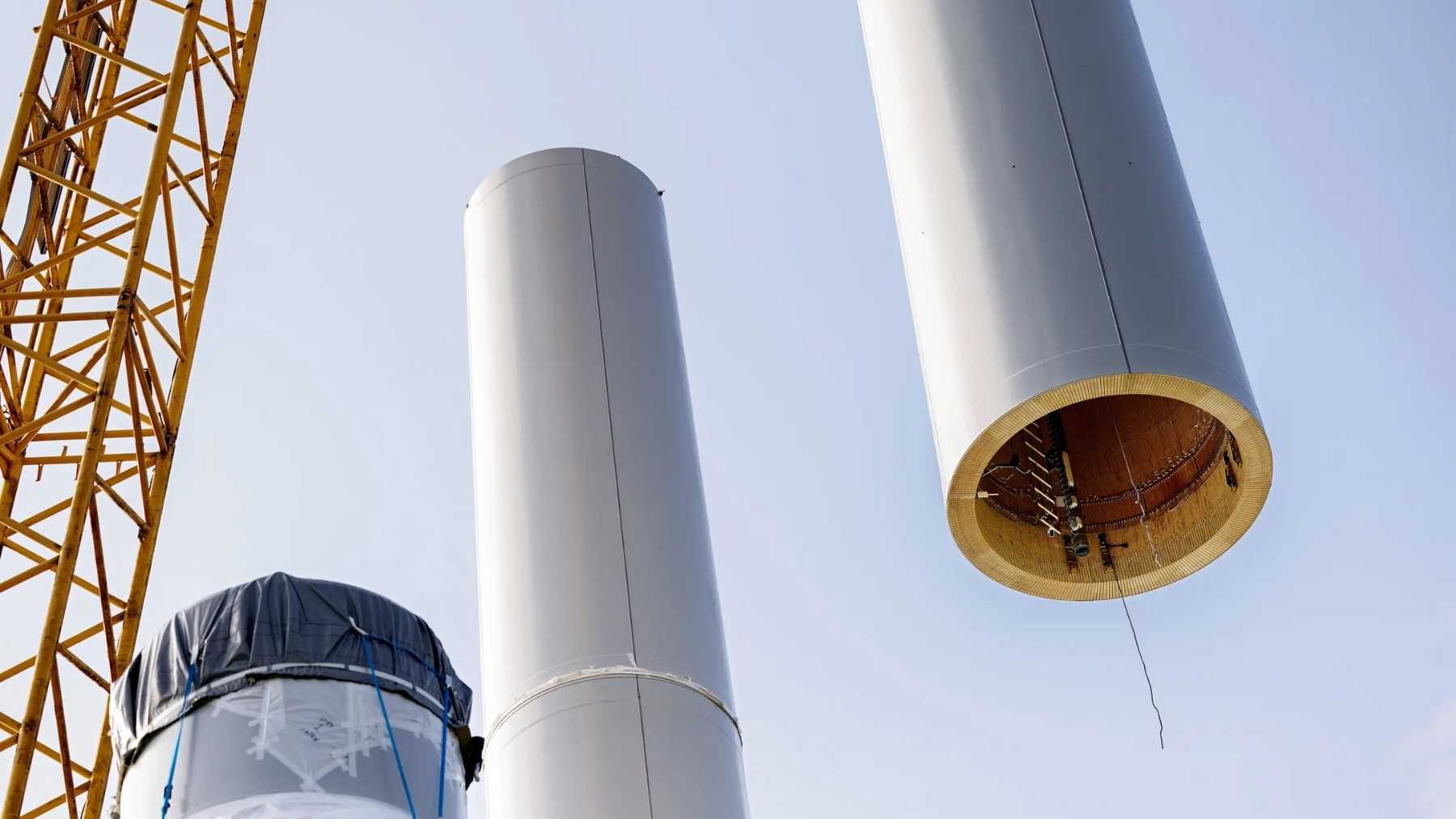
Modvion’s tower is made from laminated veneer lumber, or LVL, the same engineered wood used for beams and load-bearing structures in tall timber buildings. It is thin spruce veneers glued into dense sheets, then shaped into curved modules.
Steel is stronger in absolute terms, but wood wins on strength per unit of weight, which is the number that matters here. That lets a wooden tower come in lighter and skip a lot of the reinforcement a tall steel tower needs just to carry itself.
The modules ship on standard trucks and get assembled and glued into cylinders at the site, which sidesteps the whole road-width problem. Erik Dölerud, a senior development engineer at Modvion, calls wood “the original high-performance construction material”, and points out that a tree spent millions of years evolving to carry load and stay upright in wind.
Then there is the carbon. Making steel is emissions-heavy, while wood stores the carbon it pulled out of the air as it grew, so a finished tower holds more CO2 than its production releases. According to a lifecycle analysis by the Swedish research institute RISE, the tower alone emits roughly 90 percent less than a steel tower of the same height and load.
Across the whole turbine the drop is smaller, more than 25 percent, because the blades, hub and foundation are still conventional. In hard numbers, Modvion puts the lifecycle emissions of a steel tower around that size near 1,250 metric tons of CO2, against roughly 125 tons for the wooden version.
The tallest wooden tower is already turning outside Skara
This is not a rendering. Modvion has a commercial tower spinning outside the Swedish town of Skara, about 105 meters (345 feet) tall, built for the local utility Varberg Energi and carrying a 2-megawatt Vestas turbine.
With the blades on top, the full machine reaches about 150 meters, which is where plenty of headlines get the number wrong. The wooden part is the 105-meter tower, not the whole turbine.
It followed a 30-meter proof-of-concept from 2020, and by the company’s count it has now run for more than 15,000 hours. Modvion has also cleared a bigger hurdle on paper, with a taller 119-meter tower design, sized for a 6.4-megawatt turbine, that received a design sign-off from the certification body TÜV SÜD.
None of this is happening in a vacuum. Vestas, the world’s largest turbine maker, invested in Modvion back in 2021, and utilities including RWE and Vattenfall have signed on to evaluate the wooden towers for future wind farms.
€39 million to build the world’s first factory
The grant is what turns a working prototype into a business. Modvion was one of 61 projects picked from 359 applicants for the EU Innovation Fund, and the €39.1 million is earmarked for a volume plant in Trollhättan, Sweden, that the company says would be the first serial production facility for wooden wind towers on the planet.
Full capacity is not expected until 2031. Over ten years, Modvion estimates the plant could build roughly 1,500 towers, and that the turbines mounted on them would generate around 29,000 gigawatt-hours a year, enough to power about 7.3 million average EU households while avoiding some 18 million metric tons of CO2.
CEO Maria-Lina Hedlund, who moved up from CFO last year, called the funding key to “move from demonstration to scale”. The factory is designed for towers with hub heights up to 200 meters, aimed at turbines of 6 megawatts and above.
Wood is not about to out-tall steel
A wooden tower does not set outright height records, and it does not decarbonize the whole turbine. Steel and hybrid towers have carried enormous machines well past 250 meters, so Modvion’s 105-meter tower is modest next to the tallest turbines out there.
The blades and the nacelle are still made of the usual materials, so the wooden tower cleans up one big piece of the turbine, not all of it. And the carbon-negative claim leans on counting the CO2 locked in the wood, which some researchers argue is not the same thing as a wind turbine being carbon neutral once you factor in forestry, adhesives and what happens at the end.
Modvion’s answer is to cut up and reuse the wood as construction beams when a tower is retired, keeping the carbon put away for longer. Whether that holds depends on execution the company has not had to prove at industrial scale yet.
It is a reminder that the turbine is being rethought from several directions at once, from wooden towers to a Spanish startup betting on a bladeless pole that shakes instead of spins.
The bet is narrow on purpose
Modvion is not trying to reinvent the turbine. It is going after the boring steel tube underneath it, which happens to be the heaviest, most carbon-intensive and hardest-to-ship part of the whole machine.
If the Trollhättan plant hits its numbers, the real question is not whether a wooden tower can stand up. The one outside Skara has done that for more than 15,000 hours. It is whether utilities start ordering them by the hundred once steel stops being the only option on the table.
 @charlespate ROOKIE2 months ago