
- 4 MONTHS AGO · INDUSTRYA 4,400-ton boring machine just began crawling out of Melbourne by night, broken into loads so big that traffic lights come down ahead of her, leaving her twin alone 148 feet under the river, chewing 33 feet a day until later this year
- 1 MONTH AGO · INDUSTRYTwo 160,000-pound valves rode a barge through a 35-foot tunnel into the base of the tallest dam in the country, behind a pair that has been there since the dam was built, because when the lake drops below the powerhouse intakes, they’re the last way to let water out
- 2 WEEKS AGO · INDUSTRYA 111-year-old lock and dam that holds back a North Carolina river for the intakes feeding Wilmington’s drinking water has a channel carved under it by the current, and the Army Corps of Engineers says more erosion could undermine the riverbed holding it up
- 2 DAYS AGO · INDUSTRYA 55-foot-deep boat lock in Seattle has been pumped dry so its 800-foot filling tunnels can be scraped clean of barnacles, a job federal law requires once a year because young salmon pulled through with the water get dragged along the walls and cut open
- TODAY · THIS ARTICLEA 99-year-old lock chamber on the Allegheny River, 360 feet long, was pumped dry behind 16 bulkheads and 13 structural struts because winter ice tore gaps in the oak sill its gates seal against, and with barge traffic stopped until December all eight emptying valves are being replaced
If you’ve ever ridden a boat through a lock, you probably remember the gates, the noise and the slightly odd feeling of a whole river rising or falling around you. You probably don’t remember the floor. That’s because you can’t see it, and on most days no one can.
But for the last few weeks, the Army Corps of Engineers has been staring at a lot of floor in Natrona, Pennsylvania. Its Pittsburgh District drained Allegheny River Lock and Dam 4’s chamber and shut the river to traffic there for months, and the whole thing comes down to one piece of oak.
In the release it posted on Nov. 6, the Corps describes the chamber walls as 99 years old and says it’s the first time in three decades the chamber has been completely drained. The Pittsburgh Post-Gazette puts the last time it was emptied at 1996.
You don’t get a look like this very often. We got one when a South Dakota dam’s generator was taken apart for the first time in 70 years, and another this week when a Seattle lock was pumped dry.
So what’s a miter sill, and why does it matter?
If you’ve seen a river lock, you’ve probably seen miter gates. Basically, they’re two big steel doors that swing out from the chamber walls and meet in the middle at an angle, so the weight of the water pushes them shut even harder. The miter sill is the ledge on the chamber floor that the bottom of those doors presses against to make the seal.
On Lock 4, that ledge is oak. Timber sills go back to the 1800s on American locks, since oak is tough and makes a tight seal, and the Corps says this one follows a design picked back in Warren G. Harding’s presidency. It sits under the downstream gates, which hold the water in when the chamber’s full.
Then winter happened. The Corps says ice coming down the Allegheny during last winter’s severe freeze damaged the sill and opened gaps that let water leak past the gates. According to the Post-Gazette, the culprit was a late-January storm that sent sheets of ice more than 10 feet wide and 8 inches thick down the river, and the leaks showed up in early spring. The lock kept working, sort of. The Corps says its aging filling valves were working overtime to replace the water leaking out through the bad seal, and a few more equipment failures could have left the chamber unable to fill to the upstream level. And a lock that can’t fill doesn’t let anything through.
That’s where Lock 4’s design hurts. Plenty of bigger river locks have two chambers side by side, so one can close for repairs while traffic squeezes through the other. Lock 4 has exactly one, 56 feet wide and 360 feet long, next to a fixed-crest dam (a concrete wall the river simply pours over). So when that chamber is out of action, the Allegheny is closed at Natrona, and there’s no detour for a barge.
Draining a lock takes a lot more than a big pump
You can’t just pull a plug. The chamber’s got river on both ends, and the moment you start pumping, the Allegheny wants to pour right back in. The Medium Capacity Fleet, a Corps maintenance team run out of its Huntington District, took the job, and it had to wall the chamber off first.
Crews set 16 bulkheads, which are basically heavy panels dropped in to block the water, plus two needle-dam systems to seal off the chamber. Then they braced it with 13 structural struts. An empty chamber has the river and the ground around it pretty much leaning on its walls, and the Corps says the struts are there to support them while the water’s gone. After that, the pumps went to work on millions of gallons.
Getting those bulkheads in took divers, and not in a nice spot. Some of the work happened near the crest of the dam, where the Corps says the water’s rough enough to be a real safety concern. Chris Smidl, a Pittsburgh District project engineer, described the bulkheads for the valves as high-risk work. To make conditions a little friendlier, the Corps’ water managers juggled releases at eight flood-control reservoirs upstream to dial the river down for a while.
The oak is on its way out
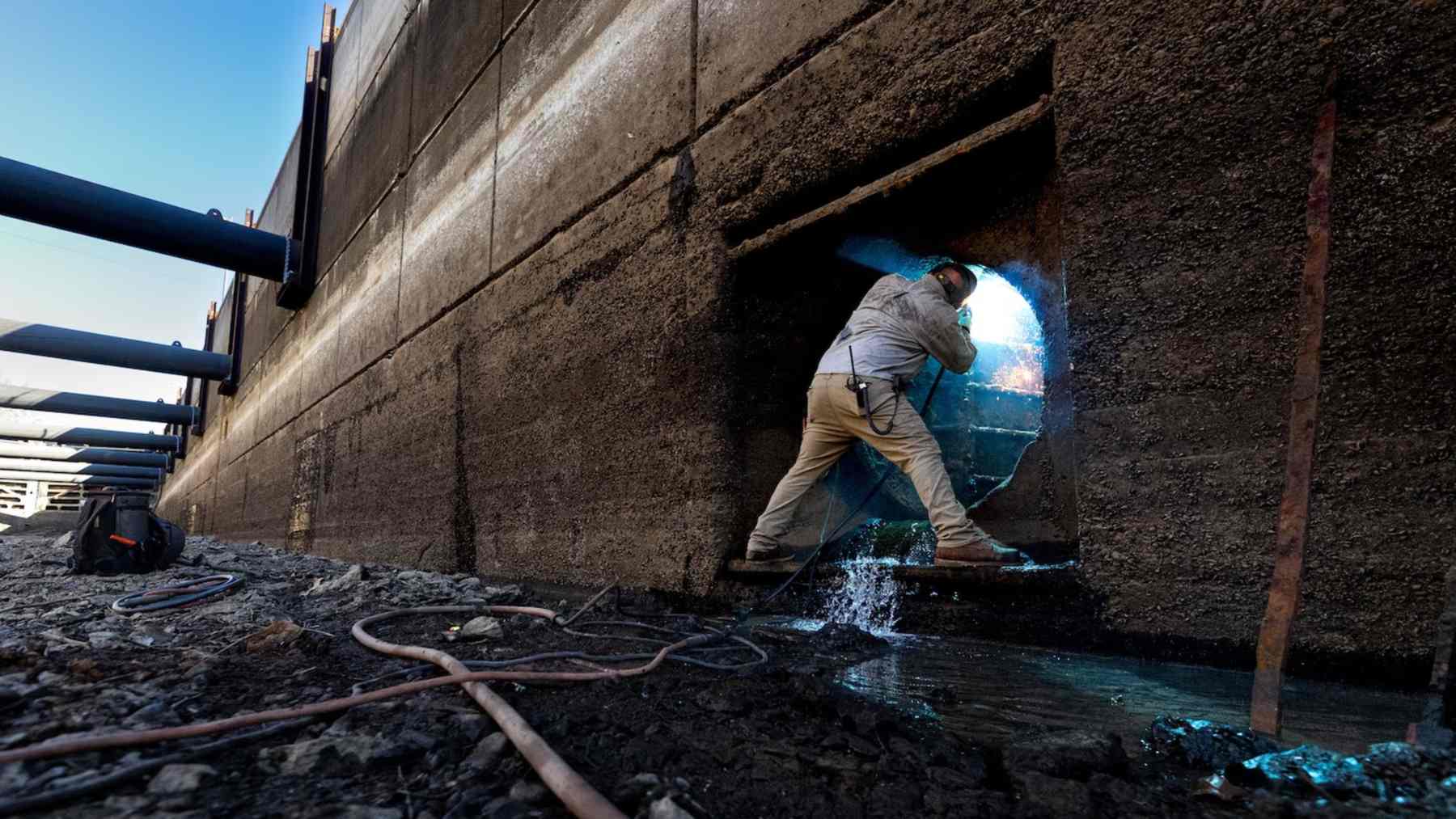
To get at the sill, crews had to take the downstream gates out entirely. The Corps lists those steel miter gates at 86,000 pounds, and photos from Nov. 3 show them resting on barges while a crew member goes after what’s left of the old-growth oak with an air chipper.
The replacement isn’t wood. The Corps says the new sill is a steel-and-concrete assembly with a bolted rubber seal, built to handle future impacts better than the oak did. That’s a pretty sensible trade on a river that just proved it can send 8-inch-thick ice at the gates, even if it’s a bit of a shame to see a Harding-era design go.
So why not swap the wood and refill the thing?
Because once a chamber like this is dry, the Corps isn’t going to waste it. The Corps says the fleet is also replacing all eight of the lock’s emptying valves, plus the shafts and bushings that go with them, which is the kind of job you basically can’t do with a river sitting on top of it. Smidl said the team is doing “additional maintenance work that otherwise would not be possible.” That’s arguably the smartest part of the whole job.
Draining it has turned up at least one more problem, too. The Post-Gazette reports that crews found erosion at the base of the upstream gate, and that one’s slated for a later repair.
So when can barges get through again?
The Corps says it took the district about three months to get from first idea to ready-to-build, helped by a stock of replacement parts it already had. That’s frankly pretty quick for a job involving divers, cranes and an empty river lock. Smidl also said the district pushed the closure back so some critical equipment shipments could get through first.
The Corps calls the river here an important route for heavy industrial gear, building materials and oversized loads headed to companies on both sides of the lock. I couldn’t find a published count of how many tows are waiting on either side, though, so I can’t tell you how backed up things are.
The Post-Gazette reported on Nov. 13 that the job was about halfway done. The lock lifts and lowers boats nearly 11 feet between pools, according to the paper, and Smidl hopes this round of work keeps Lock 4 going an extra 20 to 30 years until it needs surgery this big again.
The Corps expects the Medium Capacity Fleet to wrap up in December, and the river closure at Lock 4 is scheduled to end on Dec. 18.
 A 700-ton boring machine with a cutting face 23.5 feet across just passed its factory tests in Germany and ships early next year to dig 1.6 miles under Manhattan’s Second Avenue, between 35 and 120 feet down, on a line that will also reuse a stretch of tunnel built about 50 years agoIndustry · 2 hours ago
 A network of 1980s copper lines just got overloaded with data on Friday and produced the longest nationwide ground stop in 25 years, holding departing flights for more than four hours until it was lifted at 8:15 p.m. Eastern as old switches and routers fed inconsistent radar and radioIndustry · 7 hours ago
 A nationwide ground stop that held departing flights at U.S. airports for more than four hours has just been lifted after old switches and routers on the FAA’s copper-line telecom network got overloaded with data, federal officials say, and thousands of flights were canceledIndustry · 18 hours ago