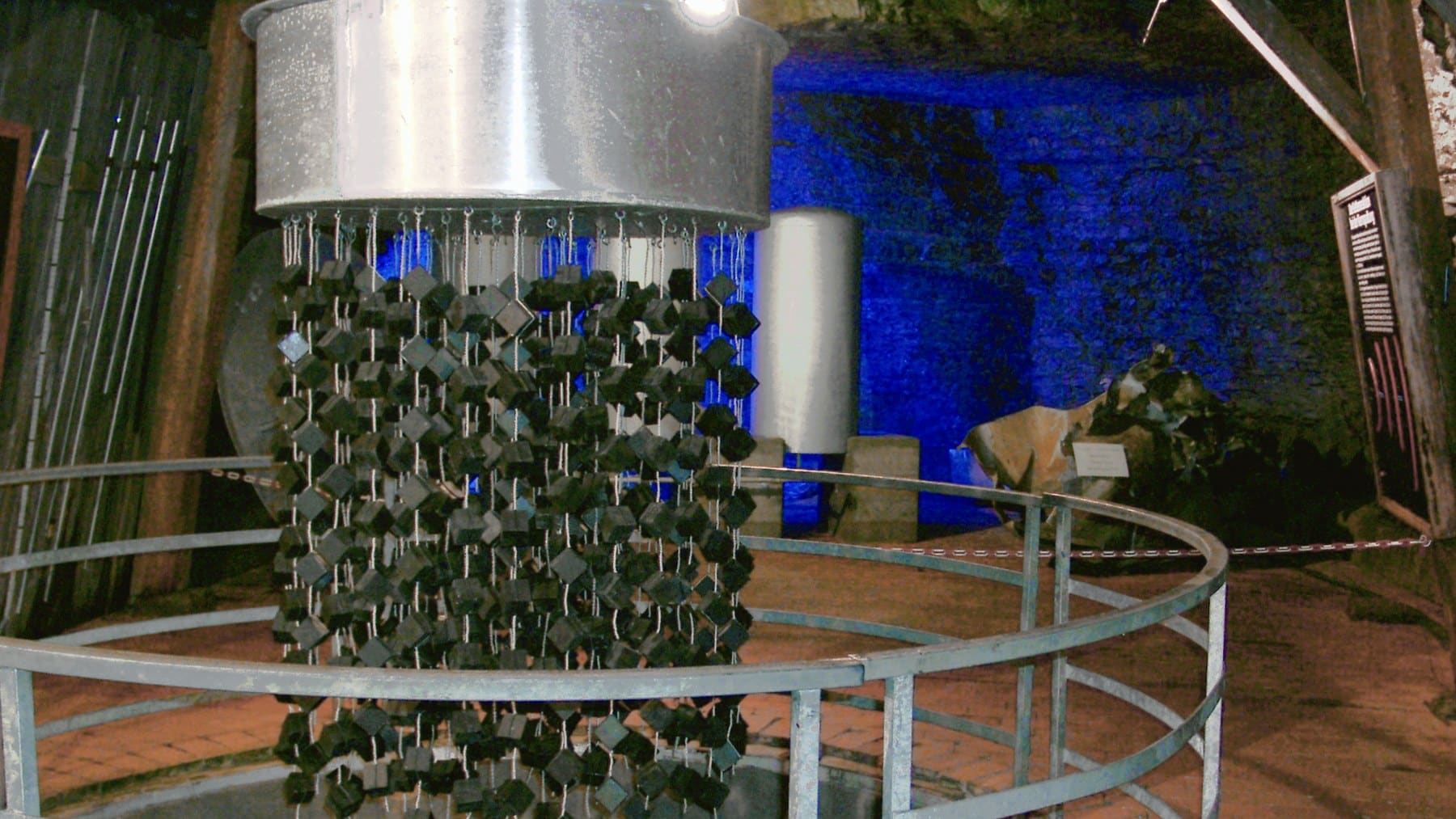

Heisenberg's team hung 664 natural uranium cubes, each about 5 pounds, in chains of eight and nine dropped into roughly 370 gallons of heavy water.
The computer model puts the B8's multiplication factor at 0.94, so every 100 neutrons produced only about 94 in the next round of fission.
Norsk Hydro's Vemork plant turned out about 6,260 pounds of heavy water in the entire war, according to its engineering chief Alf Larsen.
The Siemens-Plania graphite wrapped around the B8 carried about 3.4 parts per million of boron or its equivalent.
Ask The Box:
You’ve probably heard some version of the story that Nazi Germany was racing America to the atomic bomb, and that it got uncomfortably close. It’s a big part of why the Manhattan Project happened at all. Washington was scared the Germans had a head start, and that fear wasn’t crazy, since Germany’s uranium program got going in April 1939, before the US effort did.
Werner Heisenberg, the physicist behind Germany’s last reactor experiment, kept a milder version of that story alive after the war. He said his machine had fallen only slightly short of working. But a team of physicists has now gone back with two of the surviving uranium cubes, a stack of wartime documents and a lot of computer time, and it turns out Heisenberg’s idea of close was pretty optimistic.
The study, published in PNAS Nexus this fall, was led by Patrick Park of Columbia University, with Timothy Koeth and Miriam Hiebert of the University of Maryland among the co-authors. Their answer is that the reactor would’ve needed about twice the uranium and more than twice the heavy water it actually had. Germany didn’t have that much of either.
Germany never ran one big program the way the US eventually did. It split its reactor work between rival groups in Berlin, Leipzig and at an Army proving ground in Gottow, and labeled each group’s piles with a letter. B8 was the eighth pile built by the Berlin group, which Heisenberg led.
After Allied bombing wrecked Berlin in 1944, that group moved to Haigerloch, a small town in southwestern Germany. In April 1945, it assembled the B8 in a rock cellar under the town’s castle. The site’s now the Atomkeller Museum, and there’s a replica of the reactor inside.
The design was a bit odd to look at. Heisenberg’s team hung 664 cubes of natural uranium, each about 2 inches on a side and about 5 pounds, in chains of eight and nine cubes arranged in five rings. That’s roughly 3,390 pounds of uranium. The chains went down into a cylinder of heavy water about 4 feet across and 4 feet tall, which held about 370 gallons, more or less a big hot tub. Around that sat about 16 inches of graphite, then roughly 2 feet of ordinary water.
Koeth and Hiebert called it an “ominous uranium chandelier” in a 2019 Physics Today article, and honestly, I can’t think of a better description. In that article they said the cubes hung on aircraft cable, going off Heisenberg’s own 1953 book. The new paper says the little notches filed into each cube held aluminum wire.
Why heavy water? Uranium splits much more readily when the neutrons hitting it are moving slowly, so a reactor needs something to slow them down, called a moderator. Heavy water works because its hydrogen atoms carry an extra neutron, which lets them slow neutrons down without swallowing many of them.
Heisenberg thought it was close
In a 1947 article in Nature, Heisenberg wrote that the material at Haigerloch had fallen just shy of what the pile needed, and that “a relatively small amount of uranium would in all probability have sufficed.” He pointed out that a rival German group at Stadtilm had been given a big share of the available uranium.
A year later, in a postwar review of German science, he got more specific. The core would’ve needed to grow “by not quite half,” and Park’s team says that works out to about 1.5 times the uranium and heavy water.
Koeth and Hiebert were, if anything, even more hopeful in 2019. They’d found records of about 400 more cubes held by the Gottow group, and they wrote that pooling everything would’ve been more than enough to get the B8 going. The new paper says that wasn’t true, which means it’s the same researchers changing their minds in public. I think that’s admirable.
So how far off was he?
The team started with two of the cubes. According to Science, one is the cube Koeth was given in 2013, and the other is one he’d turned up in a filing cabinet in 2011. Koeth and Brittany Robertson of Pacific Northwest National Laboratory ran the lab work.
One cube came out about 2.5% less dense than solid uranium should be, thanks to tiny voids inside it from rough casting. Gamma measurements on the other confirmed it’s natural uranium, the same stuff that comes out of the ground. Then there’s the heavy water. No record of its purity seems to have survived from the experiment itself, which is a bit frustrating, but samples the Americans took after the war were measured at 96.8% pure in 1947, so that’s the figure the team used.
With all that, they built a computer model of the B8 and checked it against the measurements Heisenberg’s own team took in that cellar. It matched. That match is what gives the rest of the paper its weight, as far as I’m concerned.
The model puts the B8’s multiplication factor at 0.94. Basically, that means for every 100 neutrons the reactor produced, there’d only be about 94 in the next round of fission, then about 88 after that, and so on until the chain reaction fizzled out. Think of it as a campfire that doesn’t have quite enough wood to keep itself going. A reactor goes critical at 1.0, when each generation of neutrons exactly replaces the last.
Six neutrons out of 100 doesn’t sound like much, and I suspect that’s why the near-miss story hung around so long.
Purer heavy water wouldn’t have closed the gap, either. Even at 100% purity, the model only nudges the B8 from 0.94 to 0.95.
To go critical, the paper says the B8 would’ve needed roughly double its uranium (2.0 times as much) and a bit more than double its heavy water (2.2 times as much). Elsewhere in the same paper the heavy water figure is closer to 2.3, and the full range runs from 1.9 to 2.7 times the uranium and 2.1 to 2.4 times the heavy water, depending on how you balance the two. In the team’s best-balanced version, that’s about 6,860 pounds of uranium and about 7,610 pounds of heavy water, against the 3,390 and 3,415 pounds Heisenberg actually had.
So could Germany have scraped that together? No. The paper puts those amounts at about 1.2 times the uranium and 1.8 times the heavy water Germany is estimated to have had during the war. Even if you’d pooled every cube and every drop the team could account for, the model still lands at about 0.96.
Heavy water was the real choke point. The only source in Europe was Norsk Hydro’s Vemork plant in Norway, which the Germans controlled from April 1940 until Allied bombing destroyed it in November 1944. Alf Larsen, who ran engineering at the plant, put its total wartime output at about 6,260 pounds. The French got away with about 410 pounds in 1940, another 310 pounds or so went up when Heisenberg’s L4 pile in Leipzig blew apart in 1942, and Norwegian commandos sent about 1,500 pounds to the bottom in 1944. That’s at most about 4,050 pounds left in Germany by 1945, and Heisenberg hauled about 3,300 pounds of it to Haigerloch.
Which means there simply wasn’t a second B8’s worth of heavy water anywhere in the country. The paper’s own verdict is that “Heisenberg significantly underestimated the materials required.”
Graphite wouldn’t have saved them either
Historians have spent decades arguing that Germany’s real mistake was picking heavy water at all. Enrico Fermi’s Chicago Pile 1, the first reactor to go critical, used graphite as its moderator, and the author Richard Rhodes is among those who’ve suggested the Germans got that call wrong.
Frankly, the graphite section is what I find most interesting in the whole paper. Graphite only works as a moderator if it’s incredibly pure, because even a trace of boron soaks up neutrons that should be splitting uranium. Reactor graphite is still pretty picky stuff to make today.
Germany made its graphite from metallurgical coke out of the Ruhr, after a British naval blockade in January 1940 cut off the American petroleum coke it had been importing. The team estimates the Siemens-Plania graphite wrapped around the B8, reused from the earlier B7 experiment, carried about 3.4 parts per million of boron or its equivalent. That’s not a lot of boron, but it doesn’t take much. Their model says no pile built with it could have gone critical at any realistic spacing.
The Americans weren’t immune to this, by the way. Fermi and Leo Szilard had written graphite off themselves by February 1941, and it wasn’t until later that year that a low-boron coke from Pennsylvania came along. So it’s fair to say the US got lucky with its raw materials, and Germany didn’t.
A working reactor still isn’t a bomb
Park’s team is talking about a reactor here, not a weapon. A working reactor would’ve turned some of its uranium into plutonium, which can be separated and used in a bomb, and Malte Göttsche, of the Technical University of Darmstadt and the Peace Research Institute Frankfurt, told Science that route was the only realistic one for wartime Germany. Göttsche wasn’t involved in the study, and he told Science he finds its evidence persuasive.
But the B8 didn’t get as far as a working reactor. So any line you draw from that cellar to a German bomb has to run through a machine that, according to this paper, couldn’t have been built with what Germany had.
Most of the cubes are gone
The B8’s last days were a bit of a scramble. According to Koeth and Hiebert’s 2019 account, Heisenberg’s team took the B8 apart as Allied troops got near, put the cubes in the ground in a field nearby, hid the heavy water in barrels and stashed key documents in a latrine. Heisenberg himself had already slipped away, pedaling east in the dark with some of the cubes stuffed in his backpack. It’s not the most dignified exit for a Nobel Prize winner, and it’s a mental image I won’t be shaking any time soon.
The Alsos Mission, the American team sent to find out how far German nuclear research had gotten, dug up 659 cubes from that field on April 27, 1945, and shipped them to Paris and then the US, the pair wrote.
The new paper says the German program held about 1,100 of these cubes in total, and today only 14 have a known home, spread across private, university and museum collections. The authors think most of the B8’s cubes were melted down in the US for the nuclear stockpile. Koeth and Hiebert’s 2019 research also traced others into a postwar black market in Eastern Europe. Where the rest ended up, I can’t tell you, and neither can anyone else with any certainty.
If you think you can make Heisenberg’s math work anyway, the team posted its code and data on GitHub, and PNAS Nexus has had the paper free to read since September 29.
 A 66-foot-deep gravel pit in Finland just started taking in about 100 million gallons of tap water, and once a nine-acre lid goes on top, it’s meant to hold enough summer heat at up to 194°F to cover as much as nearly a quarter of the town’s yearly heat demandEnergy · 2 hours ago
 A 375,000-pound turbine now spins inside a Tennessee dam in place of one that ran for more than 80 years, and a federal watchdog just found that 196 of the 240 welds on the ring guiding water out of it failed on a job where some welders weren’t qualifiedEnergy · 5 hours ago
 280 solar panels on trackers 15 to 16 feet up over a Spanish olive grove are built to tilt whenever the trees need shade, one rig for machines that shake each tree and one for harvesters that straddle the rows, and lying flat on a July test day they left the leaves underneath greenerEnergy · 6 hours ago