
- 2 MONTHS AGO · ENERGYA 10-foot-high field of solar panels covering 2.2 acres let a Massachusetts farmer pull sweet corn at about 80 percent of his open rows, at the same quality, while 832 modules on 28 tracker motors made 445 kilowatts over the same dirt
- 2 MONTHS AGO · ENERGY5,500 rotating solar panels stand 16.4 feet over a French cornfield that outgrew the open rows beside it in a drought year, 19.6% more dry matter and plants 79 inches tall against 63, because the shade cut the water the field sweats out under the sun
- 1 MONTH AGO · ENERGYRows of solar panels 9.2 feet tall fold 70 degrees apart to let the combine drive through an Austrian wheat field, and in a drought year the wheat between them came in 14 percent ahead of the open field next door, because a moving band of shade keeps the soil damp
- 4 WEEKS AGO · ENERGY79,000 solar panels on a New York farm had two, four and eight sheep per 2.5 acres grazing under them for three summers, and the lightest flock left 38 percent more bees and ladybugs than a mower did while the heaviest kept the grass shortest and cut the honeybees nearly in half
- TODAY · THIS ARTICLEA Wisconsin research farm grows hay under 5,424 solar panels on 16 acres, and the first two cuttings in their shade came in at 77 and 82 percent of the open field, but after a drought the third one outweighed the full-sun plot by more than a fifth
Sheep have pretty much become the solar industry’s favorite lawnmowers. They don’t burn gas, and Wisconsin utilities and developers apparently trust them around the hardware a lot more than cows. Usually, a farmer gets paid to keep the grass low enough that it won’t shade the panels, and whatever the flock gets out of it is a bonus.
So what happens if you plant that grass to actually feed something?
UW–Madison Extension has been testing exactly that in southeast Dane County, Wisconsin. Will Fulwider, a regional crops educator and one of four Extension researchers on the forage project, laid out the early yields in Farm Progress on September 9. The shaded plots trailed the open field for two cuttings this year. Then the weather dried out, and the third one under the panels beat full sun.
So what’s sitting over the grass?
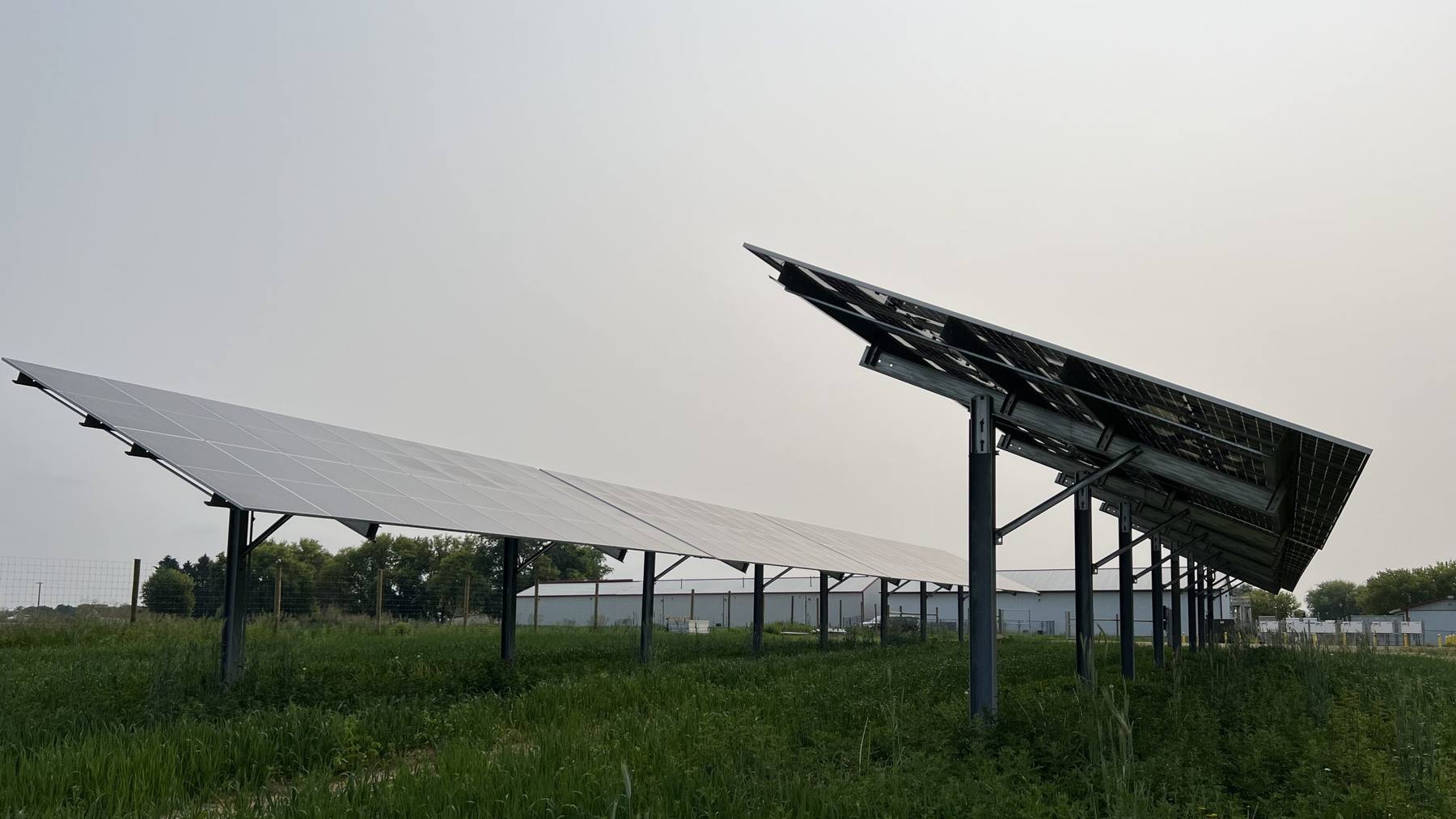
The machine doing the shading is a solar array on UW–Madison’s Kegonsa Research Campus. Alliant Energy owns it, and the university collects a monthly lease for hosting it. According to the UW–Madison Office of Sustainability, it was energized in the spring of last year.
It’s rated at 2.25 megawatts AC, which UW says is about what 450 to 500 Wisconsin homes use. The array covers 16.44 acres of a 280-acre campus in Dunn Township.
There are 5,424 modules out there, which UW lists as Heliene 144HC M10 SL bifacial panels rated at 520 to 540 watts. Bifacial basically means the panel works on both faces, so it also catches light bouncing up off the ground.
I went through UW’s technical specs, and it isn’t one uniform field of glass. It splits into three sections:
- Elevated fixed-tilt: two rows of 72 modules (144 in all), angled at 25 degrees and facing south, with the low edge 8 feet off the ground and the high edge up at 14 feet.
- Single-axis trackers: 10 rows of 48 modules (480 in all) that pivot on a tube about 5 feet up, with a motor rolling them from east to west through the day to follow the sun.
- Standard fixed-tilt: 24 rows of 200 modules (4,800 in all) on a slope that faces south, also at 25 degrees, running from 2.5 feet off the ground up to 9 feet.
In that big fixed-tilt block, UW says rows sit anywhere from 17 feet 6 inches apart, standard at that latitude, to 31 feet 8 inches. Farm Progress counts the fixed-tilt rows at two spacings separately, which is why it describes four racking systems. It’s a frankly clever setup, with several kinds of shade on the same dirt.
What’s a cutting, and why does the third one matter?
A cutting is one harvest of a hay or pasture field. You mow it, let it grow back, and mow it again, and each round gets weighed on its own.
Fulwider’s team put its plots among the fixed-tilt rows at both spacings, under the trackers, and out in full sun for comparison. None of them are under the elevated section. There are four treatments: orchardgrass with Kentucky bluegrass and red clover, meadow fescue with the same bluegrass and clover, straight alfalfa, and a control that’s the standard mix developers plant on solar sites.
The plots get sampled four times a growing season, on roughly the schedule you’d cut hay or move sheep through, and each sample is checked for yield and feed value. Here’s how the shaded plots did against full sun over this year’s three cuttings:
So what happened before that third cutting? Fulwider describes “the droughty growing conditions prior to the third cutting,” and the shaded plots got through that stretch better than the ones out in the open.
Most of the grasses in these mixes are cool-season species. They grow best in the mild weather of spring and fall and slow way down when summer turns hot and dry, which farmers call the summer slump. A panel overhead takes some of the heat off, and Fulwider says the shade helps soften that slump.
Meadow fescue was a good example. It doesn’t root as deep as orchardgrass, and it got more out of the shade in the tighter fixed-tilt and tracker rows than the orchardgrass mixes did, especially once things dried out.
I’d be a little careful with the 122 percent, though. It’s one cutting after one dry stretch.
Across the whole season, the shaded plots produced somewhere between 70 and 88.5 percent of the dry matter per acre that full sun did. Dry matter is what’s left once you take the water out, so it’s the actual feed. The panels still cost you some grass over a season. They just seem to cost you a lot less when the weather turns on you.
The sun-tracking panels were the steady ones
If I were a grazier, the tracker numbers would arguably interest me more than the headline figure. The plots under the single-axis trackers had the most consistent production all season. Their third cutting came in at 72 percent of their first, while the full-sun plots dropped to 58 percent of theirs.
That means grass in the open ran out of steam faster as summer wore on. And a pasture that holds up late in the season is pretty valuable when you’re planning how many animals it can carry.
Then there’s the alfalfa. Of every mix and racking setup, alfalfa under the trackers did best against its full-sun twin, beating it by 25 percent. Fulwider calls that a surprise, and it’s probably the oddest result in the set. You’d expect a crop people grow for hay in wide-open fields to want every bit of sun it can get.
Feed quality moved a little too. The shaded plots trended toward lower lignin and better NDF digestibility. Lignin is basically the woody stuff in plant cell walls that animals can’t break down, and NDF digestibility measures how much of the fiber they can actually use, so both point the right way.
Crude protein and ADF, another fiber measure, were mixed. Fulwider also mentions anecdotal signs that the shaded plants matured later.
Wisconsin doesn’t have the sheep for the giant sites
Fulwider is pretty upfront about where this fits. Wisconsin doesn’t have enough sheep for some of its biggest solar farms, but sites covering tens of acres vastly outnumber the ones covering thousands. On those, a grazier who’s already paid to keep the grass short could plant something more productive and run more sheep per acre. That’s a reasonable pitch, frankly.
What I can’t tell you is how much extra lamb that adds up to. I couldn’t find stocking rates or animal numbers for this trial in Fulwider’s write-up or on UW’s pages, so every number here is a forage yield. The results are preliminary, too.
We’ve seen shade earn its keep in a dry spell before. A raised array over a Normandy dairy pasture kept its grass green while the open field nearby dried out in July, and wheat between folding panels in Austria beat the open field in a drought year.
Fulwider’s team seeded the Kegonsa plots in the spring of last year, and the 77, 82 and 122 percent figures come from the three cuttings it had weighed when his Farm Progress piece ran on September 9.
 A copper mine with no pit and no shaft is running southeast of Phoenix on about 145 wells that push weak acid through broken rock as deep as 1,200 feet and bring the metal back up dissolved in it, built to turn out 85 million pounds of cathode a year from a deposit sized for 22 yearsEnergy · 3 hours ago
 A 590-megawatt reactor on the Lake Michigan shore shut itself down from full power at 5:12 in the morning when its main generator locked out, its leftover heat went out as steam through valves that vent to the open air, and three days later the 56-year-old unit was still at zeroEnergy · 9 hours ago
 A 426-foot ship built to lay internet cable across oceans can now carry about 4,400 tons of power cable on two giant turntables, and it has started unspooling 311 miles of it across the seabed of a British wind farm to plug 197 turbines into two converter stations out at seaEnergy · 1 day ago