
- 5 MONTHS AGO · INDUSTRYThe U.S. Army just sent a swarm of tiny solar-powered drone boats out to guard a real cargo run in the Philippines, screening a ship full of armored vehicles and allied troops 260 miles up the coast with nobody aboard the escorts, a first for an Army resupply run in the Pacific
- 5 MONTHS AGO · INDUSTRYAmerica just put a drone boat in the water that shoots at warships and aircraft at once from a 43-foot hull with nobody aboard, industrializing a trick Ukraine already pulled off when its sea drones shot Russian jets out of the sky
- 3 MONTHS AGO · INDUSTRYThe Navy took a 7-foot drone’s depth sensors, sonar and buoyancy with nothing but a wall of air bubbles in a Latvian harbor, and the Coast Guard just gave industry until August 7 to offer something better
- 3 MONTHS AGO · INDUSTRYA 236-foot American solar drone with a wingspan longer than a 747’s flew eight days over the Gulf with no fuel and nobody aboard, ran a Navy radar the whole time, and then went into the water on the way home because the batteries ran flat before sunrise
- TODAY · THIS ARTICLEA 15.7-foot government drone boat sat on Lake Erie with one foot of hull above the water, no radar reflector and its cameras off until a 45-foot cruiser hit it and wound it into a propeller pod, and federal investigators now want the Coast Guard to write rules for boats with nobody aboard
There’s one rule on the water that pretty much every boater hears before they’re allowed near a throttle. Keep a proper lookout. Someone on board watches what’s around you the whole time, which kind of assumes there’s a person on the boat to do the watching.
So who’s the lookout on a boat with nobody aboard?
That’s the question at the center of a report the National Transportation Safety Board put out on October 27. It covers a collision on Lake Erie that happened back on August 10, 2024, so the crash itself is more than two years old. What’s new is the NTSB’s verdict on it.
Here’s what happened. At about 7:12 p.m. that Saturday, a privately owned 45-foot Prestige 450 Flybridge cruiser was heading home to its marina at about 25 mph, roughly 6 miles east-southeast of Monroe, Michigan. It hit a 15.7-foot drone boat belonging to NOAA’s Great Lakes Environmental Research Laboratory (GLERL).
The drone boat got wound up in the cruiser’s starboard propeller pod. The two were towed to a marina still stuck together.
So what was a drone boat doing out there?
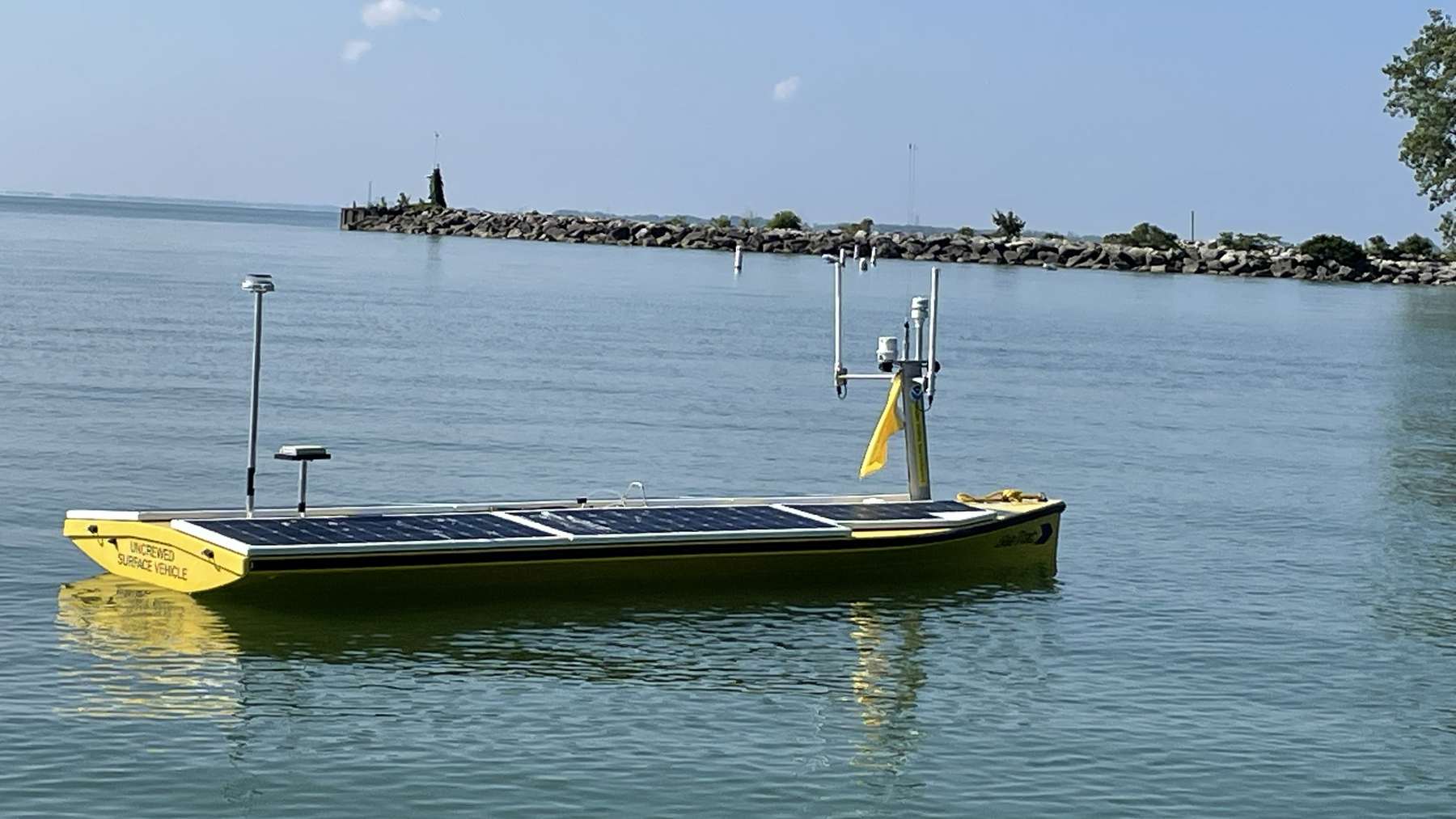
The boat is a SeaTrac SP-48, built in 2021, and it’s what the industry calls an uncrewed surface vessel, or USV. Think of it as a small boat that drives itself where you tell it, while a person on land keeps an eye on it through a computer dashboard. GLERL was using it to support monitoring of harmful algal bloom toxins in western Lake Erie, which is a pretty useful job for a boat this size.
And it really is small. The NTSB puts it at 15.7 feet long and 4.6 feet wide, and it showed only about a foot of freeboard. Freeboard is the height from the waterline up to the deck, so we’re talking about a hull that sticks up roughly to the middle of your shin.
Solar paneling covers most of the deck and feeds a 6.75 kWh lithium-iron-phosphate battery. A single 1,000-watt electric motor pushes it along at up to 5 knots. If the yellow hull and solar panels look familiar, we covered a very similar 16-foot solar drone boat that went silent in the Gulf of Maine back in October.
To be fair to NOAA, this thing wasn’t trying to hide. The hull is yellow, and the stern says UNCREWED SURFACE VESSEL in capital letters. A forward mast about 26 inches tall carries a small yellow flag that the NTSB estimates sat about 2.5 feet above the water, and GLERL added an aft mast with an all-around white light.
Its Class B AIS transponder was on, too. AIS is basically a radio beacon that puts your boat’s name, position and heading on other boats’ screens. The USV didn’t carry a radar reflector, but it wasn’t required to.
Why couldn’t anyone see it?
This is where the report’s favorite word comes in: perceptibility. It just means how easy a boat is for other people to notice, whether that’s by eye, by radar, by AIS or by sound. A boat can be bright yellow and still score badly if it’s a foot tall and bobbing in 3-foot waves.
Those were the waves that evening, with wind at 18 knots gusting to 23. Sunset wasn’t until 8:39 p.m., and the cruiser’s operator told investigators the sun was off to his right. He also said anything sitting that low was impossible to pick out against the color of the lake.
Then there’s the electronics. The cruiser’s operator usually kept his radar dome folded on its hinge because it got in the way of his covered slip, so the radar wasn’t available. The cruiser had no AIS either, and none was required.
Which means the drone boat’s AIS signal had nobody to talk to. The NTSB says that in this case the USV’s AIS and an optional radar reflector wouldn’t have been effective. Frankly, that’s a little unsettling, since the drone boat carried more visibility gear than anyone required of it.
Nobody was really watching it, either
The USV was in a mode GLERL calls adapted hold. Basically, you park it on a spot, let the wind and waves push it around, and once it drifts past a 150-foot circle, it motors back toward the middle at a 3-knot setting. The lead engineer told investigators it was really only doing about 2 to 2.5 knots. So it wasn’t anchored. It was holding station, a bit like a dog on a long leash.
The pilot on shift was working from home, monitoring passively through the dashboard. The boat’s four cameras were off. GLERL told the NTSB its main worries about running them for long stretches were cellular data getting throttled and battery drain. A collision-avoidance feature SeaTrac was still testing was turned off, and the AIS proximity alert can only warn about boats that broadcast AIS, which the cruiser didn’t.
So what does having no lookout mean in practice? A lookout is someone whose job is to notice trouble coming and react in time. A dashboard nobody’s actively watching and switched-off cameras don’t really fill that role.
That’s pretty much where the NTSB landed. Its probable cause blames two things: a drone boat other boaters couldn’t readily see in that spot and those conditions, and a lack of active monitoring that, according to the NTSB’s full report, “left the USV without a proper lookout to avoid a collision.”
You’ll notice the probable cause doesn’t land on the cruiser’s operator. I’m not going to put it there either.
The cruiser’s operator hurt his foot, the one minor injury in the report. The drone boat’s hull split in two, and it was declared a constructive total loss of about $186,000. The cruiser took about $100,000 in damage, including salvage.
So what does the NTSB want?
The two recommendations that matter most for everyone else on the water go to the Coast Guard. M-26-03 asks it to draw up a national set of standards for USVs covering how visible they are, how they avoid collisions and how they navigate safely. M-26-04 asks it to turn those standards into actual regulations.
That second one is arguably overdue. The report says the Coast Guard had no regulations for uncrewed surface vessels in US waters when the collision happened. Its 2026 work instruction counts only as guidance, and it leaves out small uncrewed systems operated by NOAA.
NOAA got three recommendations. M-26-05 and M-26-06 tell it to rewrite its Uncrewed Marine Systems Manual so its USVs are perceptible where they operate, and to test that with the people who run other boats in the area. M-26-07 says it should monitor these boats at a level that matches how autonomous they really are.
I’d say the test-it-with-real-boaters idea is the smartest one in the bunch. It’s a pretty cheap way to find out whether a boat that looks obvious to its engineers looks obvious to someone doing 25 mph through 3-foot waves.
SeaTrac got one, M-26-08, asking it to make the SP-48 easier to notice where practicable. The company now offers an optional reflection kit with a passive radar reflector and reflective tape, and the report says it had sold 25 SP-48s as of June 2026.
Twenty-five boats isn’t a huge fleet. But that’s one model from one builder, and drone boats will probably keep getting more common, from research boats like this one to defense types like the 19,800-pound drone boat that ran around the clock in an Australian port.
We don’t know yet how the Coast Guard will respond. The NTSB’s investigation page lists the case as completed, and the board issued all six recommendations in its October 27 announcement, which puts M-26-03 and M-26-04 on the Coast Guard’s desk.
 A 99-year-old lock chamber on the Allegheny River, 360 feet long, was pumped dry behind 16 bulkheads and 13 structural struts because winter ice tore gaps in the oak sill its gates seal against, and with barge traffic stopped until December all eight emptying valves are being replacedIndustry · 3 hours ago
 A 700-ton boring machine with a cutting face 23.5 feet across just passed its factory tests in Germany and ships early next year to dig 1.6 miles under Manhattan’s Second Avenue, between 35 and 120 feet down, on a line that will also reuse a stretch of tunnel built about 50 years agoIndustry · 5 hours ago
 A network of 1980s copper lines just got overloaded with data on Friday and produced the longest nationwide ground stop in 25 years, holding departing flights for more than four hours until it was lifted at 8:15 p.m. Eastern as old switches and routers fed inconsistent radar and radioIndustry · 10 hours ago