
If you’ve ever crawled along an interstate behind an oversize-load convoy hauling a single wind turbine blade at bicycle speed, you’ve seen the thing that actually decides how tall these machines get. Every part travels by road, and roads come with overpasses, ramps and tight corners. A steel tube wide enough to hold up a really tall turbine won’t clear the bridges long before engineers run out of ideas.
A German construction company has now pushed well past that limit, and it picked the most on-brand spot imaginable to do it: its own backyard.
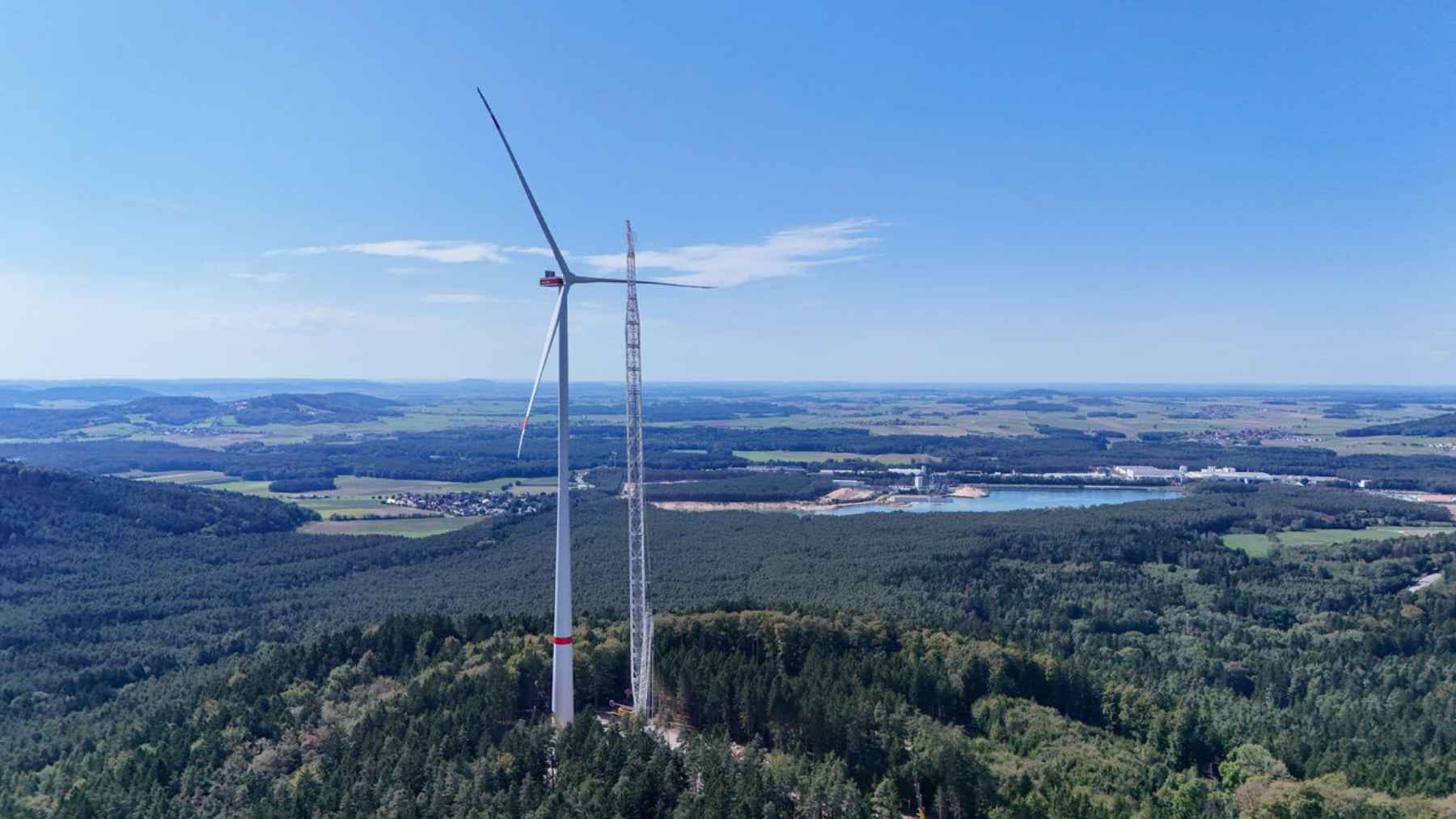
On September 8, Max Bögl and Vestas finished a wind turbine at Winnberg, right next to Max Bögl’s home plant in Sengenthal, Bavaria. The hub sits 653 feet (199 meters) off the ground and the blade tips sweep up to 935 feet. Vestas calls it a world record for hub height, and the tower holding it all up is a series-produced product rather than a one-off engineering stunt. Max Bögl builds more than 1,000 of these towers a year at three German plants.
The hub alone sits higher than the top of the Space Needle. And that’s before you count the blades. Count them and the whole machine tops out about 110 feet short of the Chrysler Building, in a field in Bavaria.
So what exactly is a hybrid tower?
Basically, it’s concrete where the loads are biggest and steel where they aren’t. The lower part of the tower is stacked from precast concrete segments that get cast in a factory, trucked out on standard trailers and assembled into rings on site, so the tower itself doesn’t need the rolling-roadblock treatment the blades still get. A conventional steel tube goes on top, the nacelle and rotor ride on the steel, and the whole stack stands on a ring foundation of poured-in-place concrete. Max Bögl machines the concrete parts so precisely that the rings stack in a dry joint, with no mortar in between, and the company says that lets crews keep building in almost any weather.
Why go through all that? Because wind a few hundred feet up is stronger and steadier than wind near the ground, where trees, buildings and terrain churn everything into turbulence. Max Bögl’s pitch is that taller hubs turn mediocre inland sites into productive ones, and it sells hybrid towers with hub heights from 525 feet (160 meters) on up. Winnberg’s is the first one that’s been built to the full 653.
The turbine on top is a Vestas V172 rated at 7.2 megawatts, a good deal bigger than the typical machine you see spinning along an American highway. The 172 in the name is the rotor diameter in meters, which means the rotor’s about 564 feet across. Vestas, for its part, framed the project as a preview of what future onshore wind can reach when a big turbine meets a tall enough tower.
Other companies are chasing the same trucking problem from different directions, including a Swedish outfit that stacks its towers out of laminated wood. Concrete segments just happen to be the version you can already order in bulk.
The record comes with a couple of asterisks
Wind records are a genuinely messy business, because some get claimed by prototypes and some by production machines, and the two don’t compare cleanly. An offshore turbine already carries its hub 607 feet above the water, and RenewEconomy notes that reports put that machine’s blade tips at about 1,115 feet, so it’s still the taller machine overall. What the Bavarian tower can claim, per the same outlet, is the tallest hub ever on land and the tallest hub on any series-built machine.
I’d also like a few numbers nobody has published yet. Max Bögl hasn’t said how the 653 feet splits between concrete and steel, what the heaviest segment weighs, or which crane put the last piece up there. For a company that builds towers for a living, those specs feel like the fun part, and I can’t find them in anything it’s put out so far.
Why put your record in your own parking lot?
Because the plant next door has a power bill. The turbine feeds Max Bögl’s Sengenthal site directly, and the company already runs its own solar arrays, a combined heat and power unit and battery storage there. Once the new machine spins up, Max Bögl expects self-generated electricity to cover about two-thirds of the site’s demand, with the turbine alone producing 17 to 18 million kilowatt-hours a year. And if your whole sales pitch is that anyone can order this height from a catalog, there’s no better proof than standing one at your own address.
Stefan Bögl, CEO of the Max Bögl Group, says the project “opens a new chapter in the technical possibilities of wind tower construction.” It’s also, frankly, the tallest business card in the industry: a working demo that every potential customer can watch make power over the builder’s own roofline.
So is the timing a coincidence? I doubt it. The turbine was finished exactly two weeks before WindEnergy Hamburg, the wind industry’s biggest trade show, and Max Bögl gets to walk in as the company holding a fresh world record. Germany’s wind business could use the win, too, in a year when a fallen blade idled 64 turbines in the German North Sea.
Max Bögl says commissioning is set for the coming weeks, and the completed tower gets its first public showing at WindEnergy Hamburg, which runs September 22 through 25.