
Every crane that matters gets loaded past its rating before anyone lets it near a paying job. You hang more weight on the hook than the machine will ever lift in service, you watch for anything that bends or creaks, and then you sign the certificate.
On May 2, 2020, Liebherr ran that test on the largest offshore crane it has ever built, bolted to a ship tied up in Rostock, Germany. The plan called for 5,500 metric tons. The hook let go somewhere around 2,600.
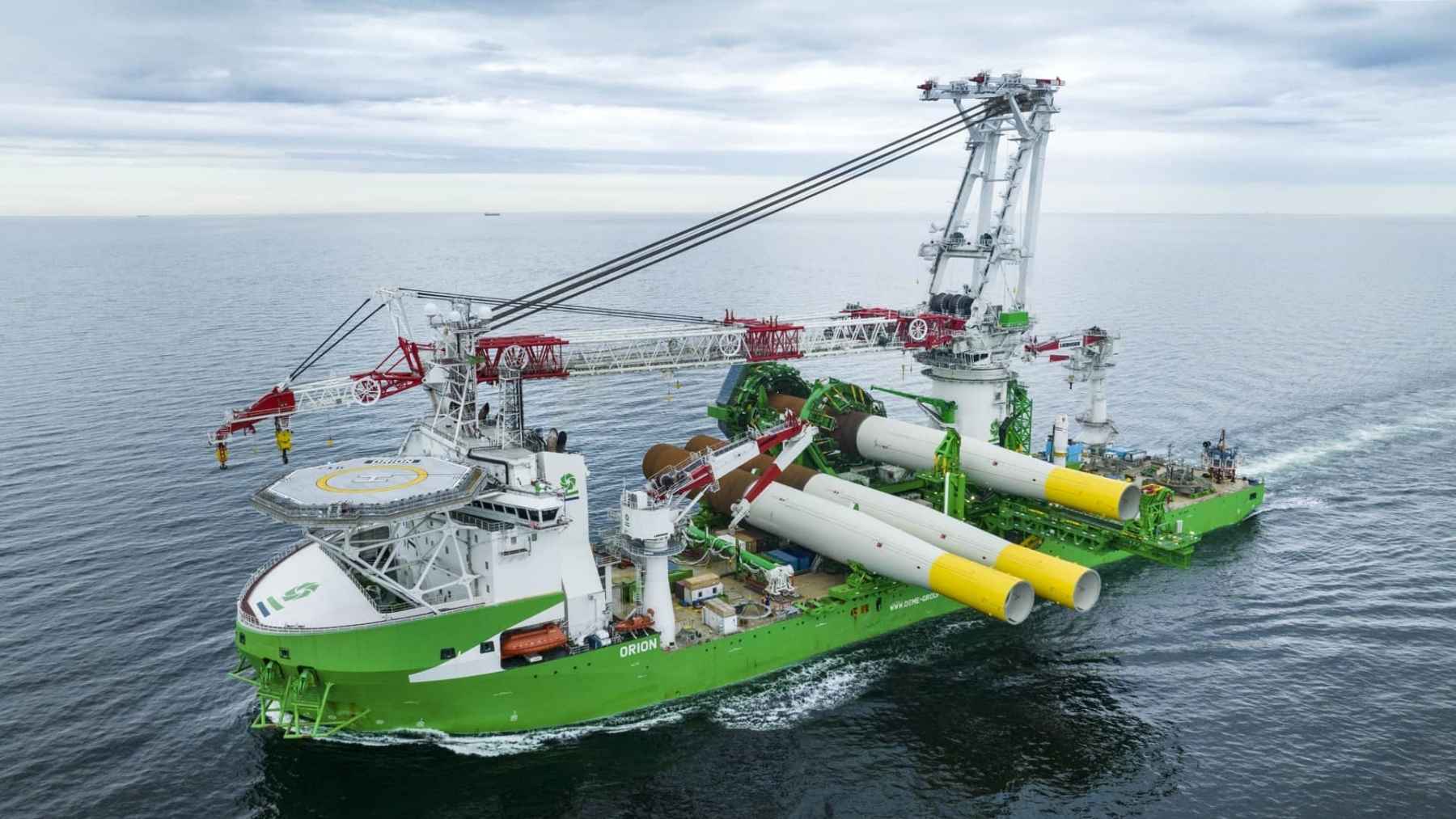
The crane came down across the deck of a vessel called Orion, owned by the Belgian marine contractor DEME. Two people went to the hospital, another ten were treated on the quay, and the ship spent the next two years going absolutely nowhere.
That story never really escaped the trade press. The sequel is the interesting bit. Repaired, the same machine went on to install all 176 monopile foundations under Coastal Virginia Offshore Wind, the largest offshore wind farm in the United States.
DEME is now running the same scope at the largest one in Germany, where the first foundation went into the seabed on July 1 and the first transition piece was announced this week.
The overload test is supposed to be the boring part
The crane is a Liebherr HLC 295000, and Liebherr still lists it as the biggest offshore crane the company has ever manufactured: 5,000 metric tons of capacity, about 5,512 U.S. tons, at an outreach of 35 meters, with a hook that can climb 175 meters above the deck. Both Liebherr and DEME liked to describe that capacity as nine fully loaded Airbus A380s in a single pick.
The test load was higher than the rating on purpose, ten percent over in this case. The weight was a barge full of water hanging off the starboard side, with the ship counter-ballasted several degrees the other way to keep it honest.
The failure happened at roughly half of what the crane was rated to hold every working day of its life. Video from the quay shows the lattice booms flipping backwards over the top of the ship, which is the direction a boom goes when the load holding it forward disappears all at once.
The hook came from somebody else’s factory
Liebherr issued a statement four days later saying investigators had reached an early consensus, and the company was fairly direct about where the problem sat. Offshore Engineer published the statement in full, including the line that “a broken crane hook was the cause of the accident.”
Liebherr added that the hook had been designed and manufactured by an outside supplier, and that an error in the Liebherr crane itself could therefore be excluded. Ropeblock, the Dutch company that makes lifting blocks, said publicly that it had supplied the design of the crane’s lifting blocks including the hook. No public report has been issued explaining why the hook failed at that particular load.
Liebherr put the bill at a high double-digit million figure. For a component that sits at the very bottom of a machine costing several hundred times as much, that is a spectacularly bad ratio.
The schedule damage was worse than the money. Orion was due to be handed over in the second half of May 2020 and go straight to Scotland to install 103 jacket foundations at Moray East. DEME told reporters at the time it was hunting for a replacement vessel inside its own fleet and outside it.
Two years on a quay, and a new boom built from scratch
Salvaging a collapsed 5,000-ton crane is its own engineering project. Sarens handled the recovery, and the gantry crane used to lift the pieces off Orion was the TCC 78000, the same permanently installed machine in Rostock that had assembled the HLC 295000 onto the ship in the first place.
By November 2020 the jib components were down and the dismantling was reported as on plan. The 145-meter boom and parts of the A-frame could not be straightened or reused, so Liebherr manufactured them again from raw steel at its Rostock plant.
Orion finally joined DEME’s fleet on April 30, 2022, with Amélie Michel, wife of then European Council president Charles Michel, as godmother at the naming ceremony. That is almost two years after the delivery date the accident erased.
Vessel figures from DEME’s Orion specification sheet. Crane figures from Liebherr.
Virginia got the rebuilt crane before Germany did
Once it was working, Orion went through Europe fast. It put 28 XL monopiles into the Baltic at Arcadis Ost 1, piles up to 110 meters long and 2,100 metric tons each, and it did it floating rather than jacking the hull up out of the water.
Then it set a 1,300-ton jacket and a 2,200-ton substation topside at Fécamp off Normandy, and 29 monopiles at Moray West in Scotland through a winter, in about two months.
Then it crossed the Atlantic. On May 22, 2024, Dominion Energy announced that Orion had installed the first of 176 monopiles for Coastal Virginia Offshore Wind, roughly 27 miles off Virginia Beach. Each of those piles weighs around 1,500 metric tons, and they were staged out of Portsmouth Marine Terminal.
The reason Orion can work without dropping anchors is a motion compensated pile gripper designed jointly by DEME and Huisman. It clamps the pile and cancels out the ship’s movement, so the monopile stays vertical while the hull rolls underneath it, and the DP3 system holds position on thrusters instead of mooring lines.
That job is finished. DEME confirmed in its first-quarter update this year that all 176 foundations, all 176 transition pieces and the offshore substations at Coastal Virginia are in, and that Orion and the jack-up Sea Installer had both sailed back to Europe for new work in the second quarter of 2026.
Dominion said on August 3 that the project was about 81 percent complete as of July 31, with 31 of the 176 Siemens Gamesa turbines standing and the last one now targeted for the end of 2027. First power reached the Virginia grid back in March.
For a sense of what that lifting capacity is worth on land, Britain’s Big Carl, the largest land-based crane on Earth, carries the same 5,000-metric-ton rating and spends its entire career parked on one nuclear construction site in Somerset. Orion carries its 5,000 tons across an ocean.
Germany is next, and the piles are coming out of Rostock
DEME won the Nordlicht contracts in early 2025: 68 foundations at Nordlicht I and 44 at Nordlicht II, 112 in total, plus the scour protection at both. The company named Orion as the installation vessel for the foundations when it announced the award, alongside a jack-up for secondary steel and a fallpipe vessel for the rock.
Vattenfall confirmed on July 2 that the first monopile had gone in the day before, about 53 miles north of the island of Borkum. Each pile runs up to 80.5 meters, near enough the length of a soccer pitch, and up to 1,290 metric tons. The first transition piece followed, announced August 4.
Nordlicht I is around 980 MW and Nordlicht II around 630 MW, roughly 1,610 MW between them, using 112 Vestas V236-15.0 MW turbines and targeting full operation in 2028. The monopiles are being rolled by EEW Special Pipe Constructions in Rostock, which is the same port where the crane fell over in 2020. The transition pieces come from CS Wind Offshore in Aalborg, Denmark.
There is more queued behind it. On July 20, DEME picked up the foundation contract for phase 1 of the Zeevonk project in the Netherlands, 69 monopiles for a roughly 1 GW wind farm owned by Vattenfall and Copenhagen Infrastructure Partners. Offshore construction there is scheduled for 2028 and the contract still depends on a final investment decision.
Add it up and one hull is carrying 176 American foundations already in the ground, 112 German ones underway and 69 Dutch ones penciled in. Not every heavy lift needs a crane at all, and the vessels that skip them entirely, like the 31,000-ton single-lift platform removals done by Pioneering Spirit, work on a completely different principle. But monopiles get picked up and stood on end, and that means a hook.
Which brings the whole thing back around.
Orion is a 710-foot ship with roughly 44 megawatts of installed power, eight thrusters, a positioning system that holds station in a swell without a single anchor, and a crane rated for the equivalent of nine widebody jets. The part that cost it two years and a repair bill in the tens of millions was the single piece of forged steel at the end of the rope, bought in from a supplier. Everything upstream of that hook worked exactly as designed, right up until the moment none of it mattered.
 @ratwest ROOKIE1 month ago