
Germans are not famous for whimsical naming. This is the country that looked at a glove and went with “hand shoe.” So when a German utility picks a name for the biggest offshore wind farm it has ever built, and that name translates to “It Spins,” you can safely assume the spinning is the entire point.
The farm is called He Dreiht, Low German for exactly that, and as of August 12 it is finished in the way that matters most. EnBW announced that all 64 of its wind turbines are now standing in the German North Sea, roughly 85 kilometers, call it 53 miles, northwest of the island of Borkum.
Each of those 64 machines is a Vestas V236-15.0 MW, which is the Danish manufacturer’s flagship offshore turbine and, until this project, one that had never been installed at commercial scale anywhere on Earth. Together they add up to 960 megawatts, enough for the equivalent of about 1.1 million households once the farm hits full output, which EnBW expects by late summer.
So the electrons are already moving, the towers are all up, and the only things left are weeks of electrical commissioning work. Then Germany’s largest offshore wind farm, by EnBW’s own accounting, starts earning its name full time.
Each blade is longer than a football field, end zones included
The number in the turbine’s name is the whole story. V236 means the rotor is 236 meters across, or 774 feet, and each of the three blades measures 115.5 meters according to Vestas. That is 379 feet of single blade. An NFL field runs 360 feet with both end zones, so one blade overhangs the entire thing by 19 feet.
The hub sits 142 meters above the water, about 465 feet, and a blade pointing straight up puts its tip somewhere past 850 feet. Every full revolution sweeps 43,742 square meters of sky, an area EnBW compares to six soccer fields.
Vestas rates the V236 for a capacity factor above 60 percent, with a single unit good for up to 80 gigawatt-hours a year depending on the site. The stat EnBW keeps repeating is simpler than any of that: one rotation of one rotor covers a household’s electricity for a full day. Four households, one lazy turn.
Two ships, 16 months and 1,350 tonnes of steel per tower
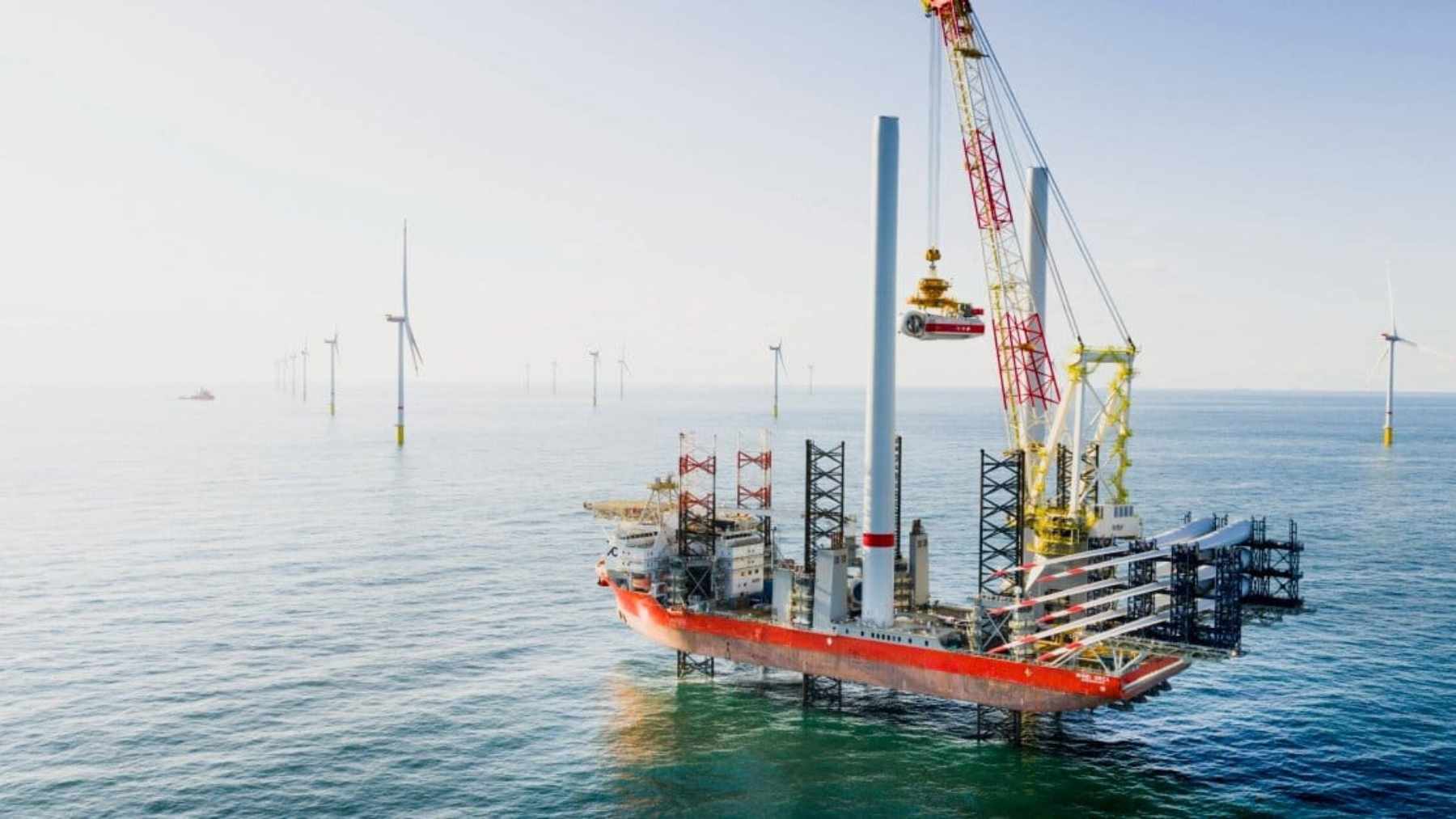
Getting 64 of these upright in open ocean took a while, and it took hardware most people have never heard of. Cadeler’s jack-up vessel Wind Orca set the first turbine in April 2025. A second ship, Wind Keeper, took over the remaining installs in the first quarter of 2026 and placed the last one this month, in what was its first wind campaign since Cadeler bought the vessel from a Chinese yard in May 2025 and refitted it.
Underneath every turbine is a monopile 70 meters long and about nine meters across, with steel walls ten centimeters thick, hammered into a seabed that sits 37 to 40 meters down. Each one weighs around 1,350 tonnes. There are 64 of those too, and they went in before a single blade showed up.
The farm did not wait for the finish line to start working, either. He Dreiht fed its first power into the German grid back in November 2025, while installation was still underway. Grid operator TenneT carries the output ashore over 120 kilometers of subsea cable and another 110 kilometers on land.
Nobody subsidized any of this
He Dreiht splits from most giant renewable projects on one line of the balance sheet: the €2.4 billion bill lands entirely on EnBW and its partners. The utility won the site in Germany’s first offshore wind auction back in 2017, and the project collects no feed-in remuneration under the country’s Renewable Energy Act. No production credits, no guaranteed price floor. If the wind farm loses money, that is EnBW’s problem.
The plan for not losing money is long-term power purchase agreements, and the customer list reads like a stock index. Google has locked up 100 megawatts of the output, Frankfurt Airport operator Fraport took 85, Bosch signed for 50 and DHL for 20, with chemical maker Evonik and steelmaker Salzgitter in the mix as well. A consortium of Allianz Global Investors, AIP Management and Norway’s sovereign wealth fund manager holds 49.9 percent of the farm itself.
The nameplate math puts 960 megawatts in the territory of a large nuclear reactor. The honest caveat is that a reactor runs flat out most of the year, and a wind farm does not. Even so, a capacity factor north of 60 percent is unusually strong for wind, and it is the reason companies were willing to sign decade-scale contracts against North Sea weather.
New York ordered the same machine three years ago
If the V236 sounds familiar to American readers, there is a good reason. It is the exact turbine Equinor picked for Empire Wind 1, the 810-megawatt project south of Long Island that is supposed to send power into Brooklyn. That farm needs 54 of them, and Empire Wind’s own material notes that one rotation covers a New York home for about a day and a half.
Empire Wind has had a rougher road. The project survived a federal stop-work order in the spring of 2025, then lost its contracted installation vessel when a shipbuilding deal fell apart. Foundations were finished in the fall of 2025, turbine components are due out to the lease area later this year, and commercial operation is targeted for 2027. The turbines Germany finished installing this month are the ones New York is still waiting to stack, and the one American-built ship that can do that kind of stacking is busy off Virginia.
China is running its own version of this race with different priorities. It drew plenty of attention in May for floating a single 16-megawatt turbine in water too deep for foundations, and its floating machines are already feeding offshore oil platforms. Those are one-off demonstrators and specialty hardware, though. He Dreiht is the other kind of milestone: the biggest turbine Western industry sells, bought 64 times, planted in rows, and paid for by customers rather than a ministry.
The North Sea got the first punch in
The project is not tying a bow on itself just yet. In late July, part of a rotor blade broke off one of the turbines and dropped into the sea, and Germany’s Federal Police fished the fragment back out. EnBW said on August 7 that Vestas is investigating what caused the damage.
That leaves He Dreiht heading into its final commissioning weeks with 64 machines standing and one of them already needing blade work before the farm reaches full power. Nobody said the North Sea was a forgiving place to park 774-foot rotors. The name on the project promises spinning, and 63 out of 64 is close. EnBW has until the end of summer to make it unanimous.
 @richardmercer ROOKIE2 months ago