
- 6 MONTHS AGO · NEWSA Cybertruck Got Stuck in Sand and Had to Be Pulled Out by a Toyota Sienna. Days Later, Another One Got Stuck in a Muddy Puddle. Elon Musk Spent Years Telling Owners These Trucks Could Cross Rivers
- 5 MONTHS AGO · CARSHawaii built a road out of fishing nets pulled from the Pacific to see if it would shed plastic into the sea. Eleven months of lab tests came back with an answer nobody expected
- 5 MONTHS AGO · NEWSWhile their neighbors sold and Mason County rezoned 2,080 acres for a nameless Fortune 100 data center, an 82-year-old Kentucky farmer and her daughter just said no to $26 million, again
- 3 MONTHS AGO · NEWSTesla’s lawyers told the other side that the data the car sends home holds no crash video and no snapshot, so a hacker from Tesla’s own bug bounty program took the computer out of the wrecked Model S, read it in a Starbucks, and the jury gave the automaker a third of the blame.
- TODAY · THIS ARTICLEA 525-foot asphalt tanker hit a docked Mississippi paddlewheeler in New Orleans about two hours after she tied up, about 100 people were pulled from the river and all 191 aboard came out alive, and investigators now hold the recorder designed to capture what was said on the tanker’s bridge
Most of the coverage out of New Orleans since Friday has been about the people, and honestly, that’s the right call. All 191 people on board the American Heritage got off alive after a tanker hit the docked riverboat and rolled her over, according to Fox8. WBRZ reports 32 were taken to the hospital, and eight were still there Saturday afternoon, two in serious condition.
But the federal investigators who showed up on Saturday went straight for something a lot less dramatic. Within hours of arriving, a team of 16 from the NTSB pulled the voyage data recorder off the tanker, a ship called the Atlantic Asphalt.
So why does a box matter that much?
Because the cause of this crash isn’t known yet, and that recorder is about as close as investigators can get to a witness who stood on the tanker’s bridge the whole time.
So what happened at the dock?
Here’s what we do know. The American Heritage had come down the river from Natchez, Mississippi, and tied up at the Port of New Orleans, just below the Crescent City Connection bridge. WDSU reports she’d been docked for about two hours, and passengers were starting to get off, when the Atlantic Asphalt hit her at around 12:30 p.m. on Friday, November 13.
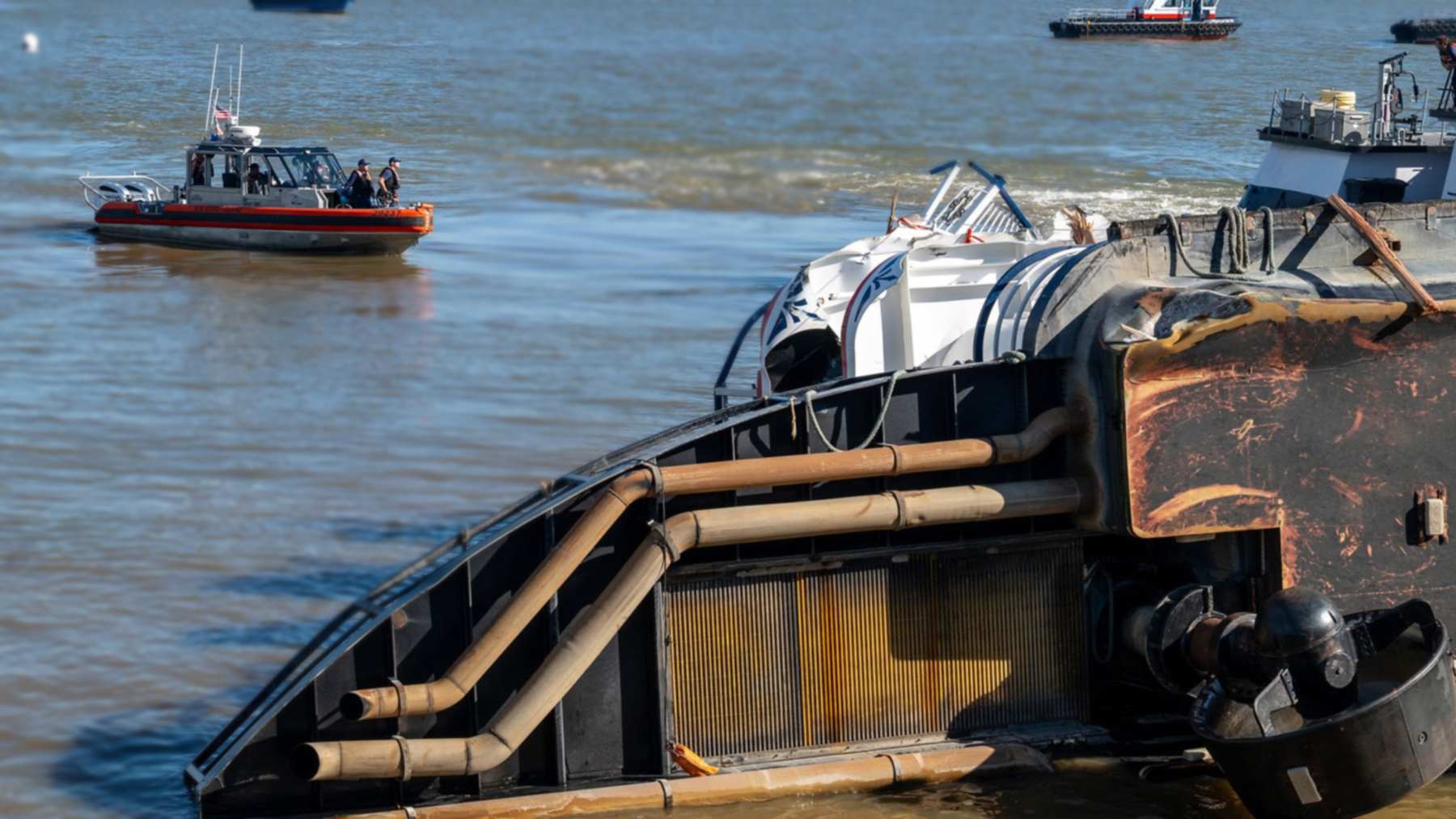
The tanker struck her port side, which is the left side if you’re standing on the boat and facing the bow. Going by the video gCaptain ran, the riverboat took on water, leaned over (sailors call that a list) and then capsized right alongside the dock. Fox8 says she’s now lying on her side in 25 feet of water.
New Orleans Mayor Helena Moreno said about 100 people had to be pulled out of the river, per WBRZ. According to American Cruise Lines, Capt. Leonard Stewart never left the bridge while she capsized. The company says he kept calling for help the whole time and worked to keep the boat up against the dock.
If you saw an early report with a smaller headcount, that was the port’s first estimate of about 129 passengers plus crew, which gCaptain passed along Friday. Everyone’s working from 191 now.
So what’s on a voyage data recorder?
A voyage data recorder, or VDR, is basically the ship version of an airliner’s black box. It keeps a running log of what the ship is doing and what’s being said on the bridge, and the recording is stored in a protective capsule that’s built to survive a collision, a fire or a sinking.
NTSB board member John DeLeeuw made that same comparison on Saturday and likened it to a plane’s flight data recorder. Drew Ehlers, deputy director of the NTSB’s Office of Marine Safety, said it logs the basics, “speed through the water, direction, course,” plus audio from the tanker’s bridge, according to Fox8.
That first one is a bigger deal on a river than you’d think.
Speed through the water isn’t the same as speed over the ground. The Mississippi itself is moving, so a ship can be pushing hard upstream and barely creeping past the bank, or riding the current and covering ground fast with the engine doing very little. Line that up with the heading and course, and investigators should be able to work out how hard the tanker was working and which way the river was pushing her.
Then there’s the audio. I’d argue that’s the most valuable thing on the box, since it should pick up the orders given on the bridge and any radio calls in the minutes before the hit. The NTSB hasn’t said what’s on it, or whether it’s played anything back yet, and DeLeeuw wouldn’t speculate about a cause.
Why didn’t the tanker just stop?
Your car has brakes. A ship doesn’t, at least not in any way you’d recognize. To slow down, the crew has to put the propeller in reverse and wait for the water to drag all that weight to a halt, and the rudder only steers when water is flowing past it, so a ship that loses steering in a moving river pretty much goes wherever its momentum and the current take it.
If you’ve followed the USS Kidd, the WWII destroyer in Baton Rouge that can’t get back into her riverside cradle until the Mississippi rises to about 32 feet on the gauge, you already know this river tends to set the schedule for everybody on it.
And the Atlantic Asphalt isn’t a small ship. She’s a Marshall Islands-flagged asphalt tanker built in 2017, about 525 feet long and 77 feet wide, with a deadweight of about 19,600 short tons according to VesselFinder. Deadweight is how much a ship can carry, cargo and fuel included, so it tells you her capacity, not what she weighed on Friday. I haven’t seen anything official on how loaded she was when she hit.
As for what went wrong, nobody in charge has said yet. WBRZ reported that the tanker lost steering. Coast Guard Capt. Melanie Burnham told reporters Friday that the ship appeared to have some kind of steering loss, ABC News reports, and on Saturday she said the mayday calls suggested a technical failure, per Fox8. Those are early reads from the scene. They aren’t findings, and the NTSB, which now leads the investigation, hasn’t reached any conclusions.
The American Heritage is a pretty young boat
The American Heritage is an American Cruise Lines paddlewheeler built in 2015 by Chesapeake Shipbuilding in Salisbury, Maryland, and she’s rated for up to 150 passengers. CBS News describes her as five stories tall.
Her length depends on who you ask. gCaptain, citing MarineTraffic, puts her at about 266 feet, while cruise seller Adventure Life lists her at 295 feet. Either way, the 525-foot tanker was somewhere between 1.8 and 2 times her length.
Frankly, the fact that everyone got off a boat that ended up on her side is probably the headline most people in New Orleans care about, and it’s hard to argue with that. Moreno called it a miracle on the Mississippi, ABC News reports, and you can kind of see why.
The NTSB has a busy week ahead
Fox8 says the NTSB’s to-do list for the coming week includes talking to witnesses, going over both ships, gathering crash footage and putting divers in the river to hunt for evidence. Investigators also planned to board the tanker, which has been towed away from the scene, this weekend. And if you shot video of the collision, the NTSB wants it.
Getting the American Heritage back upright is going to take a while. Officials told Fox8 salvage could take weeks, and the Coast Guard is getting hazardous materials off the wreck first. How much fuel is still in her depends on the outlet, too. Fox8 says an estimated 16,000 gallons, while WBRZ quotes officials at about 60,000. The Port of New Orleans, meanwhile, has already sued the tanker’s owners and operators, and says its damage tops $1 million, per WBRZ.
I checked the NTSB’s case page on Sunday morning, and the findings section is still empty, which is pretty normal this early. The NTSB expects to publish a preliminary report on case DCA27MM003 within 30 days, and Fox8 says the final report could be 18 to 24 months away.
Credit: U.S. Coast Guard
 The Worst Moments From the Cybertruck’s Short, Miserable LifeElectric Vehicles (EVs) · 5 days ago
 Why Tesla’s Cybertruck Failed, and What We’ll Remember it ForElectric Vehicles (EVs) · 6 days ago
 China Is Working On a Way To Give EVs Over 1,200 Miles Of Range On a Single ChargeElectric Vehicles (EVs) · 6 days ago