
Solar farms have a bit of a bad reputation in farm country. Often, it boils down to one objection you’ll hear at pretty much every county land-use meeting: the panels kill the grass, and land that grows panels stops growing food.
Hearing that, yeah, it sounds bad. The first half of that objection is true, which probably adds to the feeling of concern if you’re on the outside. Oregon State University measured it at a solar array on its own land in Corvallis, and the pasture under the panels grew 38 percent less forage than open ground next door.
However, it’s the second half that falls apart. The university also ran lambs on both pastures for two springs, weighed them on the way in and on the way out, and found that the lambs on the thinner grass gained pretty much the same weight. The trial ran in spring 2019 and spring 2020, and the results came out in Frontiers in Sustainable Food Systems on April 29, 2021.
Sure, it’s years ago, but I’m dragging it back into the light because the argument it speaks to is still being had in county meeting rooms all over the US. And from the looks of things, hardly anyone in those rooms has read it. The authors, for what it’s worth, believed nobody had run a livestock trial under solar panels before theirs.
So what do the panels actually do to the grass?
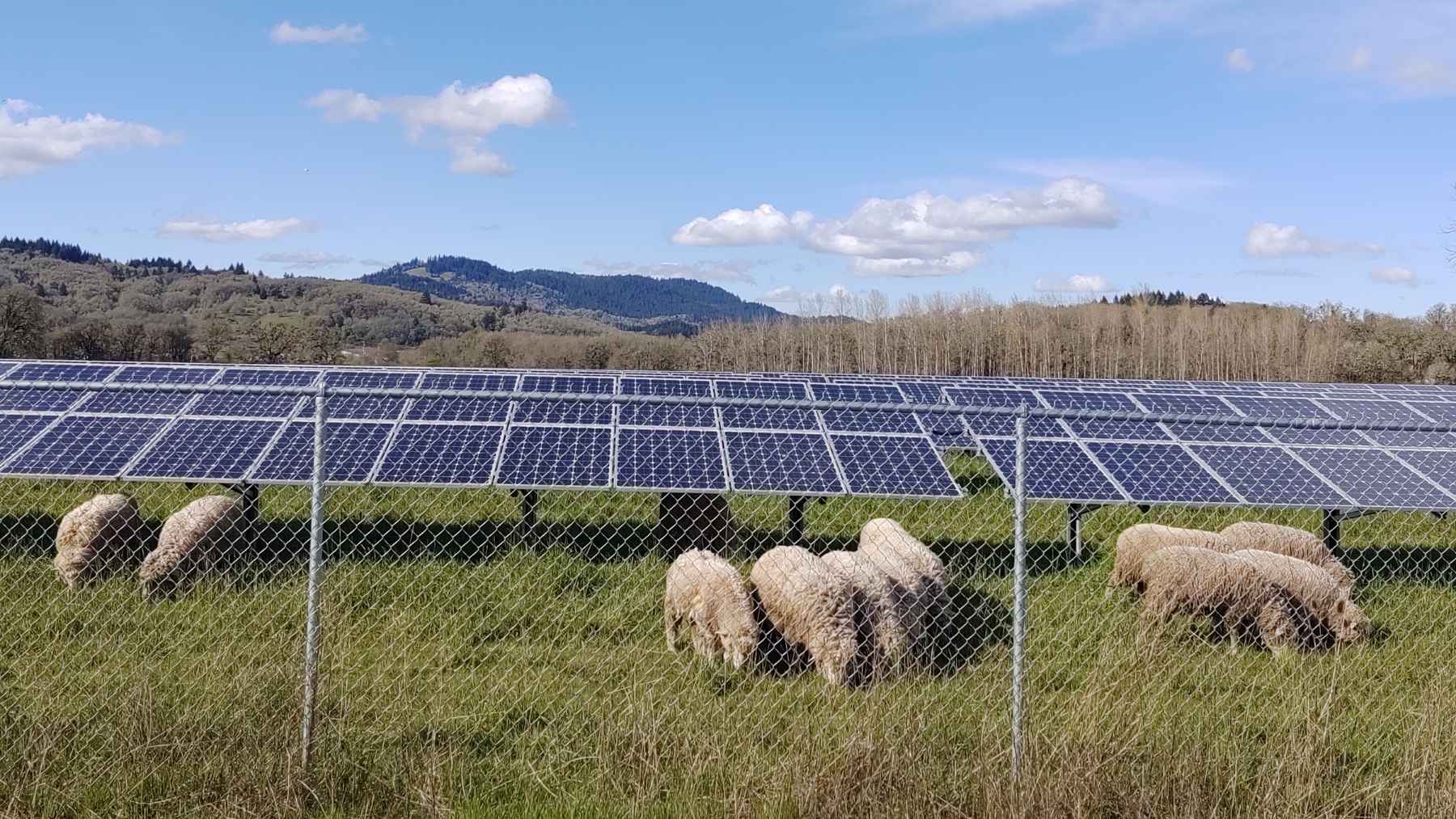
The array sits on about six acres west of the Corvallis campus. OSU’s facilities people call it the 35th Street array, while the researchers call it the Rabbit Hills solar farm. No matter what you wanna call it, it’s a real 1.4-megawatt power plant, with 5.4-foot-wide panels tilted 18 degrees toward the south, rows nearly 20 feet apart, and the low edge of the glass hanging 3.6 feet off the ground.
That layout splits the ground into stripes. Roughly half of each solar paddock sat in full shade under the glass, and the other half sat in the partly shaded alleys between the rows. The alley grass kept up with the open pasture reasonably well. The grass directly under the panels came in thin and patchy, and the lambs made it worse by crowding into the shade and trampling whatever grew there. Add it all up across the study, and the solar pastures produced 38 percent less forage than the open ones.
So the county-meeting crowd is right about the grass, I’ll give them that. But are the animals that eat the grass noticing the difference? That’s exactly what this trial was built to answer.
The lambs came out even anyway
The test animals were weaned Polypay lambs, a workaday American breed, about two and a half months old at turnout. Each side got a core group of nine lambs every spring, plus spare animals the team shuttled in and out to keep grazing pressure matched to the rate at which the grass was growing. (Grazing researchers call that put-and-take, and it’s the standard way to keep a pasture trial honest.)
Man, what I’d give to be paid for a test where I get to eat all day…
In spring 2019, the solar-side lambs gained 0.265 pounds a day against 0.262 pounds in the open, and in 2020 it was 0.196 against 0.203. Neither gap comes close to being statistically significant. The team even ran a heavier stocking rate on the solar side in late spring 2019, and the gains still held.
How do you get the same lamb out of a third less grass?
According to researchers, the shaded forage was measurably richer. Grass growing in shade stays leafier and greener for longer, and the lab work showed higher crude protein in the solar pastures both years. Less salad, but more of the good stuff in every bite, so the smaller supply fed the lambs just as well. That’s the authors’ interpretation of their own data, and I’d add the obvious hedge: it held on this grass, in this climate, with these animals. Nobody should promise a ranch in a Texas summer the same arithmetic.
The lambs spent their downtime parked under the panels
The behavior logs are, frankly, my favorite part of the paper, as someone who wants to picture lambs frolicking and eating in a field. When the lambs were loafing or chewing their cud, they were under the glass more than 96 percent of the time. When they were actually grazing, they split their day about evenly between the shade and the alleys. In short, the flock treated the panels as furniture.
There’s a water angle too, though it’s easy to oversell. In the hot back half of spring 2019, lambs in the open field drank about a fifth of a gallon more per head per day than the ones with shade. In spring 2020, the difference didn’t show up at all. So shade saved water in one of the four measured periods. It’s a modest effect, but it’s still an effect.
The grazing pays the array back in kind. Sheep working the rows keep vegetation down in strips a mower can’t reach, and around hardware a mower shouldn’t touch, the same logic that has a Virginia outfit breeding a 1,000-pound cow specifically to fit a solar farm. Under panels, the animal is the maintenance plan.
The whole thing is still a working power plant
It’s interesting to see innovations leave the paperwork behind and do some real-world implementation. The 35th Street array is the largest of five ground-mounted arrays that have been feeding OSU’s buildings since 2013, and the university doesn’t even own the hardware. Tesla installed, owns, and operates it, and OSU buys the electricity under a power purchase agreement at a rate below what the local utility charges.
The money side of the grazing came out nearly flat. The researchers put the return from spring grazing at about $423 an acre per year in open pasture and $416 under the panels ($1,046 versus $1,029 per hectare in the study’s own figures), a 1.6 percent haircut before you count a single kilowatt-hour. Study co-author Serkan Ates, an animal scientist at OSU, argued in the university’s announcement that a setup designed for production “would likely get even better numbers.” By the team’s land-use math, running sheep and power off the same six acres roughly doubled what the land produced compared with doing either alone.
Germany has started writing that kind of measurement into its rulebook, with a yield threshold farmland has to keep hitting after the panels go up. The US mostly hasn’t, which is why a two-season trial with actual scales remains one of the better data points an American county has to argue from.
What I can’t tell you is whether a flock is out there this fall. OSU hasn’t published follow-up lamb numbers from this site, and the 2021 announcement said lead author Alyssa Andrew was moving on to test three different pasture mixes under the panels. So treat the animal side as a completed experiment rather than a running operation.
The panels, meanwhile, haven’t gone anywhere. OSU’s energy inventory, last updated in August 2025, still lists the 35th Street array as the biggest of the university’s five, at 1,435 kilowatts across those six acres west of campus. They gotta be doing something right.
















Does the array have a different impact during drought vs high rainfall? Can your herd size supported on the 6 ac support the more, less the same without the panels in those conditions?