
Sheep grazing under solar panels stopped being news a while ago. American developers rent out entire flocks to mow the grass between rows, there’s a whole trade group for it, and the sheep frankly seem to enjoy the arrangement more than anyone. But the solar field that got its ribbon cut in Belgium on September 18 has a landlord I don’t run into very often: a limestone quarry, which burns a good chunk of the electricity coming off the panels next door.
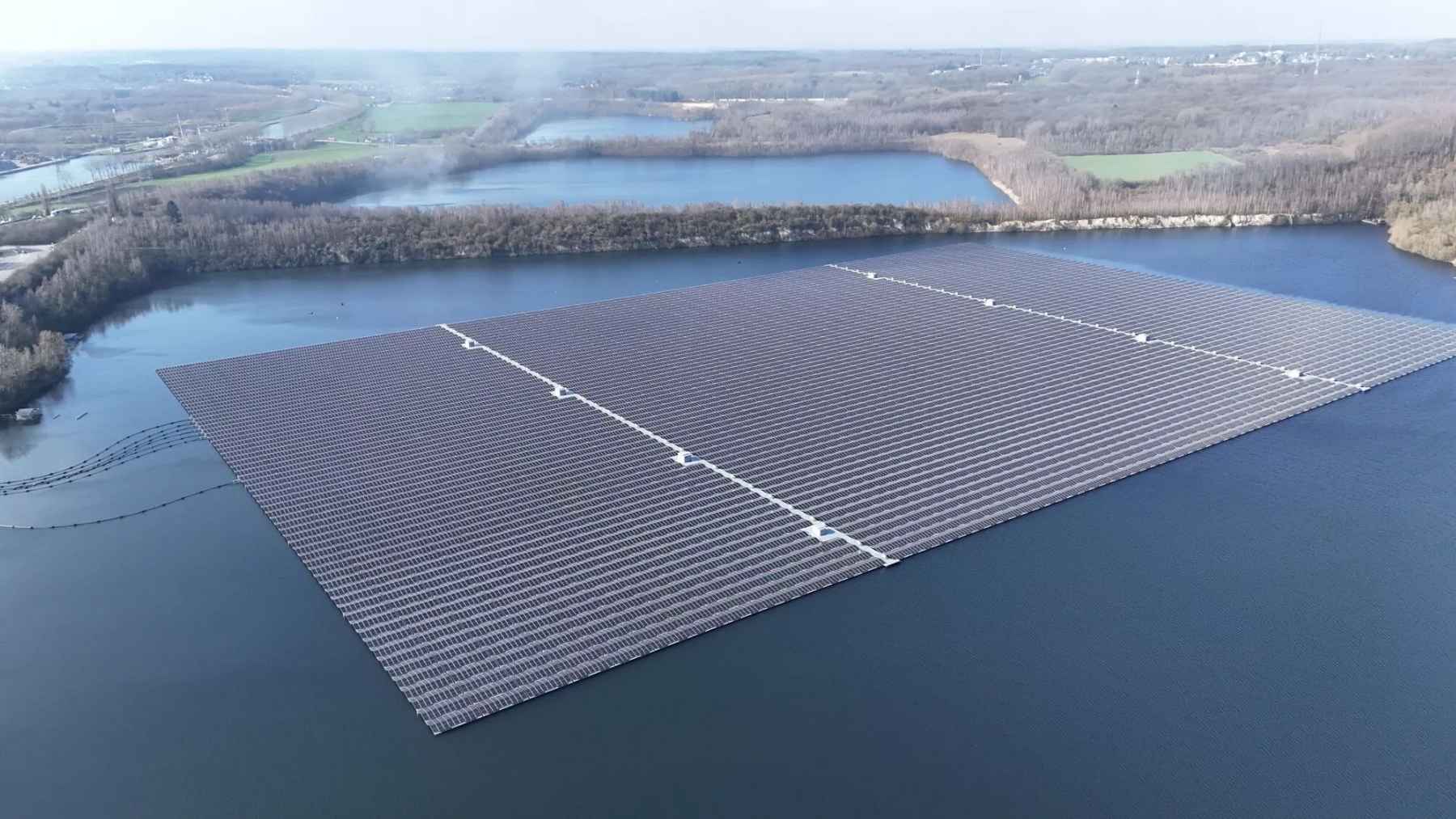
The field sits at Corenne, in Belgium’s Namur province, on grass owned by Calcaires de Florennes, the company that runs the quarry. A Belgian solar outfit called etherr.a built it: 3,240 bifacial panels rated at 700 watts each, 2.27 megawatts combined, spread over 8.2 acres (3.3 hectares) of pasture. L’Avenir covered the opening, and the Belga agency’s figures put annual production at 2.33 gigawatt-hours, roughly what 225 households use in a year.
Bifacial, by the way, just means the panels catch light on both faces. The front takes direct sun, and the back works off whatever bounces up from the grass.
So what does a limestone quarry want with 50 sheep?
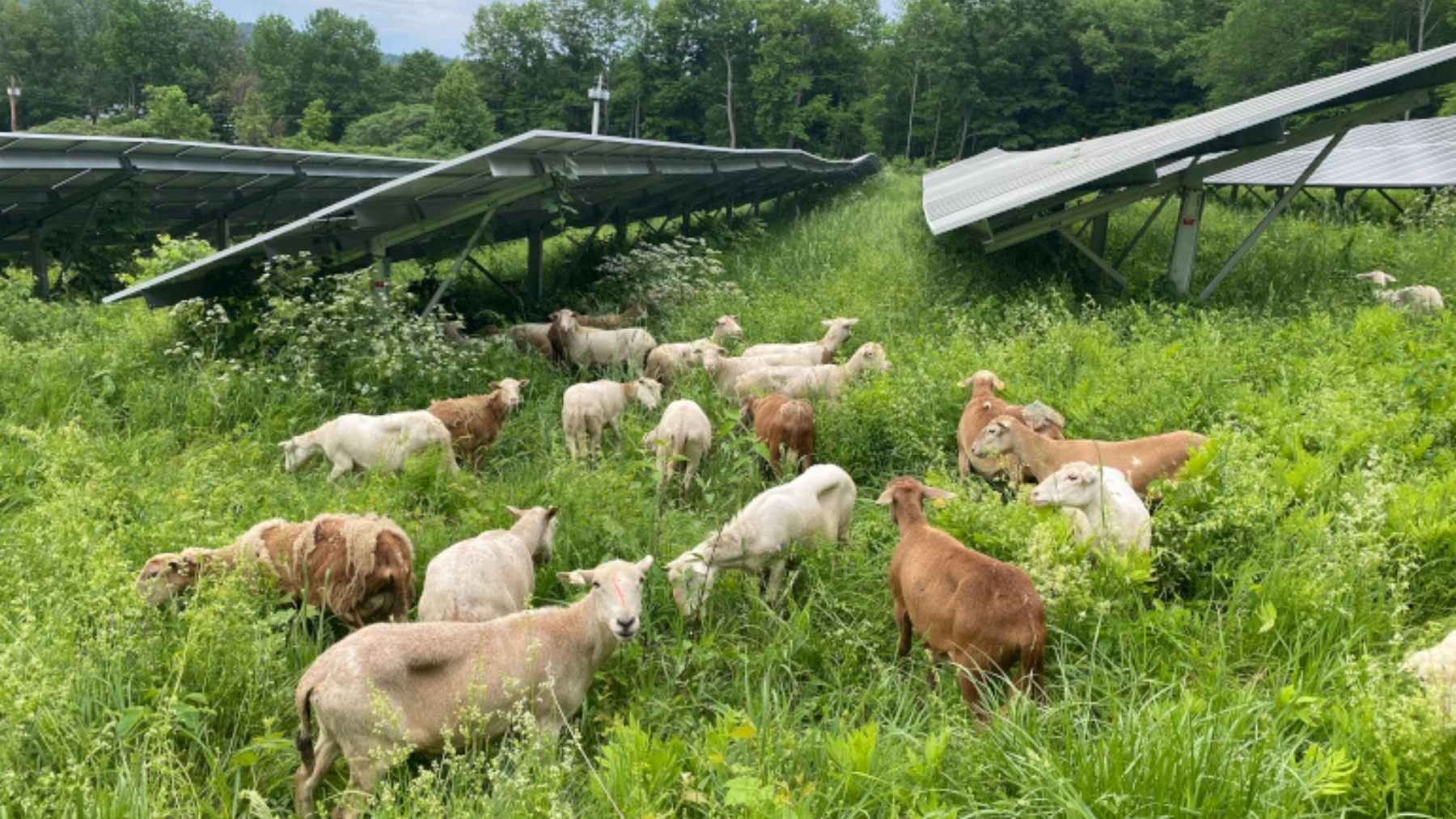
The short answer is that the sheep aren’t really the quarry’s. Around 50 ewes come over from Ferme du Grand Bois, a farm in nearby Gerpinnes, and graze the field in rotation across three fenced paddocks. The panels stand high enough for them to walk under, the rows sit 20 feet apart, and the partners say the animals get shade in summer, shelter in bad weather, and grass that keeps its moisture longer because the shaded ground loses less to evaporation.
That’s the pitch, anyway.
The setup’s called agrivoltaics, if you haven’t run into the term: one piece of land doing farming and power generation at once, instead of picking a side. Raise the panels and space the rows, and the ground underneath stays a working pasture rather than turning into gravel and cable trays. It’s the same idea behind the 74,064 panels standing over a farm at Berlin’s airport, and behind the 378 vertical panels planted in a cattle pasture we wrote about earlier.
I’ll flag one thing, though. As far as I can tell, nobody’s published a single measurement from Corenne on what the panels actually do for the grass or the ewes. The shade and soil moisture benefits are the partners describing how agrivoltaics is supposed to work, and they’re plausible, but that’s a description, not data from this field.
The field’s been running since June 2025
One detail made me look twice: the ribbon got cut on September 18, 2026, and the field’s been making power since June 2025. The party came about 15 months after somebody flipped the switch.
So what took so long?
Nobody’s said why they waited, and my guess is calendars rather than anything interesting. Ceremonies like this one tend to happen when the schedules of a mayor, a chairman and a general manager finally line up. The years before the switch were the slow part anyway: etherr.a got a ministerial no in 2022, won its appeal at Belgium’s Council of State in 2023, and once crews broke ground in spring 2025, the field was producing by June. That works out to roughly four years of paperwork and one spring of actual construction, which frankly feels about right for Europe.
Crushing rock takes more electricity than you’d think
Calcaires de Florennes pulls the limestone out of the ground, then crushes it, screens it and ships it, and every step of that runs on power. Daniel Gauthier, the quarry’s owner and chairman, told L’Avenir the field will cover 40 to 50% of the company’s energy needs.
I ran that math backwards, because the announcements give you the households number and leave the quarry’s own bill alone. If 2.33 gigawatt-hours covers somewhere between 40 and 50% of it, the quarry burns around 5 gigawatt-hours a year, give or take. That’s the annual electricity of roughly 450 to 560 households, going into turning big rocks into smaller rocks. Cement plants play the same game on a bigger board, like the cement plant that floated solar panels on its own flooded quarry.
Whatever the panels make and the crushers don’t take gets sold onto the public grid, and the partners say that surplus could eventually feed a local renewable energy community, a Belgian arrangement where people nearby buy power produced in their own backyard. Pierre de Liedekerke, etherr.a’s general manager, put the cost of the whole installation at about 1.8 million euros, right around $2 million.
A second field already has its permit
The Corenne array’s designed for a 30-year run, and Renouvelle, the Walloon renewables association’s magazine, notes the whole thing’s fully reversible and comes with about 2,000 feet (600 meters) of freshly planted hedges to prop up local biodiversity. The sheep presumably appreciate those too.
And if you’re wondering whether this stays a one-off, it doesn’t. De Liedekerke says the permit for a second field of 2,000 kilowatts is already in hand, on the south side of the extraction pit, batteries are in the plans as well, and the whole package should be operational in 2027.