
If you farm in the US right now, you have probably had the conversation. Somebody wants to lease your acreage for solar panels, or somebody wants to buy it outright and put a data center on it. In early 2024, more than half the farmers who discussed a solar lease were offered $1,000 an acre per year or better, according to the Purdue University-CME Group Ag Economy Barometer, which frequently beats what the crop on that same ground returns.
The catch is that the field usually stops being a field.
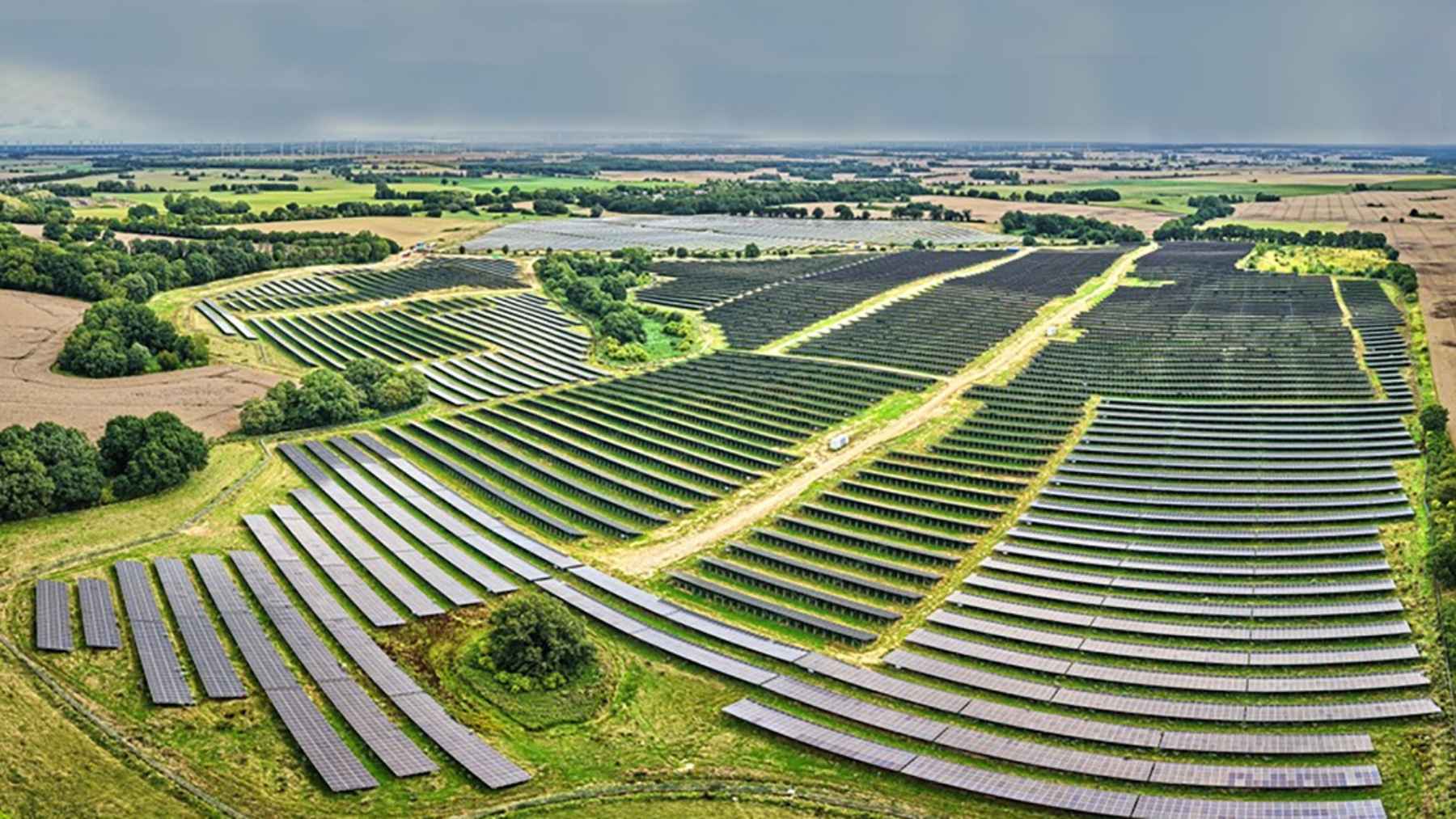
Germany built the version where it doesn’t. In Tützpatz, in the Mecklenburg Lake District of Mecklenburg-Western Pomerania, the Swedish utility Vattenfall stood 146,000 solar panels across 230 acres (93 hectares) and put laying hens and a four-crop rotation underneath them. Rated output is 76 megawatts. It went into commercial service on September 10, 2025, and it was built without a cent of government support.
The interesting part is not the panel count. It is that German rules would not let Vattenfall call this a farm unless the farming actually kept working.
German law puts a number on what counts as a farm
Every solar developer on earth says their project is compatible with agriculture. Germany got tired of hearing it and wrote down a threshold.
The document is DIN SPEC 91434, published in April 2021. It says that after you build the array, the land has to still produce at least 66% of its reference agricultural yield. Miss that, and what you have is a solar farm with livestock as an alibi.
It also splits agrivoltaics into two categories, and the split is the whole reason people argue about which German project is biggest. Category I is overhead: panels lifted more than 2.1 meters (about 7 feet) clear, crops growing directly beneath the glass, and no more than 10% of the site lost to structures. Category II is interspace: panels at conventional height with the rows pulled far enough apart to farm between them, and up to 15% land loss allowed.
Tützpatz is the second kind, built at scale. Most of the agrivoltaic projects that make good photographs are the first kind, built small.
One more thing worth knowing. DIN SPEC 91434 is a pre-standard, not a binding law on its own. It only acquires legal teeth where legislation points at it, which German renewables law does when subsidies are involved. Vattenfall took no subsidies here, so the specification functioned as the industry yardstick rather than a condition of payment.
146,000 panels, split three ways
Tützpatz is not one array. It is three, each engineered around a different kind of farming, which is why the site works as an argument rather than just a power station.
Tützpatz 1 is the livestock section: 43.3 MW across 117 acres (47.5 hectares), with modules on fixed racking from Portuguese manufacturer Pradecon, set at 11 and 25 degrees. Six mobile chicken coops are planned for it, each holding up to 2,500 birds. That is 15,000 laying hens, in movable housing, rotating around the posts.
Tützpatz 2 and 3 are the arable sections, 13.3 MW on 53 acres and 19.4 MW on 59 acres respectively. Both use single-axis Schletter trackers, and this is the clever bit. The modules sit on a longitudinal axis and tilt east to west out of horizontal, so at planting and harvest they rotate toward vertical and open a corridor for a combine. The row gaps are wider than a conventional plant would ever bother with, purely so the machinery fits.
The panels themselves are bifacial 550 W modules from Chinese manufacturer GCL. Power reaches the grid through 240 Sungrow SG250 HX string inverters and into the regional network run by E.DIS Netz GmbH. Vattenfall puts avoided emissions at roughly 25,000 metric tons of CO2 a year, on 2024 figures.
Deutsche Telekom is the reason it got built without a subsidy
Vattenfall did not fund 76 megawatts on optimism. It signed a power purchase agreement with Power and Air Condition Solution Management GmbH, or PASM, a wholly owned subsidiary of Deutsche Telekom AG. PASM takes the entire output for ten years.
What Telekom gets is cell towers running on contracted solar. PASM managing director Bernd Schulte-Sprenger put the arithmetic at roughly 4,600 mobile sites covered annually, out of about 35,000 the company operates. So this park handles something in the region of 13% of Telekom’s German tower fleet, and the utility got a decade of predictable revenue in exchange.
Then there was the grid problem, which almost nobody reports and which nearly defines the project. There was no suitable connection point anywhere near Tützpatz, and the local high-voltage network was already close to full. So a 110 kV substation was built from scratch in the neighboring village of Breesen just to get the power out. A battery is planned alongside it, and pv magazine reports a 50.4 MW / 109 MWh system slated for 2027.
If you have ever wondered why big renewables projects take four years, that substation is your answer. The panels were never the hard part.
The project got smaller between the announcement and the ribbon
Here is the sort of detail that gets lost when a project recirculates as a headline. Tützpatz did not arrive the size it was promised.
When Vattenfall announced construction in September 2023, the release said 79 MW peak, intended agricultural use listed as organic free-range eggs, and completion in 2024. What actually got commissioned was 76 MWp, described as conventional laying-hen housing plus a four-crop rotation, switched on in September 2025.
Three megawatts and a year, which in utility-scale solar is a rounding error and a rough Tuesday. Vattenfall’s solar chief Claus Wattendrup acknowledged as much at the opening, saying the team had delivered the project “despite some hurdles.” Planning had been running since 2017.
The stranger drift is in the Telekom number. The 2023 release said the plant would cover about 2,500 mobile phone stations a year. The 2025 release said 4,600. Neither company has published a reconciliation, and the honest reading is that the assumption about consumption per tower changed somewhere in those two years, not that the park got more productive while losing 3 MW.
Germany can’t agree on which one is actually the biggest
Search for Germany’s largest agrivoltaic plant and you will get two different answers, both defensible, which is exactly what the Category I and II split predicts.
Vattenfall’s claim is specific and worth reading closely: the largest ground-mounted solar project in Germany combining generation with arable farming and animal husbandry. That is a Category II interspace claim, and at 76 MW it is not close.
The rival sits in Schlier, Baden-Württemberg, where developer Solmotion built about 10 MW across 14 hectares at three locations, energized in April 2024 and opened that July by state agriculture minister Peter Hauk. Schlier is overhead Category I, panels lifted high with roughly 11 meters between rows and crops growing directly underneath. For that architecture, it is the biggest commercial installation in the country.
Local reporting at the time added the number that puts the sector in perspective: that single 10 MW plant represented around 40% of all agrivoltaic capacity installed in Germany. So when Tützpatz switched on with 76 MW, it did not join a mature industry so much as double it.
American counties are already writing this into their zoning
The reason any of this should interest a US reader is that the fight over farmland here has gotten sharper than the fight over farmland there.
There are 1,214 operating data centers in the United States drawing a combined 57,431 MW, according to market intelligence firm Cleanview, with 1,788 more projects planned that would add 366,278 MW. The Wisconsin Farm Bureau Federation notes that a large data center can want upwards of 1,000 acres. The USDA counts 354 counties as farming-dependent, and pv magazine USA reported on August 18 that ten of them have now banned data centers outright.
Against that, the American Farmland Trust puts agrivoltaics at under 5% of installed US solar capacity. Most of what does exist is pollinator habitat and sheep grazing rather than row crops, which is a considerably lower bar than making a combine work around a tracker.
A handful of counties have started doing what Germany did, which is to make the farming a condition instead of a talking point. Chaffee County, Colorado permits solar above 20 acres on working farmland only where the design keeps agriculture underneath. Montour County, Pennsylvania restricts building on its best soils without it. Delta County, Colorado approved the 80 MW Garnet Mesa project after sheep grazing and irrigation were written into the plan. Virginia recently passed legislation establishing a formal state definition of agrivoltaics.
None of those carry a number like 66%. That is the gap.
We have covered plenty of the elegant small stuff. A Bavarian hop grower mounted panels 23 feet up on his trellis poles and learned that hops climb until they hit glass. A Rhineland orchard has been ripening apples 10 to 12 days late for five years under 1,148 modules. Volkswagen keeps 50 sheep and a guard donkey on its Chattanooga array, and a Calgary site added pigs, chickens and beehives under 109,000 panels.
Those are experiments, and good ones. Tützpatz is what the experiment looks like once a telecom company is contractually obliged to buy the output for ten years and no subsidy is underwriting the mistake.
What it has not proven yet is the harvest. The crop rotation and the hen houses appear in Vattenfall’s own materials as planned use, and the company has not published yield data from under the trackers. The 66% threshold is a specification, not a receipt. Until somebody weighs what comes off those 45.5 hectares and puts the number next to a control field, the honest claim is narrower: the site was engineered to keep farming, and the machinery clears the rows.
Which is still more than most 230-acre solar developments can say. The panels are the easy half. Getting a combine through them, and getting the power off a network that was already full, is where these things are actually won.