
When you think of an offshore oil platform, you probably think of something permanent. A steel tower sticking up out of the sea, a flare burning off the top, and a helipad for the people who live and work out there.
Eventually, though, someone has to come and take it away. North Cormorant spent 42 years pumping oil out of the North Sea off Scotland’s Shetland Islands. Its turn came on a Friday afternoon in late August.
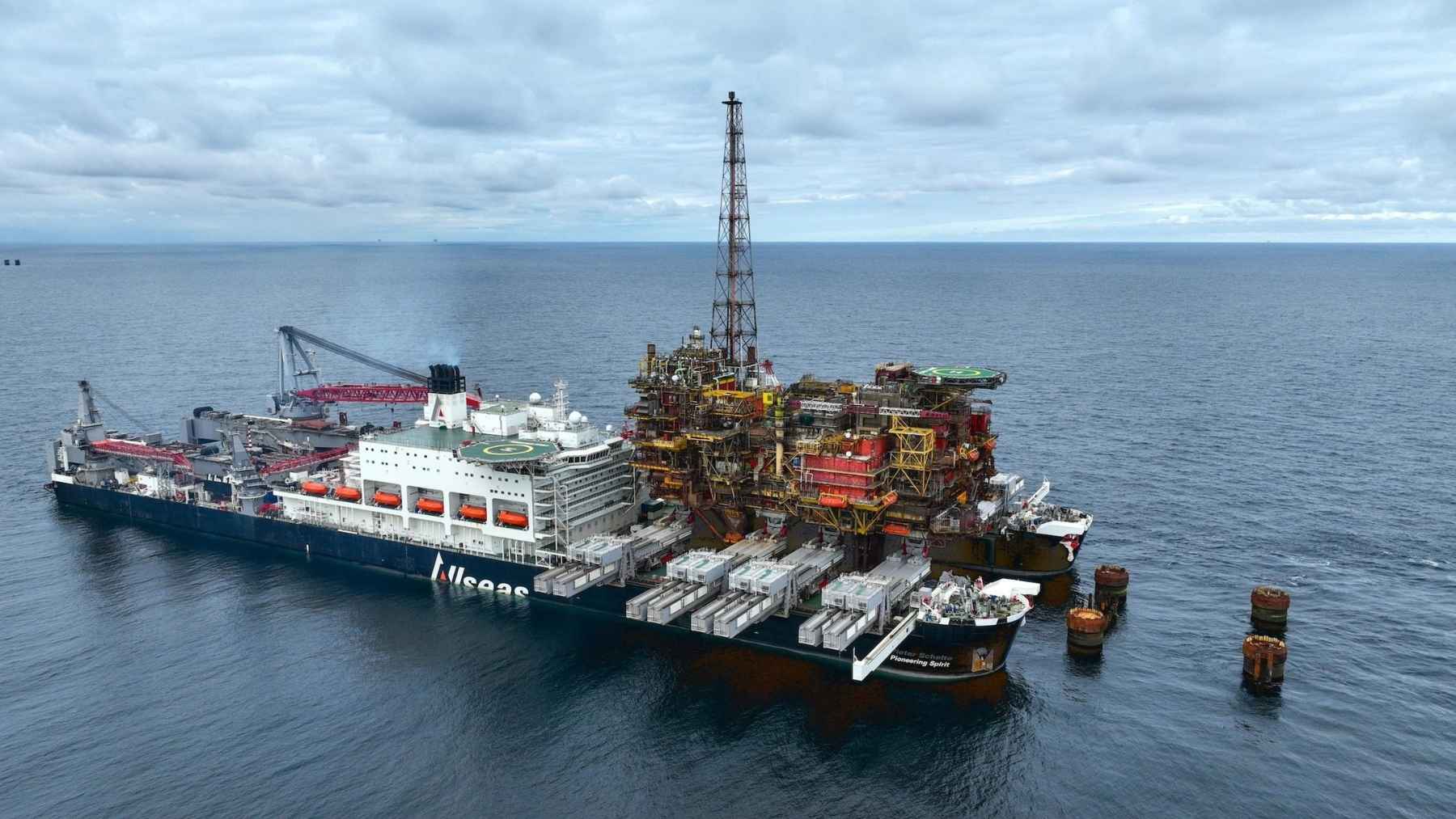
That’s when Pioneering Spirit, the ship we dug into back in June, picked the platform’s entire deck up off its legs in one go. Allseas, the company that owns the ship, puts that deck at about 19,000 tons. Its project manager on the job, Jeroen van der Sman, said the removal took “a matter of hours” in an announcement from TAQA, the company that ran North Cormorant. The port authority in Lerwick, Shetland’s main town, announced the ship’s arrival the next morning, Saturday, August 22.
Quick translation, since the oil business has its own words for everything. What I’ve been calling the deck, the industry calls the topsides. On North Cormorant, that meant a stack of modules holding the wellheads, the processing plant, a drilling derrick, the living quarters and a helipad, according to the operator’s decommissioning plan. The legs are called the jacket, and here that’s eight steel legs braced together into one big frame and pinned to the seabed.
So how do you pick up a 19,000-ton deck?
Not with a crane. Crane ships, like the Thialf we covered last month, hang whatever they’re lifting off hooks. Pioneering Spirit works more like a car jack. It gets underneath the load and pushes up.
The ship’s basically a giant catamaran, 1,253 feet long, with a slot 194 feet wide cut into its bow. It moves in until the platform’s legs are sitting inside that slot. Then it slides its steel lifting beams under the deck and takes on or pumps out seawater to get the height right.
Once everything’s lined up, the beams take the deck’s weight a little at a time. The last move is a hydraulic lift of about 13 feet that’s over in seconds, according to Allseas. Speed matters because the ship moves with the waves and the legs don’t, and you don’t want the deck bouncing back down onto them.
Those few seconds are what ends up on video. Getting to them took four months, with crews working off a second construction ship called Oceanic. They disconnected the conductors and risers (the big pipes running from the deck down to the wells and the seabed pipelines), added lift points, reworked parts of the structure, tied the modules down for the trip and finally cut the deck loose from its jacket.
Van der Sman also pointed out that the lift came ten years to the month after Pioneering Spirit’s very first one. Which, I suppose, makes North Cormorant’s deck a pretty heavy anniversary present.
So how heavy is it, exactly?
It depends on who you ask. TAQA says more than 18,700 tons, while the ship’s owner and the port authority say about 19,000. The deck came in at about 17,800 tons in the decommissioning plan, though. My guess is the gap comes from the steel that went on during all that prep, but I couldn’t find anyone who’s broken it down.
The deck’s getting cut up in Shetland
Most ports can’t take a ship as big as Pioneering Spirit, so it often hands a deck off to a barge for the last stretch. That’s how North Cormorant’s deck made it to Dales Voe, the port’s decommissioning base. TAQA said on August 27 that it was safely ashore.
It’s also the largest structure the port has ever taken in for decommissioning, beating the 15,700-ton deck from another North Sea platform, Ninian Northern. Brown & Mason is running the teardown with Peterson Energies, and the port expects the work to take about 18 months. The company says it’s confident it can get at least 97% of the deck reused or recycled.
That number’s still a goal, though. And the deck isn’t exactly clean scrap. The plan lists about 680 tons of hazardous waste aboard, paint included, and some of that paint is lead-based. Asbestos turned up in surveys, too. Still, Allseas says the yard in northeast England that handled Shell’s earlier Brent decks has recycled 98% of their material, so 97% doesn’t sound crazy to me.
If you’re wondering what all this costs, so am I. TAQA gave its cost estimates to the British regulator in confidence, and the public version of the plan just says so.
So what happens to the legs?
As far as I can tell, they’re still standing. North Cormorant’s jacket is 564 feet tall in 528 feet of water, so the top of it still sticks up out of the sea. Navigation aids have to stay on that stump so other boats don’t run into it.
The frame weighs about 22,100 tons, and that’s before you count the piles holding it down or everything that’s grown on it. TAQA’s plan for the jacket spells out why it can’t come up in one piece. Lifted whole, it’s too tall to haul out of the sea and stand upright on a barge, and it can’t hold its own weight lying on its side. So the plan splits it in two. The top section comes off first, everything from the stump down to 381 feet below the surface. The bottom section, known as the footings, could stay on the seabed for good.
That can happen under OSPAR, the treaty that sets the rules for this stuff in the northeast Atlantic. It lets the owners of steel jackets heavier than about 11,000 tons apply to leave the footings in place, and North Cormorant’s frame qualifies as a candidate, according to the plan. The footings will get a plan of their own later.
The Scottish Fishermen’s Federation flagged the obvious catch during consultation: once the top section is gone, there’s nothing sticking out of the water to warn a trawler. The plan’s answer is to mark the footings on official British nautical charts and in FishSAFE, the hazard-mapping system fishing boats use.
Fun detail from the same document: two of the legs doubled as diesel tanks, and four held drinking water. That’s a pretty efficient use of a hollow leg.
Figures: Allseas, TAQA, Offshore magazine. Converted to U.S. tons.
The ship’s been upgraded for bigger decks
Pioneering Spirit was partway through an upgrade when we looked at it in June, and that’s now in place. Offshore magazine reported in late September that its deck-lifting system has been upgraded to handle about 66,100 tons, up from 52,900, with Equinor’s Statfjord A in mind. That’s a huge platform with concrete legs in the Norwegian North Sea, and the lift is expected to rank among the heaviest of its kind ever attempted.
What I couldn’t pin down is whether the final load test on the whole system, last penciled in for late 2026 or early 2027, has happened yet. That strikes me as a pretty sensible thing to nail down before you go pick up one of the biggest platforms in the North Sea.
As for North Cormorant, its legs are next in line. TAQA’s plan has the top section of that frame, about 13,800 tons of steel and sea life, coming out of the North Sea by the end of 2027.