
If you’ve driven I-25 between Denver and Colorado Springs, you know the stretch. It’s the 18 miles between Castle Rock and Monument where the subdivisions run out and the ranchland starts, the stretch everyone calls the Gap, and for a long time its claim to fame was the deer on the shoulder. A Colorado Parks and Wildlife biologist put the old rate at about one deer hit a day during the spring and fall migrations, on a road that carries more than 100,000 vehicles a day.
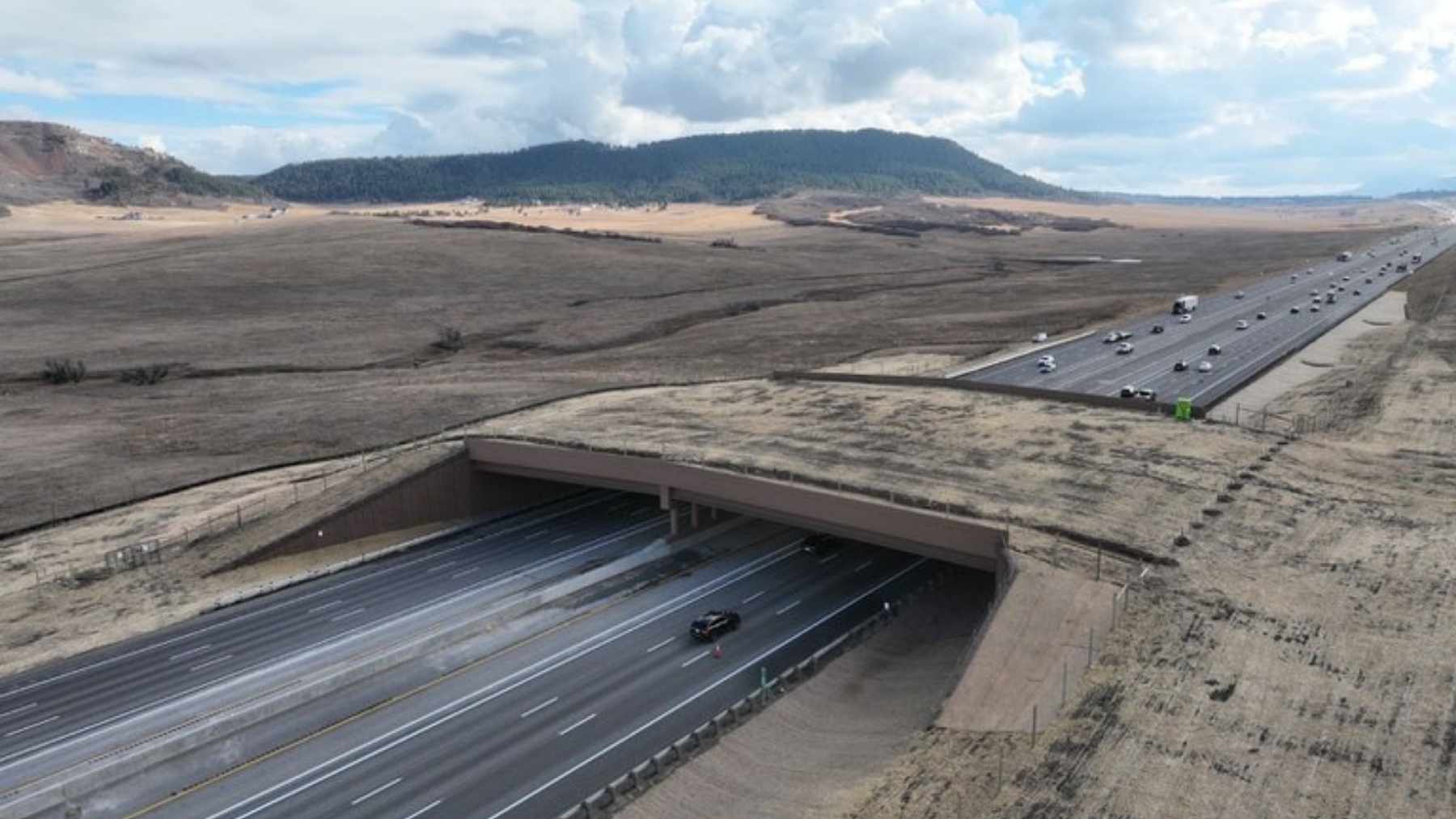
So Colorado built the animals a bridge. Not a culvert, not a tunnel, an actual bridge over all six lanes, with dirt on top instead of asphalt. It opened last December, and the state has now had the better part of a year to find out whether anything would bother to use it.
Something did. Quite a lot of somethings, from the looks of the trail cameras.
So how many crashes are we talking about?
Two. The Colorado Sun reported on October 14 that in the roughly 10 months since the overpass opened, drivers on that stretch have hit two animals, according to state wildlife managers and transportation officials, who call it a 91 percent drop. Governor Jared Polis used the same 91 percent in a September 22 post.
Now, a bit of honesty about that number, because it’s doing two jobs at once. The bridge is the last piece of a bigger system. When the state widened this part of I-25 in a project that started in 2018, it built five wildlife underpasses and ran 14 miles of fencing down each side of the interstate at the same time. A state-commissioned study, which Colorado Politics reported on September 28, looked at crash data from 2022 through 2024, when the underpasses and fences were in but the overpass wasn’t. Before any of it went in, the stretch averaged 32 reported wildlife crashes a year, and the study says those get underreported, so the real figure was higher. With the tunnels and fences alone, wildlife crashes dropped about 85 percent a year on average and 91 percent in the last year of the study. Crashes of every kind fell 20 percent, though the study credits the rebuilt road for part of that.
So what did the $15 million bridge add?
Elk don’t do tunnels
The short answer is elk and pronghorn, which are the two animals the whole thing was designed around. Mule deer, bears and coyotes will use an underpass without much fuss. Elk, as a rule, won’t walk into a concrete box they can’t see out of, partly because of the antlers and partly because an animal that stays alive by spotting a mountain lion from a long way off doesn’t like dark places with one exit. Pronghorn are even pickier. They’re the fastest animal on the continent and they can’t jump a fence, which is why a six-foot solar farm fence stops them cold while a whitetail hops it without breaking stride.
For those two, the Colorado Department of Transportation needed something they’d actually walk across: wide, open, sightlines in every direction and grass underfoot. That’s the entire design brief, and it’s basically what you’d build if you asked an elk.
So what did they build?
The Greenland overpass, named for the interchange next to it, is 200 feet wide and 209 feet long, which works out to just under an acre of bridge deck. It crosses all six lanes at mile point 165 between Larkspur and Monument, and it plugs a 3.7-mile hole in the crossing system that the underpasses never covered. Kraemer North America built it between January and December of last year. CDOT’s project page lists the construction cost at $15 million, and Chuck Attardo, the agency’s environmental manager, told CBS Colorado the state had $22 million in federal money and $8 million of its own lined up before the contractor came in at 15. CDOT says it’s the largest wildlife overpass in North America, for now.
Up top, instead of a road surface, there’s a layer of dirt with the beginnings of native grass, a low berm of brush running along it so small animals can cross without a hawk picking them off, and piles of wood laid out as a sort of covered walkway for mice and frogs. One of those mice, the Preble’s meadow jumping mouse, is federally threatened, which tells you how seriously the biologists took the small stuff.
The grass hasn’t cooperated, frankly. This year’s drought killed off a lot of the germination, and CDOT says it’ll haul in fresh topsoil and try again next year. The animals apparently don’t mind. Four cameras on the structure have caught elk herds, pronghorn, mule deer, black bears, mountain lions and coyotes using it anyway.
The elk showed up in June
CDOT posted the first video in June, three elk walking across the deck, and the Denver Gazette picked it up on June 20. By July the cameras were catching whole herds. The pronghorn were the bigger deal to the people who built the thing, though. Collar studies had tracked pronghorn walking north along the interstate for years looking for somewhere to get across, then turning back, according to Axios Denver. Attardo told CBS Colorado the agency now has pronghorn on camera reaching the west side of I-25 for the first time in decades, and summed up the footage in five words: “Based on the video feed that we’re collecting, huge success.”
Why does any of this matter beyond the crash count? Because for decades the interstate, which dates to the 1950s through here, split the elk into an east herd and a west herd that couldn’t breed with each other. Julia Kintsch, the principal investigator on the state’s overpass study, has been collecting elk droppings on both sides to build a genetic baseline, and in five to 10 years her team will sample again to see whether the two herds have started mixing. “That is a really promising sign,” she told Colorado Politics of the elk and pronghorn on camera.
Animals don’t always take the hint, either. In Banff, up in Canada, the grizzlies and wolves took years to warm up to the overpasses there. Colorado’s elk took six months.
Does it pay for itself?
Attardo’s math is that a crossing like this pays for itself in about 15 years through the crashes it prevents, and I don’t think that’s a stretch. A wildlife collision isn’t just a dead animal. It’s a tow truck, a state trooper parked on the shoulder for an hour, a lane closed on a road with 100,000 cars on it, and sometimes a person in the hospital. Spread 15 years of that across two counties and $15 million starts to look pretty reasonable.
Colorado seems to agree. A state law the legislature recently passed puts something like $3 million a year toward crossings, which Attardo admits isn’t big money on its own but works as the matching funds you need to go after the federal grants. CDOT’s wish list already has I-25 at Raton Pass on the New Mexico line, US 40 near Empire, Vail Pass and a stretch of US 287 near Fort Collins on it. Oregon, meanwhile, is still arguing over whether a 600-foot gap in a solar farm fence counts as an elk corridor, so Colorado is arguably a few years ahead of the field.
What I can’t tell you is how much of that 91 percent is the bridge and how much is the fences and tunnels that were already doing the job, and from what CDOT has published, nobody can yet. Colorado Politics reported that the overpass may not move the crash number much beyond what the underpasses already did. Its job is the elk and the pronghorn, and the camera footage is the only report card so far.
And the Greenland bridge won’t be the biggest for long. The Wallis Annenberg crossing over 10 lanes of U.S. 101 outside Los Angeles, about 210 feet long and 174 feet wide, is due to open this winter, and the California Department of Transportation has it taking the title when it does. Colorado gets to hold it for roughly a year. Which, for a dirt bridge, isn’t a bad run.
CDOT says it’ll bring in new topsoil for the deck next year, and Kintsch’s team expects the first results from the genetics study in spring 2027.