
Every deep-sea documentary has the same scene. A submarine’s lights swing across a black chimney on the seafloor, superheated water shimmers out of the top, a narrator says something about the origin of life, and that’s it. Nobody ever tries to plug anything into the chimney. Well, a Seattle startup just did, 300 miles off the Oregon coast, and the result was a power plant that ran for about nine seconds and then tripped its own battery protection.
The company is Endurance Energy, which isn’t even two years old and run by a former SpaceX engineer named Andrew Redd. In its October 19 announcement, Endurance says that on September 27 its 3-ton test plant, called Adélie, generated more electricity than it consumed while sitting on Axial Seamount, an active underwater volcano about 5,000 feet down in the Pacific. Redd’s own summary is shorter: “we put a power plant on an active underwater volcano and made power.” The whole thing was run from a room in Seattle over a fiber-optic cable lying on the seabed.
So is nine seconds a big deal or a punchline? Frankly, a bit of both, and I’ll get to why.
So what did they actually do down there?
Two things, and the first one is arguably the bigger story. Over a three-week expedition aboard a research vessel called the Ocean Guardian, Endurance sent a drill down to the floor of the Axial caldera and bored two holes less than two feet apart. Both hit hydrothermal fluid, which is seawater that’s soaked into the volcano, picked up a lot of heat and minerals, and is trying to get back out. The team then cased and cemented the second hole, put a valve on top, and called it a 52-foot geothermal well. After the cement set, the well flowed at 500 degrees Fahrenheit.
If you haven’t spent time around oil rigs, casing and cementing just means sliding a steel pipe into the hole and pumping cement around the outside so the hole doesn’t collapse and the hot fluid comes up the pipe instead of leaking out the sides. It’s the boring, essential part of any well. Doing it with a remotely operated sub at 5,000 feet is apparently a first, and Endurance is claiming the world’s first offshore geothermal well on the strength of it.
The drill itself wasn’t built for this. According to Canary Media, the team modified a Rockhopper geotechnical drill, the kind offshore oil and gas outfits use to pull core samples, and Heatmap reported the crew spent 11 of its 21 days at sea debugging the thing because nobody had ever run it underwater before. We’ve covered the seafloor-drill approach before, with a German rig that ships as a 20-foot container and drills 492 feet into the bottom, and the logic is the same: send the drill down instead of running pipe from a ship.
Two details on the well are pretty telling. The hole’s about two inches across, where oil, gas and onshore geothermal wells typically start with casings 20 to 36 inches across. And Endurance drilled with filtered seawater instead of drilling mud, skipping the chemical cocktail offshore drilling normally uses. The company also says it deliberately drilled away from the vent chimneys and the tubeworms, snails, crabs and bacterial mats that live around them, which seems like a sensible way to avoid a very bad press cycle.
The well worked. It just wasn’t enough.
Here’s where the nine seconds come in. The newly drilled well delivered hot fluid, but Endurance says it was too restrictive to run the plant. The way I read that, a two-inch hole 52 feet deep doesn’t move enough water to spin a turbine. So the team unplugged Adélie from its own well and connected it to a natural vent nearby that was flowing at roughly 538 degrees.
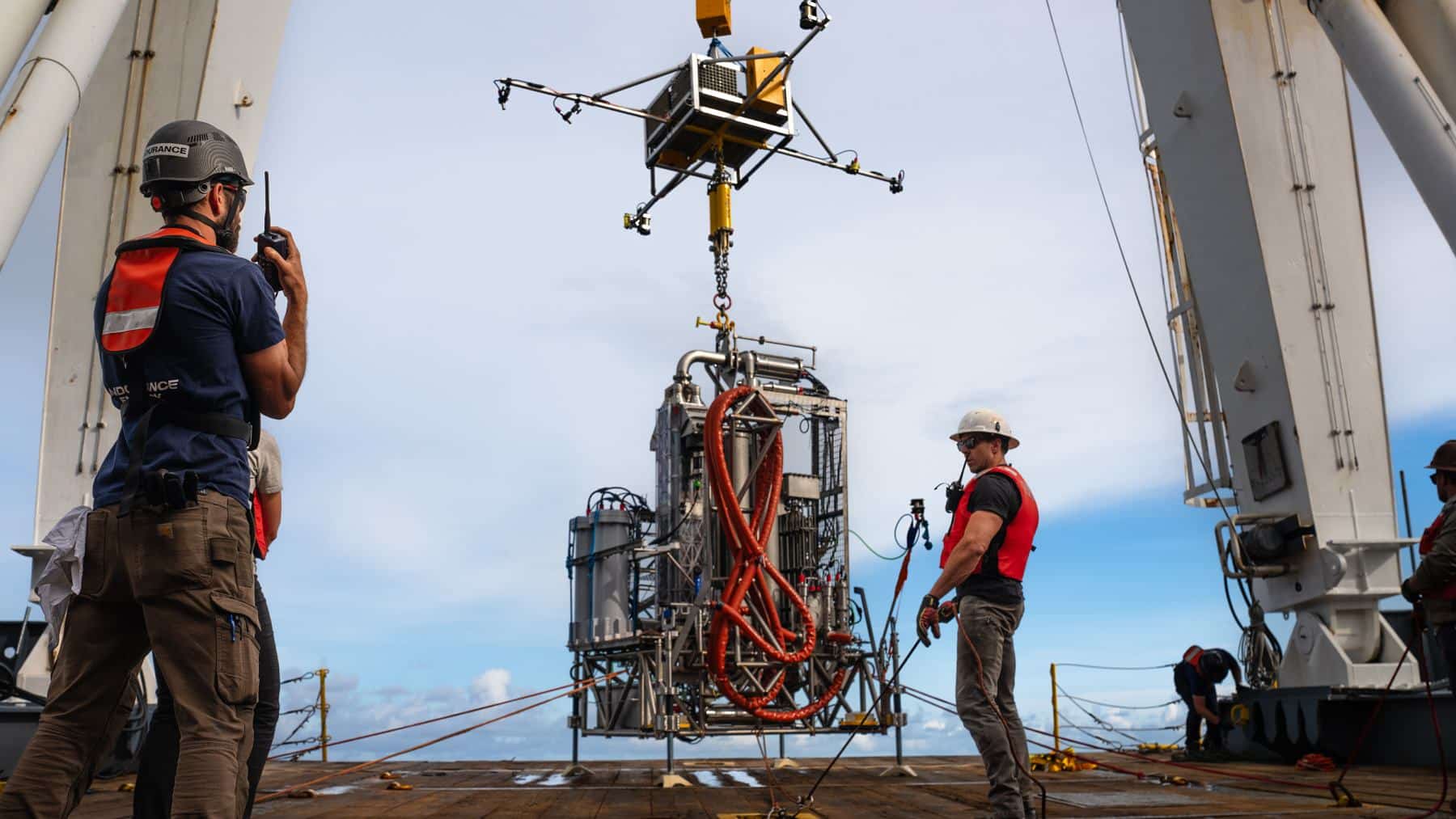
Adélie is a 3-ton titanium unit with a footprint Redd describes as comparable to a passenger car. Inside there’s an organic Rankine cycle system, which is the same basic hardware a lot of land-based geothermal plants use: hot fluid boils a working fluid with a low boiling point, the vapor spins a turbine, and cold water condenses it back for another lap. At 5,000 feet you have unlimited cold seawater on tap and a couple thousand pounds per square inch of pressure doing some of the work for you, which is a big part of why the company thinks it can build these things smaller than their onshore cousins.
On September 27 the turbine hit about 26,000 rpm. Canary Media reports the run lasted about 29 seconds and made roughly 60 watt-hours in total. For 8.7 of those seconds, the plant produced more power than it was using, with a median of about 2 kilowatts net and a peak of 16.5 kilowatts net. Then the battery’s overcurrent protection kicked in and shut it down. About ten minutes later, during a restart, a power cable feeding the refrigerant pump failed, and the dive was over.
Two kilowatts net is about enough to run your hair dryer. For 8.7 seconds.
Now compare that with what Adélie was designed to do. Endurance’s own website still describes it as a planned 100-kilowatt system meant to run for a year inside the Axial caldera, and that’s the number GeekWire was reporting in August before the ship left. So the gap between plan and result is 100 kilowatts versus a 16.5-kilowatt peak, and a year versus 8.7 seconds. Redd’s response is to compare it to Goddard’s first liquid-fueled rocket, which flew for two and a half seconds, and as a line it’s pretty good. Whether it’s the right comparison is a different question.
Endurance hasn’t published the flow rate from either the well or the vent, or how much power the plant was burning on its own pumps and electronics, and without those two numbers you can’t really tell how far 16.5 kilowatts is from what the hardware should do. I’d like to see them.
Why run it from Seattle?
Because Axial Seamount is, as far as I can tell, the one underwater volcano where you can. The National Science Foundation’s Regional Cabled Array, run by the University of Washington, is a fiber-optic and power network laid across the seafloor off Oregon and Washington, and it reaches right into the caldera. Scientists have used it for years to watch the volcano in real time. Endurance plugged into it and got live temperature and flow data in Seattle, plus the ability to send commands back down.
Which means Adélie wasn’t really a remote-control test of subsea geothermal. It was a test at the single most convenient spot in the ocean, and the company is fairly open about that. Redd told ThinkGeoEnergy the drill and the generator repeatedly landed within a few feet of their targets, and that the team recovered, modified, recharged and redeployed Adélie in under 16 hours between dives. That turnaround is the SpaceX habit showing through, and it’s probably the most useful thing the company proved.
The environmental side wasn’t an afterthought, either. Endurance says it mapped the site first, sampled water before and after every operation, filmed the seafloor community on every dive, and checked its own readings against 11 instruments run by outside scientists. The loudest sound anyone recorded was the ship’s engine. More than 40 water, rock and mineral samples are now with independent labs. All of that is self-reported, so treat it accordingly, but it’s more monitoring than most offshore test campaigns bother to publish.
Does any of this pencil out?
You may be wondering why anyone would do this when Nevada is right there. The United States has plenty of hot rock on land, and a Texas company is drilling 10,350-foot wells into an Oregon volcano without getting its feet wet. Redd’s argument is that the heat is far shallower on the seafloor, where the crust is literally pulling apart, and that the offshore oil and wind industries have already paid for most of the subsea hardware he needs.
Not everyone’s convinced. Emily Pope, a geologist and senior fellow at the Center for Climate and Energy Solutions, told Canary Media it’s “an eyebrow-raising approach,” and her point is basically that salt water, pressure and long cables add a huge amount of engineering to a problem that solar panels and batteries already solve for most islands.
I think she’s mostly right about the islands, and mostly right about the cost, at least for the next several years. Where I’d hedge is on the diesel. Tonga runs its grid largely on imported fuel, Endurance has an MOU with the Tongan government, and a 2-megawatt plant that just runs, day and night, would matter there. Whether a company that has produced 60 watt-hours of electricity underwater can deliver 2 megawatts there by 2027 is a question I’m not going to pretend to answer.
Endurance has raised $63 million so far, including a $54 million Series A led by Founders Fund, which is a lot of money for nine seconds and also pretty normal for this kind of bet.
The next unit’s called Gentoo, a rebuilt Adélie with the aim of more power for longer, and Endurance says it goes in the water this winter. The lander drill can already reach 260 feet, five times deeper than the 52-foot well it just finished, and the company expects deeper holes to deliver the flow it was missing. Behind that is Leopard, the 2-megawatt commercial generator, and the Tonga project, which Endurance is targeting for first power in 2027.