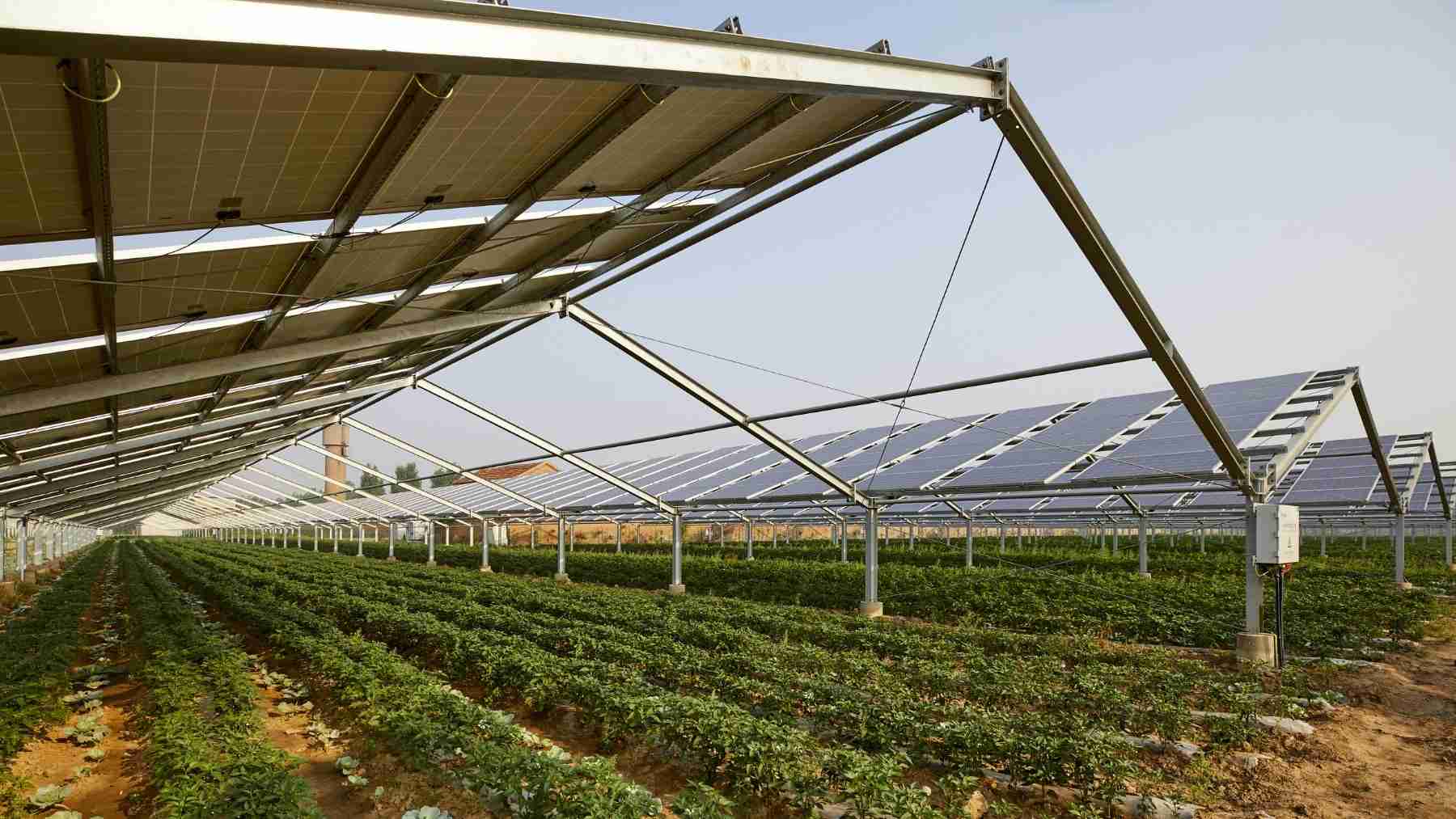

Every time somebody proposes putting solar panels on farmland, the same objection shows up: you can’t eat electricity. Take a field out of production, swap food for kilowatts, and the food loses.
A 2.2-acre field in North Hadley, Massachusetts spent this summer doing both, and it’s finally put a number on the trade. The sweet corn grown underneath the panels came in at about 80 percent of what the open rows next door gave. Same quality ears, according to the farmer. Just fewer of them.
That’s the whole idea behind what the industry calls dual-use, or agrivoltaics if you want the longer word. You raise the panels high enough for a tractor to fit underneath, space the rows out so light still reaches the dirt, and you farm the same ground you’re generating on. Massachusetts has been at this longer than most states, with a dual-use category written into its solar incentive program back in 2018.
The Hadley array belongs to Joe Czajkowski, a third-generation farmer working around 400 acres, and Hyperion Systems out of Belchertown finished building it in July 2023, according to the Energy Department. It runs 832 modules rated at 535 watts apiece. The Energy Department rounds that to a 450-kilowatt array; the farm’s own figure is 445 kilowatts of direct current, off 2.2 acres, or roughly enough for 30 homes. The rows sit 26 feet apart. Twenty-eight tracker motors tilt the panels through the day to follow the sun, and when they’re lying flat they clear the ground by 10 feet.
The money’s coming from four directions at once, which is what makes any of this pencil out. Czajkowski collects lease payments. The town gets about $15,000 in personal property taxes on the hardware. The farm’s electric bill dropped roughly 15 percent. And he still sells the corn. He’s also charging an electric van off the same panels to run produce over to UMass and its dining halls, which is a pretty tidy loop once you think about where that corn ends up.
So is 80 percent a good number?
It is, and here’s why. Nobody’s building one of these expecting the crop to match an open field. UMass Extension’s guidance for farmers says so plainly: you should expect crop yield per acre or electricity per acre to come in lower than if you’d done just one of them on that land, and the point is for the two together to beat either alone. Giving up a fifth of the corn to pick up 445 kilowatts, a rent check and a cheaper power bill is that trade landing on the right side.
What makes Hadley worth your attention is that it’s a measured number off a working field in its fourth season, not a projection in a slide deck. That’s rarer than it ought to be. We’ve written up a lot of these arrays this year and the harvest figure’s almost always the piece nobody has yet. The Spanish olive grove putting 5,150 panels over its trees hasn’t been through a full harvest underneath them. The German orchard that ripens its apples 10 to 12 days late has five years of data and still hasn’t published a yield.
So what does all that shade cost the plant?
Here’s where it gets less comfortable, and Massachusetts happens to hold the best measurement of the cost that anyone’s published.
A UMass Amherst team spent the 2024 season on a commercial bog in Plymouth, roughly 100 miles east of Hadley, watching Howes cranberries grow under fixed panels set 9.8 feet above the vines. Three row spacings produced 30, 35 and 37 percent shade, with an uncovered patch as the control. Sensors went in on June 25 and came out before the bog was harvested on October 3.
Two things happened at once. The vines got more comfortable, holding more water in their leaves as the shade went up and leaking less out of their cell membranes. Electrolyte leakage is basically a measure of how beaten up a plant’s cells are, and it fell as shade increased.
But the plants also did less work. Photosynthesis dropped at every shade level, including the lightest, and fell by as much as 47 percent at the full-red fruit stage under the heaviest. Starch in the vines went from 41.8 milligrams per gram of dry weight in the control to 35.1 at 37 percent shade. Total sugars slid from 66.5 to 63.0. Phenolics, flavonoids and antioxidant activity in the fruit all came down too.
So the vines were less stressed and less productive at the same time, and the authors settled on around 35 percent shade as the workable compromise. They were blunt that one season isn’t enough, and asked for two or three more before anybody starts talking about yield.
Then there’s my favorite detail in the whole paper. Those panels weren’t tracking the sun and weren’t hooked up to the grid yet. The one bog where somebody has carefully measured what shade does to a cranberry was sitting under an array that wasn’t producing a watt.
Those 832 panels went viral over the wrong crop
A social post doing the rounds this summer claimed a Massachusetts farm had raised 832 solar panels 10 feet above its fields and was pulling bigger, juicier, sweeter berries out from underneath.
You already know where 832 came from. It’s the Hadley array, it’s a good 100 miles from cranberry country, and there’s sweet corn under it. Broccoli, lettuce and cilantro have all had turns in that field.
Nobody’s measured whether shade sweetens a cranberry. The Plymouth team tracked sugar and starch in the vines, not sweetness in the berries, and didn’t weigh the harvest at all. A 2026 review of earlier cranberry work found the reverse of what the post claimed, with lower soluble solids and higher acidity under shade.
There is a real cranberry array, and it’s a big one
Ring Road runs across Kingston and Plympton on the south shore, built over working bogs by a developer called Distributed Energy. A presentation the company gave to New Jersey’s Pinelands Commission last year lists 4,433 kilowatts of DC capacity against 2,000 kilowatts AC, a 13,500 kilowatt-hour battery wired on the DC side, and modules standing 10 feet up so the bogs stay workable underneath. It was named a finalist in the 2025 North American Agrivoltaics Awards, and the same presentation says the company is working with UMass on yield, soil compaction and plant biomass.
I can’t find a published harvest number from those bogs, which is the same gap the Plymouth researchers want two more seasons to close.
If you want to build one of these in Massachusetts, you go through the university first. Developers chasing the state’s dual-use designation have to consult UMass Extension before they file with the Department of Energy Resources. That’s an unusual amount of agronomy homework for a power project, and it’s arguably why anybody has crop numbers out of this state at all.
Other growers around the valley aren’t waiting for the research to finish. Sidney Chang of Chang Farms in Whately, which grows bean sprouts indoors year round, spends $15,000 to $18,000 a month on electricity and is moving ahead with an array of his own, on leased ground where other farmers will grow strawberries and asparagus underneath. Jake Marley, who runs Hyperion Systems and built the Hadley array, told the Daily Hampshire Gazette that sweet corn growing under it was “exceeding my wildest expectations”.
Czajkowski’s next crop under the panels is asparagus, which is what Hadley’s known for and which he figures will take to the shade. He laid it all out on August 19 at his own farm, in front of state agriculture and energy staff and a room of other growers, and then everybody ate the sweet corn from under the array, boiled in water heated by the array.
 @jamesmckusker ROOKIE1 month ago