
Everyone in the energy business wants a bigger battery right now. Utilities are buying lithium packs by the acre, grid operators won’t stop talking about evening demand peaks, and you’ve probably seen a rendering of at least one battery farm the size of a small town. But the biggest battery anyone actually knows how to build doesn’t contain a single cell. It’s two lakes, a stack of tunnels, and some very large pumps.
Snowy Hydro, the Australian government-owned utility, has been carving exactly that into the mountains of New South Wales for years, and on September 21 the company announced that crews have started pouring the permanent concrete for the underground power station at the heart of its Snowy 2.0 project. That sounds like a routine construction update. It isn’t. It means the blasting and digging on arguably the hardest piece of the whole scheme is essentially done, and the phase where a 2,200-megawatt machine gets assembled inside a mountain has begun.
So what’s actually down there?
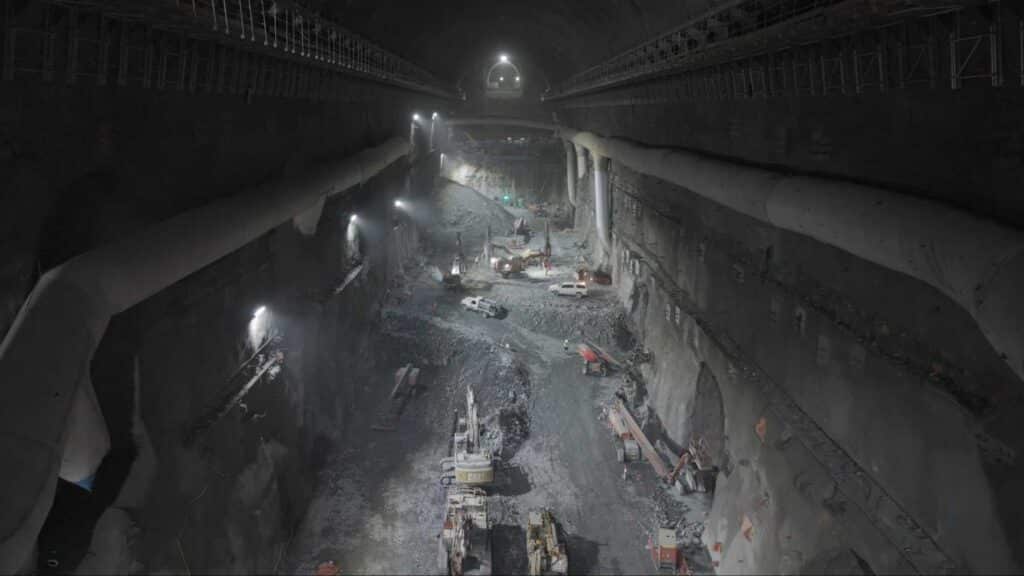
Two caverns, mostly. The machine hall, where the six turbines will live, runs 823 feet long with a ceiling 171 feet up, according to Snowy Hydro’s excavation updates. The transformer hall next door is a 732-foot cavern of its own. Six connector tunnels linking the two are fully excavated, overall cavern excavation is past 90 percent, and the company likes to say the finished complex is the size of the Sydney Opera House. From the looks of the photos, that’s not a marketing stretch.
How deep is it? That’s where I have to hedge, because Snowy Hydro’s own materials don’t quite agree with each other. The project overview says approximately 800 meters underground, which works out to about 2,600 feet, while the new announcement says almost a kilometer. I can’t tell you which figure the surveyors would sign, but either way you’ve got roughly half a mile of mountain overhead, in caverns the company bills as among the widest and deepest ever dug for a power plant.
With the heavy digging wrapping up, the fit-out starts. Crews are installing the first major steel, including inlet valves and spiral casings. If you’ve never seen one, a spiral casing is the snail-shaped steel shell that wraps around a turbine and feeds water into it evenly the whole way around. Over the coming months, workers will place the first of more than 1,400 precast concrete pieces, including the structures that will hold transformers weighing more than 880,000 pounds apiece. The high-voltage transformers are in final testing, more than 5,000 people are on the job, and “fit-out in our underground powerhouses is an extremely precise and detail-oriented process,” as CEO Dennis Barnes put it in the announcement.
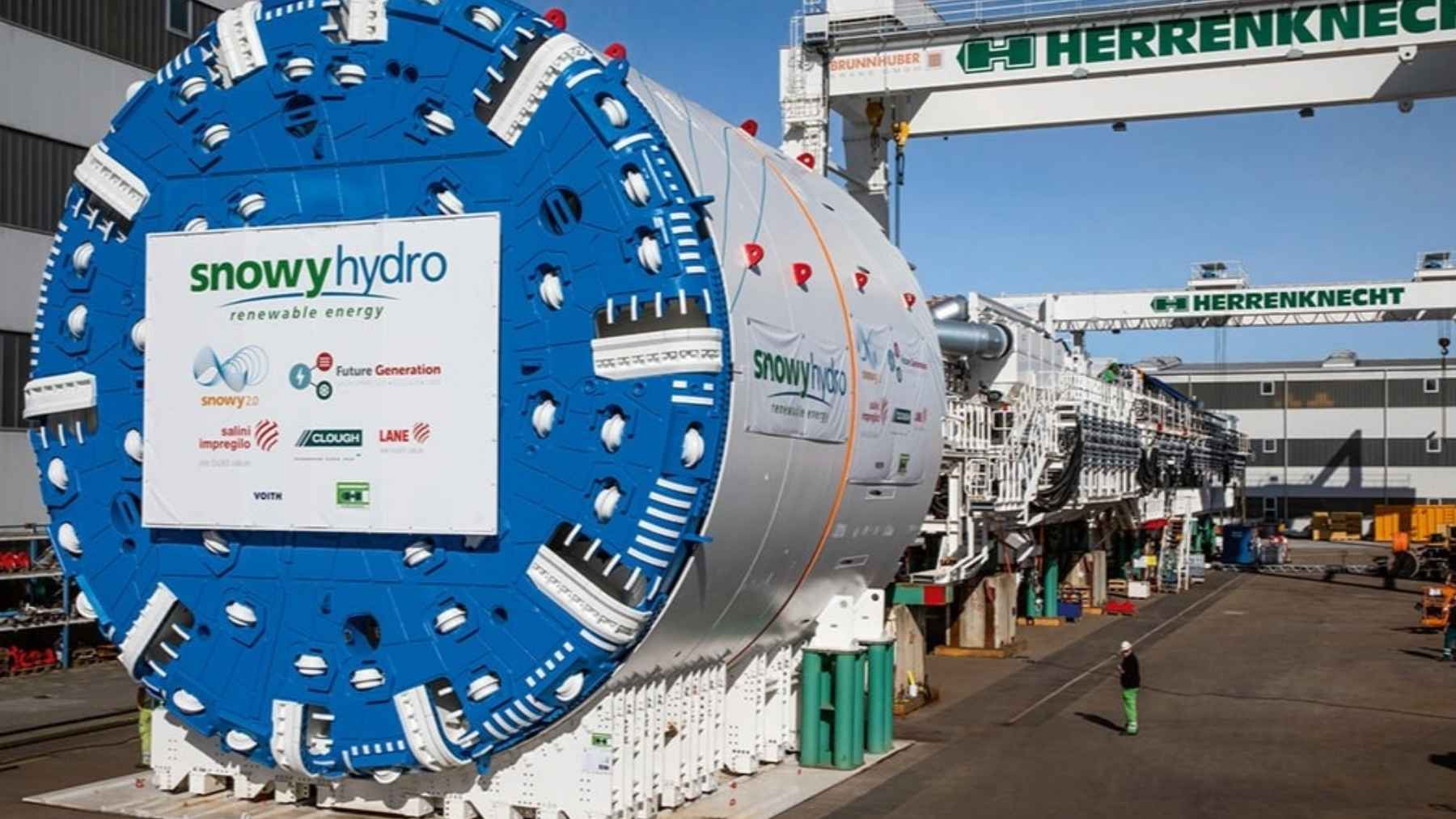
Getting here took some doing. The tunnels feeding this station have eaten years of schedule, enough that Snowy ordered a purpose-built boring machine with a deliberately short shield just to survive the worst fault zone on the route, and another machine, Lady Eileen Hudson, broke through into this same cavern complex after finishing the 3.7-mile tailrace tunnel. On this particular project, anything labeled “permanent” going in counts as a pretty big deal.
The turbines run in both directions
Pumped hydro is about as old-school as grid storage gets, and the whole mechanism fits in two sentences. When the grid has more wind and solar power than it can use, the plant runs its turbines backward as pumps and pushes water from the lower reservoir up to the higher one. When demand spikes, that water falls back through the same machines and spins them as generators. That’s the whole trick, and it’s older than the interstate highway system.
At Snowy 2.0, the machines doing both jobs are six reversible Francis pump-turbines from Voith, the German equipment maker that won the contract back in 2019. Each is rated at 333 megawatts, and three of the six are variable-speed units. All six are now sitting in Australia, waiting on their concrete. And the variable-speed part matters more than it sounds like it should. A fixed-speed unit pumping uphill draws one big block of power, take it or leave it. A variable-speed unit can throttle how hard it pumps, which basically lets grid operators lean on it to steady the system even while it’s charging.
The two reservoirs, Tantangara up top and Talbingo at the bottom, sit about 2,300 feet apart in elevation and get connected by 17 miles of tunnels. Add it all up and you get 2,200 megawatts of on-demand capacity and around 350 gigawatt-hours of storage, which Snowy Hydro says is enough to run 3 million homes for a week. I’ve read a lot of grid storage announcements, and that figure still reads like a typo. It isn’t one.
So what does all this cost?
Here’s where I’d normally give you a clean number, and I can’t. Snowy 2.0 was pitched at AU$2 billion back in 2017, and a 2023 review reset the estimate at around AU$12 billion. Then, in October 2025, Snowy Hydro told its principal contractor, the Future Generation Joint Venture, to reassess the project’s costs, and according to Utility Magazine the company is still weighing the findings as it prepares advice for the Australian government. So if you want today’s official price tag on one of the largest pumped storage projects on the planet, the honest answer is that Snowy hasn’t put one out since the reassessment began.
The concrete, at least, isn’t waiting on the accountants.
Snowy Hydro’s announcement landed on September 21, 2026, and the company’s completion target for Snowy 2.0 still sits at the end of 2028. Between now and then, somebody gets to lower six 333-megawatt machines into a hall the size of an opera house, half a mile inside a mountain. Frankly, I’d watch that on a livestream.