
- 2 MONTHS AGO · MILITARYA Danish drone boat sitting at anchor in the Baltic filmed a 330-foot Russian corvette running past at 650 feet with its transponder off, tagged the crew and the helicopter on the pad, and got the quadcopter wrong, from a hull 39 feet long that travels on a trailer
- 2 MONTHS AGO · MILITARYA 49-foot drone boat, the first the Turkish navy ever commissioned, laid a training version of a smart seabed mine once under remote control and once fully on its own, and the live mine waits on the bottom at up to 328 feet for a ship’s sound, magnetism and pressure
- 1 MONTH AGO · MILITARYA force of more than 60 drone boats and aircraft staged a simulated attack on a 3,660-ton frigate at night, while 20–30 uncrewed escorts defended it and nine separate command systems shared a network for coordinating the exercise
- 1 WEEK AGO · MILITARYA 28-foot drone boat that hits 55 knots was steered around Portsmouth harbor from a control hub as the Royal Navy commissioned its first autonomous squadron, about 180 sailors split into two watches to keep uncrewed boats running around the clock
- TODAY · THIS ARTICLEA 39-foot Danish drone boat that once had a Russian corvette pass within about 650 feet of it in the Baltic has now been steered live in Danish waters from a control room across the North Sea in Scotland, its sensor feed piped into a test of how one frigate could run a pack of drone boats
When we covered this Danish drone boat back in September, one of you raised something in the comments that stuck with me. A boat that sits out at sea for months still needs looking after, and somebody has to keep an eye on everything it sees, 24 hours a day.
Fair point. It turns out at least part of that job can be done from Scotland.
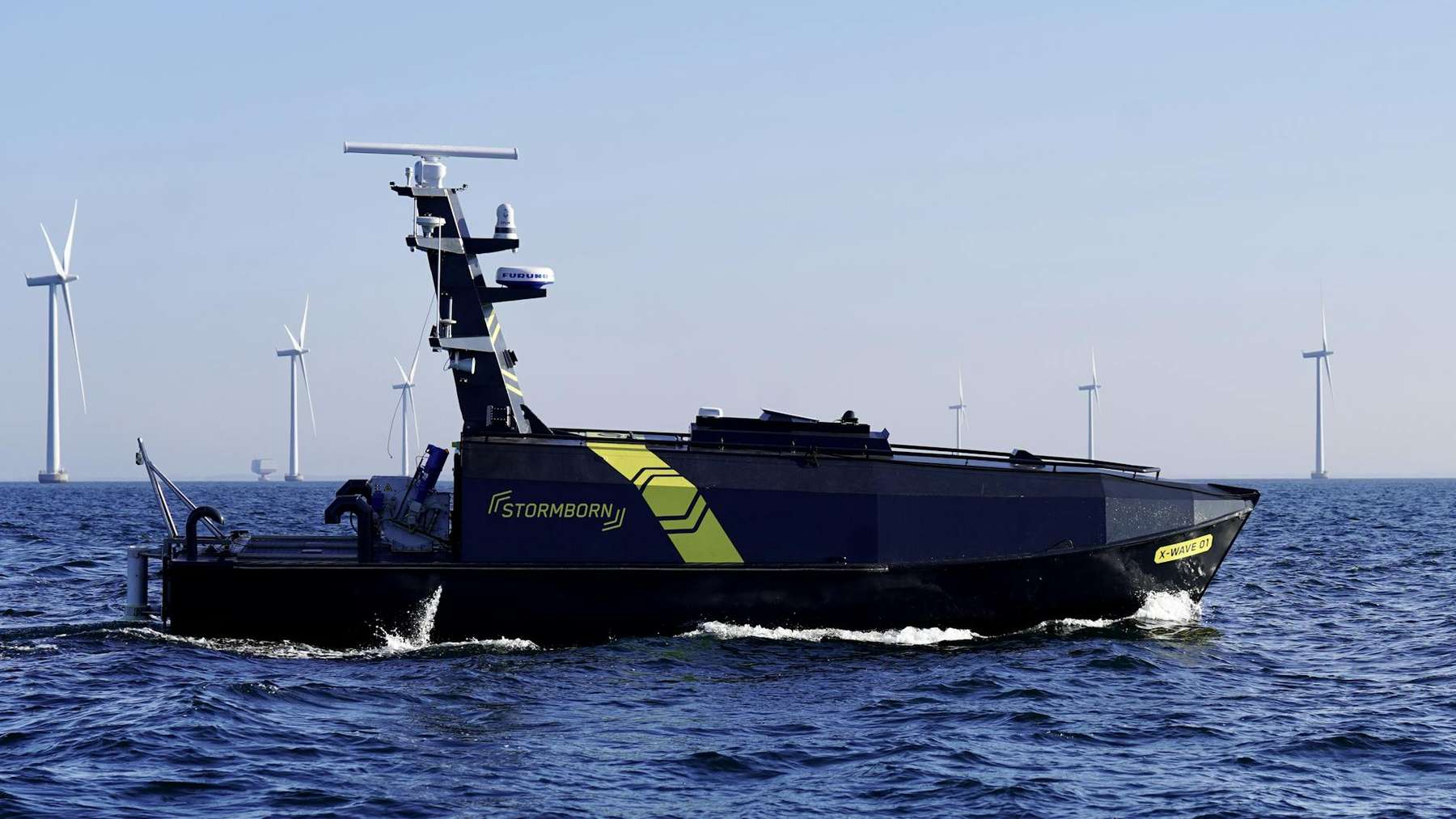
Stormborn, the Danish startup behind the X-WAVE 01, said on November 4 that it ran the boat live in Danish waters during a demonstration for British defense contractor Babcock. According to Stormborn’s own post, the systems control came from Babcock’s remote operations center in Rosyth, over on the Scottish side of the North Sea.
If the boat sounds familiar, that’s because a Russian corvette came within about 650 feet of it in the Baltic in June, with the warship’s AIS transponder switched off and a small quadcopter sent over to take a closer look. We went through that encounter in detail here, so I won’t rehash it.
So what’s a remote operations center?
Basically, it’s a room full of people running drones that are somewhere else. Babcock calls them ROCs and says they’re modular and crewed, so you can put one on a ship, on land, inside a site that already exists, or out in the field as a temporary setup.
Babcock’s line, in a post Stormborn shared on November 4, is that a human stays in charge of the mission the whole time. Babcock also says spreading command across several of these rooms means losing one doesn’t take everything down, which seems pretty sensible if someone’s trying to knock yours out.
The Scotsman got a look at a mock-up of one at Babcock’s Rosyth offices in late October, with Stormborn’s technicians showing how their boats plug into the system. The live run’s a step further, since the X-WAVE was actually floating in Danish waters while the controls sat in Scotland.
I’d love to tell you exactly when that happened, but neither Stormborn nor Babcock has put a date on the demo, and I couldn’t find one anywhere else. Neither company has said how the signal got from Fife to Denmark either.
Where does the frigate come in?
Babcock calls the whole idea ARMOR Force. It’s the company’s take on what navies have started calling a hybrid navy, where crewed ships and drones work as one unit.
This demo was built around a Type 31 frigate. In Stormborn’s telling, the drone boats were the ones out ahead, toward the threat and beyond what the frigate could see on its own. The X-WAVE held its spot and sent back ISR data (intelligence, surveillance and reconnaissance, which is a fancy way of saying eyes and ears). Kraken’s K3 boats brought the speed. Exail’s Orca-16s handled the underwater listening, which is how you hunt submarines.
Arondite’s Cobalt software handed out the jobs and pulled everything into a common operating picture. That’s military-speak for one shared map everybody’s working off, and Stormborn says the X-WAVE’s feed showed up on it live.
According to Stormborn, all of that left the frigate protected and free to do its main job as an air defense ship. Frankly, that’s a pretty smart way to use a warship. You keep the big ship with people on it farther back, and you send the boats with nobody on them to take the first look.
One caveat. Stormborn’s post talks about a T31 frigate, but it doesn’t say which ship took part, or whether a real frigate was out there at all. So it’s safest to read this as a concept built around a Type 31. It was an industry demonstration, not a Royal Navy or Danish navy operation, and neither company’s post mentions an order.
If the Kraken name rings a bell, you might remember the K3 from Portsmouth harbor, where the Royal Navy’s new autonomous squadron has been steering one around.
The X-WAVE is built to stay put
A lot of the drone boats you hear about are built to go fast, like the K3. The X-WAVE is more or less the opposite.
Stormborn describes it as a 12-meter, dual-use uncrewed boat, meaning it’s pitched at civilian jobs like seabed survey work as well as military surveillance. It anchors itself and holds its position, and the company says it can keep doing that in all sea states for up to a year. Final Frontier, one of Stormborn’s investors, says it can anchor in water deeper than 490 feet or so.
So why would you want a boat that barely moves?
Because a boat that’s already parked near an undersea cable or a pipeline doesn’t have to race out there once something goes wrong. Stormborn’s whole pitch is built around protecting that kind of offshore infrastructure, and a boat that sits still for months is basically a floating sensor post.
The spec sheet has filled in since we last wrote about it, too. In September, we couldn’t find a published range. The X-WAVE page on Stormborn’s website now lists 4,500 nautical miles (about 5,180 miles) and 60 days of endurance on patrol, alongside 365 days at anchor. Top speed, weight and price still aren’t public, which is a little frustrating if you’re trying to compare it with anything else on the water.
Baird Maritime reports the boat is light enough to go by road and carries a Terma radar, a Teledyne Marine sonar and a counter-drone system from MyDefence. Given what flew over it in June, the counter-drone gear seems like a pretty reasonable thing to bolt on. Naval analyst H I Sutton describes the boat as unarmed.
Rosyth is where the frigates get built
Rosyth sits on the Fife coast, across the Firth of Forth from Edinburgh, and it’s where Babcock is building five Type 31 frigates for the Royal Navy. The Scotsman reports that robots handle more than 80% of the initial plate welding, and that the program leans on 150 suppliers, two-thirds of them from Scotland.
There’s a fun Danish connection here as well. The Type 31 is the British version of the Arrowhead 140 frigate design, which was developed from a Danish warship. The Scotsman also reports Babcock is hoping to land a deal to supply the Danish navy with new frigates, though for now that’s just a hope.
The Type 31 displaces about 6,300 tons, according to Naval Technology. Its mission bay covers roughly 1,280 square feet and can take up to six 20-foot shipping containers, and Babcock has pitched the ship as a mothership for drones.
So, back to that reader’s question. Yes, somebody’s watching the data, and during this demo they were sitting in Fife. Sir Nick Hine, Babcock’s chief executive for its marine business, said in the company’s November 4 announcement that “people remain firmly responsible for operational intent, authority and accountability.”
That same announcement named Stormborn as one of seven new ARMOR Force partners, alongside CUBEDIN, Exail, Hensoldt, Kraken Technology Group, SH Defence and Thales. Back at Rosyth, the hulls of HMS Formidable and HMS Bulldog were going up side by side when The Scotsman visited in late October.
 A 243-foot missile corvette armed with eight vertical launch cells for cruise missiles was struck by drones in the Gulf of Finland, Ukraine’s security service said, as the same overnight raid set oil tanks on fire at a Baltic export portMilitary · 5 days ago
 A 16-foot kamikaze drone boat weighing about 1,100 pounds went from first sketch to sea trials in six months, designed by the French government’s own engineers at a lab that normally builds scale models of warships, and because the state owns the plans, any shipyard can now be handed themMilitary · 5 days ago
 A 9,600-ton guided-missile cruiser that spent eight years in an overhaul once reported 85 percent done, and never deployed again, was towed out of Philadelphia by an ocean tug for a Texas scrapyard, with its gun barrels gone and its parts stripped for its sister shipsMilitary · 47 minutes ago