
- 2 MONTHS AGO · ENERGYA well 19,448 feet long, drilled straight down into Utah and then turned sideways for 7,500 feet of it, is pushing water into rock at 460 degrees and taking it back out at more than 400, on rigs and pumping spreads that came out of the oil patch. There is no oil under it
- 1 MONTH AGO · ENERGYNearly 12,000 solar panels raised 10 to 13 feet over a blueberry field went live in eastern Germany, set high enough for farm machinery to pass underneath, and before the first post went in, ordnance crews pulled hand grenades out of the soil the bushes now grow in
- 4 WEEKS AGO · ENERGYA 502-foot concrete dam on the Green River is letting up to a million acre-feet out of its reservoir to keep Lake Powell above the line where its eight turbines shut down, the lake behind it has dropped 34 feet, and the water keeps flowing for six more months
- 3 WEEKS AGO · ENERGYA 390-foot earthen dam in Colorado has drawn its lake down to 17 percent, 19 feet above the line where its two turbines stop making power, after the driest snowmelt on record, and the river below has been cut to about 210 cubic feet a second to keep them turning
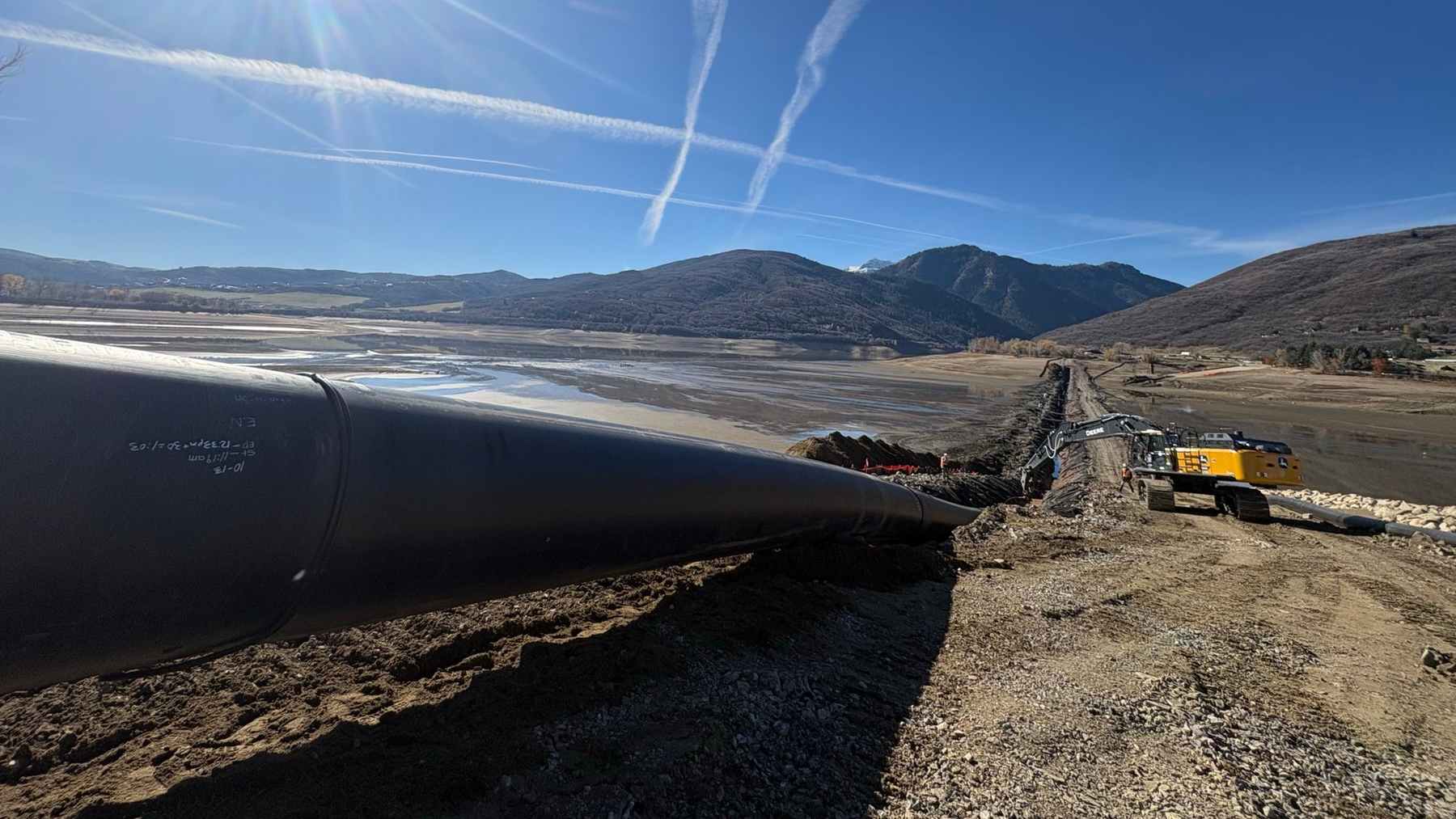
- TODAY · THIS ARTICLEA 48-inch water line has been laid in a trench across the bed of a Utah reservoir drawn down nearly empty for the job, and the falling water gave up a truck stolen in 2007, a hand grenade and a 1915 well still flowing on its own, with the crossing now ahead of its January 1 deadline
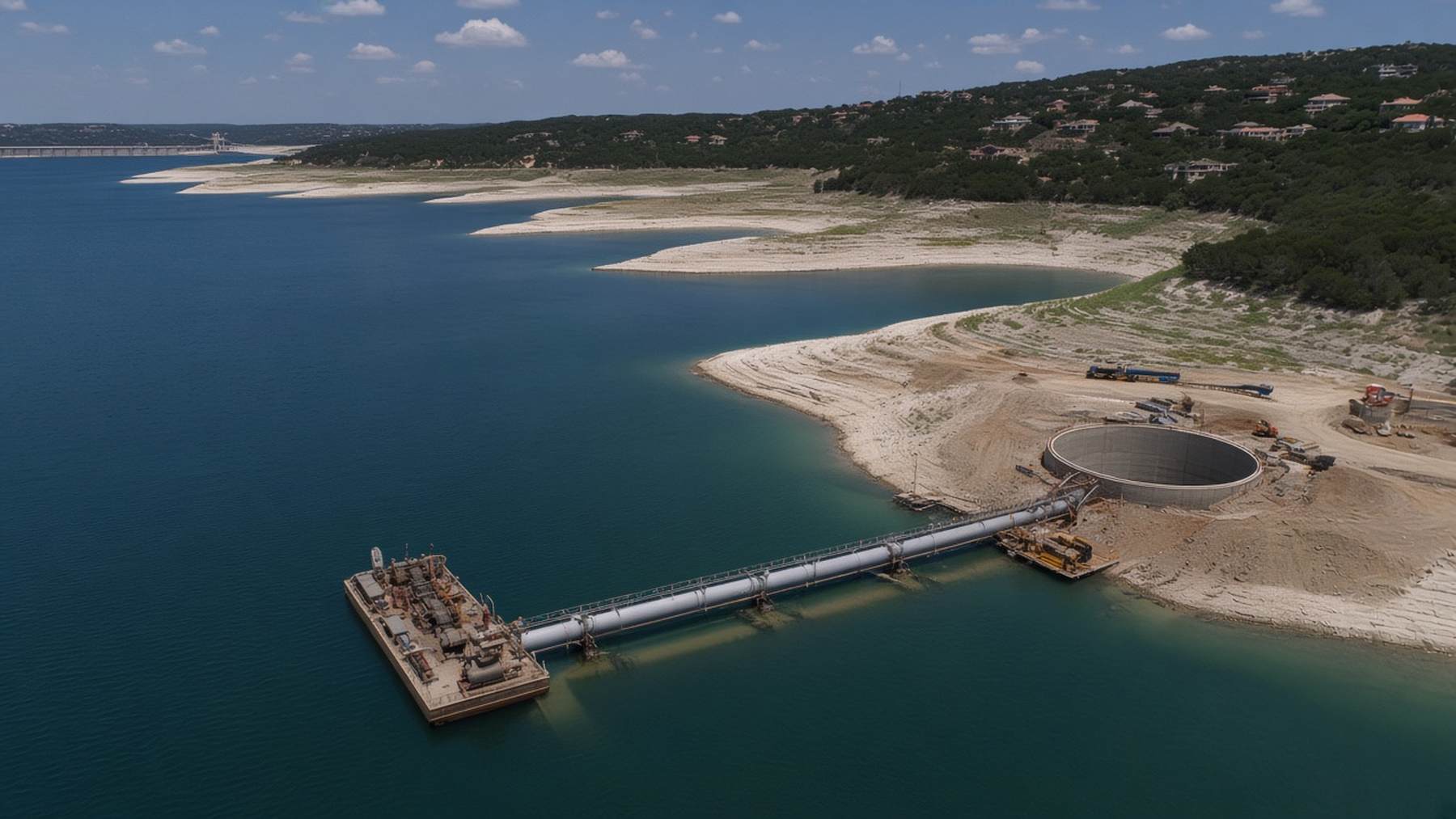
Low water at a Western reservoir is usually bad news. Boat ramps end in mud, marinas close early, and everyone starts doing snowpack math in their heads. But Ogden City, Utah, looked at Pineview Reservoir this year and saw a pretty rare chance to get at something buried under the lakebed.
That something is the city’s main drinking water line, which has run under Pineview, up in the Ogden Valley east of town, since 1970. Its replacement has to go into a trench across the bottom, so the city drew the reservoir down to a target elevation of 4,835 feet, and crews laid a temporary road out across the bed.
So far, so good. According to the city’s Pineview crossing project site, the new 48-inch line is now sitting in its trench and being backfilled.
Justin Anderson, Ogden City’s public services director, told reporters at the site on November 12 that the job is ahead of its January 1 deadline. He also told FOX 13 this phase could wrap up in December, though he didn’t put a date on it.
So why not just lay it underwater?
You’d think a city could just drop a new pipe onto the bottom from a barge. That’s not how the original went in, though. Ogden City says the 1970 line was installed by trenching the bottom of the reservoir while it was emptied, so it’s buried under the lakebed. The new one is going into a trench right beside it. Basically, if your pipe lives under the mud, you need that mud dry enough to dig.
There are other ways to get under a lake. In Oklahoma, a tunnel borer drove 510 feet through rock and came out the bottom of a lake for a water intake. But that’s a tunnel. Ogden’s going with a trench, and you can’t really dig one with a lake sitting on top of it. That’s pretty much the whole reason Pineview looks the way it does right now.
The city’s careful about the wording, by the way. Ogden City says Pineview was lowered rather than drained, while KUER described it as almost empty in mid-September. Look at photos of the exposed bed and you’ll see why both versions are floating around.
The timing helped. FOX 13 reports the work was originally slated for next year and got moved up because low snowpack meant the reservoir was going to be down anyway. Frankly, if you’re going to lower most of a lake for a pipe job, a dry year is about the least painful time to do it.
The old pipe isn’t going anywhere
Here’s where it gets a bit more interesting. Ogden isn’t ripping out the 1970 pipe. The old 36-inch line is being slip-lined, and the Standard-Examiner reports a 32-inch pipe made of high-density polyethylene (HDPE) is going inside it.
Slip-lining is pretty much what it sounds like. You slide a slightly smaller new pipe through the old one, so the old pipe ends up as a protective sleeve and nobody has to dig it out.
Which means Ogden ends up with two lines under Pineview. FOX 13 says that lets the city take one out of service for maintenance without pulling the reservoir down again. If you keep a boat at Pineview, that’s arguably the best news in the whole project.
The new 48-inch line is going in with anchors, according to the Standard-Examiner. The city’s updates don’t say what the 48-inch pipe itself is made of, and I’m not going to guess. While the crossing is torn up, a temporary 24-inch bypass is keeping water flowing to homes and businesses.
So why bother? Ogden says the line serves more than 120,000 customers, and it estimates around 1 million gallons of drinking water a day leak out of the aging system. The Pineview section is about 55 years old. The canyon stretch is closer to 100.
The full replacement runs through 2029 and costs about $100 million, paid for with a loan from the EPA’s WIFIA program (federal financing for water infrastructure), a state revolving fund, ARPA money and state grants.
Anderson doesn’t seem worried about having to do this again any time soon. He told the Standard-Examiner that “none of us will be alive when this needs to be replaced.”
So what else was down there?
When you lower a reservoir that’s been around since 1937, you’re going to find some stuff. Pineview didn’t disappoint.
The headliner is a yellow truck. Its VIN and license plate show it was stolen back in 2007, in Ogden, according to KUER. Weber County Chief Deputy Colby Ryan told the station that’s roughly when the sheriff’s office thinks it ended up in the lake, and he isn’t expecting to crack any cold cases.
Apparently it turned up out in the reservoir’s narrow neck near the spillway, in a stretch the sonar searches hadn’t reached, the Standard-Examiner reported. For context, KUER says search and rescue teams train at Pineview with sonar every year and usually find a car or truck every other year or so.
Then there’s the grenade. On Sunday, September 20, someone sweeping a metal detector along the neck’s north shore, close to the dam, found one and called the sheriff’s office. A bomb squad from the Davis County Sheriff’s Office came out and blew it up on the spot in a controlled detonation.
That’s probably not the find anyone hopes for on a Sunday afternoon with a metal detector.
By that point, the sheriff’s office counted two vehicles and three firearms recovered since the drawdown began. Its advice is simple. If you find anything that looks like it could explode, leave it alone and call.
There’s a well from 1915 that’s still flowing
My favorite find isn’t in the sheriff’s files at all. About 500 feet off Pineview’s southern shore, the falling water exposed a 6-inch iron well pipe that, according to a Utah Division of Water Rights memo, was drilled 65 feet down in 1915. It went underwater when the reservoir first filled in 1937.
When a state inspector checked on it on September 25, it was flowing at about 20.5 gallons per minute. On its own.
If you’re wondering how a century-old well with no pump pulls that off, it’s tapping groundwater that’s under pressure. Poke a pipe into it and the water pushes up and out by itself. We don’t know how long it’s been running under the lake.
The state’s September 28 memo recommends sealing it before the refill, with a licensed driller pumping cement down to the bottom of the well and filling the casing back up to the surface. I couldn’t find anything public saying whether that’s happened yet.
The dry bed is getting some upgrades, too. Ogden City is putting $200,000 and the Utah Department of Natural Resources $50,000 toward lake habitat work, and the state wants roughly 1,300 big fish structures on the bottom, which will sit 40 to 50 feet down once the water’s back, per the Standard-Examiner.
Downstream, the Great Salt Lake Commissioner’s Office says about 3.26 billion gallons are going from Willard Bay to the Great Salt Lake and its wetlands, KUTV reported. That’s a mix of water sent down by the pipeline project and water local users and Ogden City temporarily set aside.
When does the water come back?
Pretty soon, actually. Ogden City’s schedule has the refill starting January 1, 2027, and the lakebed restored to its original elevation by February 1, 2027. After that, the pipe work moves up into Ogden Canyon, where the city is estimating completion in spring 2029.
 A 1.8-megawatt wind turbine on a 257-foot tower, with 132-foot blades reaching nearly 400 feet, is one of four to be lowered by crane this fall at Ohio’s first commercial wind farm after more than 20 years, and crews will then excavate foundations about 33 feet deep, due by mid-DecemberEnergy · 14 hours ago
 A 1,050-ton slab at the bottom of a 115-foot Ontario shaft is the foundation of the Western world’s first grid-scale small reactor, and the 300-megawatt machine meant to stand on it will now be late, because its engineering is still being finished as the concrete goes inEnergy · 20 hours ago
 A 529-ton reactor pulled out of a German nuclear cargo ship has sat empty of fuel in a concrete shaft near Hamburg for 45 years, and regulators just cleared the hall where it will be cut into pieces and packed for disposal, part of a 17-year teardown of the research site around itEnergy · 23 hours ago