
- 4 WEEKS AGO · ENERGYA 19-megawatt dam on a Maine river ran one of its three turbines for four hours on a Saturday in the middle of a herring run of about a million fish, thousands of them came out the other side dead, and the owner shut the whole plant down and has kept it dark since to let the rest go by
- 3 WEEKS AGO · ENERGYA 42-megawatt Idaho dam can only swing nine of its 10 spillway gates fully open or fully shut since engineers found delaminated steel in the 70-year-old gates, and the 1,150-foot-deep lake behind it gets the first of 11 new gates next summer
- 2 WEEKS AGO · ENERGYA 100-foot earthen dam holding back a nearly 4,000-acre Michigan lake is one of 13 hydro plants up to 120 years old headed for a private buyer, and if state regulators kill the sale, the utility that owns them could tear them out and let the lakes drain
- 1 WEEK AGO · ENERGYAn 11,000-volt ship connector packed into its own container just passed factory tests with outside inspectors watching, and it’s built to reel in a high-voltage cable from an offshore wind turbine, lock it in and let a service vessel charge its batteries without heading back to port
- TODAY · THIS ARTICLEA 1.5-megawatt hydro plant dark since a 2023 fire was restarted after what its operator calls a year’s work done in seven days, as floodwater stood about 5 inches from the top of the Michigan dam beside it, and its turbine then passed about 2,500 cubic feet of water a second
Most people think of a hydro plant as something that makes electricity, and that’s fair, because that’s what it gets paid to do. But a hydro plant is also a hole in a dam. Every gallon that runs through the turbine is a gallon that isn’t piling up behind the concrete, and when a river is trying to climb over the top, that matters a lot more than the power.
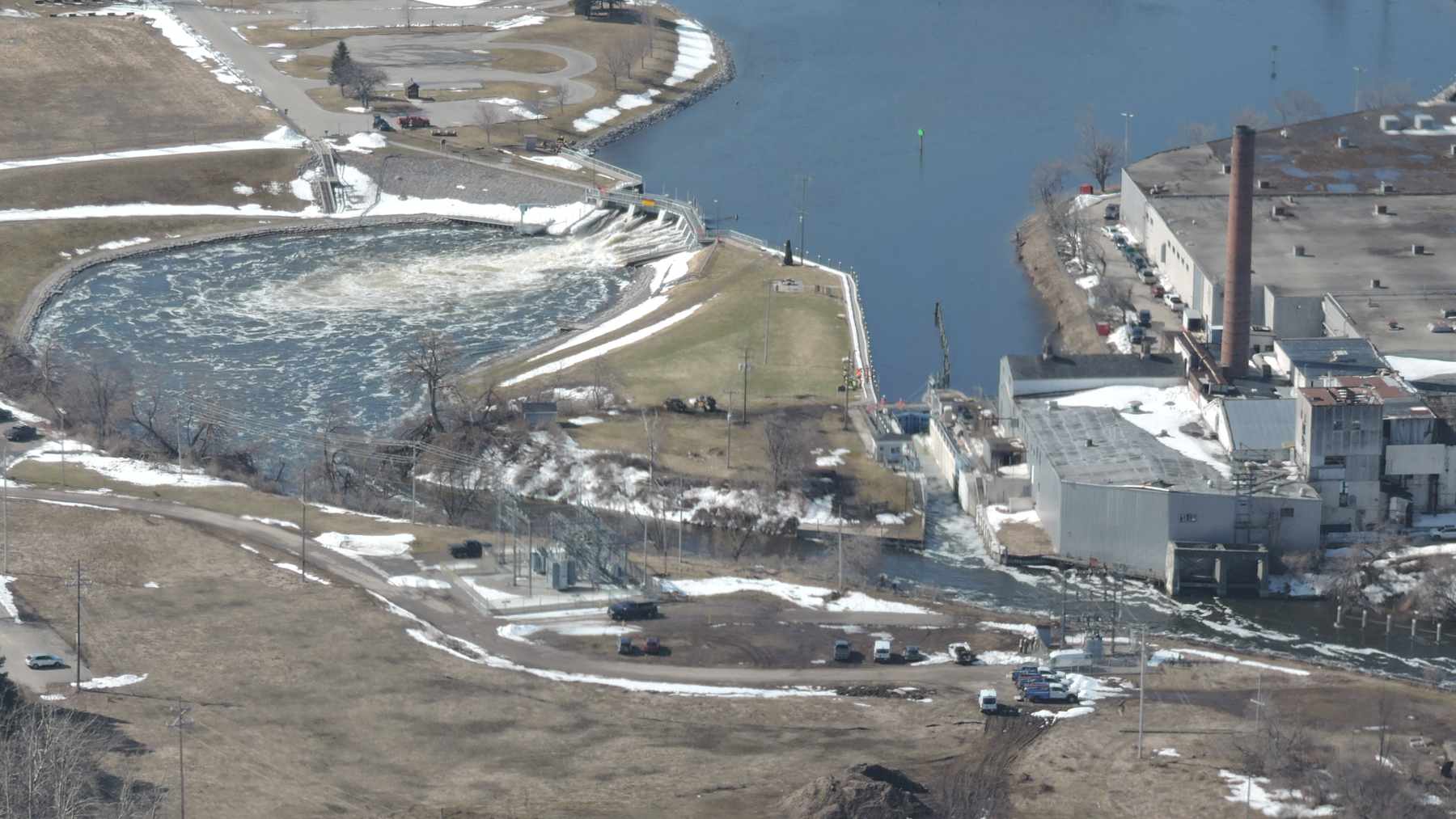
That’s pretty much the whole story of the powerhouse at the Cheboygan Lock and Dam in northern Michigan this spring. The 1.5-megawatt plant there had sat dark since a fire at the paper mill next door in September 2023. Then the Cheboygan River flooded, and someone had to get the thing spinning again in about a week.
The paperwork’s finally caught up with it. In an order dated November 5, the Michigan Public Service Commission cited a Federal Energy Regulatory Commission letter confirming the plant’s turbine went back into service on April 17, 2026.
So how close did the river get?
Closer than you’d like. Bridge Michigan reported the water was 4.92 inches from the top of the dam late on Thursday, April 16. Bridge puts the dam at 27 feet high, with 16 feet of headspace, and says it’s classified as high hazard.
That rating isn’t a grade on the concrete. It basically describes what’s downstream, and it means a failure could put lives at risk. If you lived in Cheboygan this spring, you didn’t need that explained. The county sheriff’s office had already told people living between the dam and Lake Huron to get ready to leave, and Bridge reported downstream residents would be ordered out if the water came within 1 inch of the top.
The dam is about 100 years old, according to Bridge, and the lock beside it was built in 1869, according to the Michigan Department of Natural Resources. The DNR owns the dam, while the powerhouse is private and has a longer paper trail than you’d probably expect. FERC exempted it from needing a federal license back in 1983, as Project No. 7142, when Procter & Gamble ran the paper mill, 9&10 News reported.
Upstream, things were frankly a mess. Black Lake topped out more than 5 feet above its normal level, 9&10 News reported, and the watershed that drains through this dam covers about 1,455 square miles, per the DNR. During the emergency, the state pulled all six spillway gates off the dam and brought in high-capacity pumps to push water around the structure.
Does one turbine really make that big a difference?
Roy Davis runs HydroMine Cheboygan, a Wyoming-based company that operates the plant under a lease. He gave 9&10 News a few numbers that make the point better than I can. With every gate open, the dam moves about 5,000 cubic feet of water a second. The pumps across the river add a little over 300. The turbine alone passes about 2,500.
Then there’s the moment it tripped. When the turbine briefly dropped offline, its flow went from 2,500 cubic feet a second to zero, and Davis said the water rose 3 inches in 30 minutes.
That’s your answer.
The DNR measured the effect a different way. Spokesperson Laurie Abel told 9&10 News the turbines pushed roughly 20 to 30 percent more water through the dam. They’re two different ways of counting, so I wouldn’t try to stack Davis’s numbers on top of Abel’s.
A week of work, and a summer before it
Davis called the restart “a year’s worth of work in seven days” when he talked to 9&10 News. He said he pulled the turbine apart, made adjustments and swapped the oil in the upper bearing, and his crew then did the same job on the lower bearings.
If you’ve never thought about turbine bearings, you’re not alone. They’re what hold the spinning shaft in place, and the oil’s what keeps metal from grinding on metal. Changing it sounds like a pretty mundane job, and on a normal day it probably is. Doing it while the county’s getting ready to evacuate is arguably the most stressful oil change anyone in Michigan had this year.
That’s a very different job from the planned teardown of a 400-ton generator at a South Dakota dam we covered earlier this month. Cheboygan was more like triage.
So did the whole thing really get done in a week? Not quite, and Davis didn’t say it did. He said the restoration began last summer, when the plant was dewatered for the first time in years, and that took a few weeks. Dewatering basically means draining the water out of the plant’s passages so people can get in and look at the hardware. Crews also fixed the head gate, the gate that lets river water into the plant, and Bridge reported that industrial wire for the job came in from Illinois.
Michigan State Police said the turbines came back online late Friday morning, April 17, and that by mid-afternoon the level was down about 2 inches. By Wednesday, April 22, the water sat about 8 inches below the top, and by Friday, April 24, it was nearly 10 inches below, according to 9&10 News. Officials wanted it at 18.
The turbine didn’t stay on for long
The turbine ran at full capacity from April 17 until about 8 a.m. on April 28, when it was shut down so a turbine bearing could be repaired, Michigan State Police said. The water rose for a bit, then leveled off a little more than 12 inches below the top. Abel told UpNorthLive the DNR had always known the plant was a temporary fix.
The river kept falling anyway. The state said the water had dropped to 18 inches below the top by May 8, and on May 15 the DNR said it had pulled out the emergency pumps so the spillway gates could go back in.
Is it still running?
That’s where the November paperwork comes in. HydroMine asked the MPSC in July to waive some of the state’s interconnection rules, and its application said the plant was running at 1.5 megawatts of capacity, hooked up to Consumers Energy’s grid under a temporary parallel operation agreement. Parallel operation basically means the generator is synced to the utility’s grid and feeding power into it, instead of running on its own.
Keep in mind that 1.5 megawatts is a capacity figure, meaning the most the plant is built to produce. I haven’t found anything that says how much electricity the plant made during the flood, and the July filing’s the most recent description of how it’s running that I could find. Honestly, the electricity was probably the least important thing this plant did all spring.
The powerhouse belongs to Hom Paper XI, and HydroMine took over operations under a lease signed on February 6, 2026, according to 9&10 News. Cheboygan isn’t the only old Michigan hydro plant whose future is being sorted out on paper, either. Consumers Energy wants to sell 13 of its hydro plants to a private buyer.
The Michigan Public Service Commission granted HydroMine its 30-month waiver on November 5, starting that day, so the Cheboygan plant can keep running in parallel with Consumers Energy’s grid while HydroMine works out a permanent connection.
 A 48-inch water line has been laid in a trench across the bed of a Utah reservoir drawn down nearly empty for the job, and the falling water gave up a truck stolen in 2007, a hand grenade and a 1915 well still flowing on its own, with the crossing now ahead of its January 1 deadlineEnergy · 2 hours ago
 A 1.8-megawatt wind turbine on a 257-foot tower, with 132-foot blades reaching nearly 400 feet, is one of four to be lowered by crane this fall at Ohio’s first commercial wind farm after more than 20 years, and crews will then excavate foundations about 33 feet deep, due by mid-DecemberEnergy · 15 hours ago
 A 1,050-ton slab at the bottom of a 115-foot Ontario shaft is the foundation of the Western world’s first grid-scale small reactor, and the 300-megawatt machine meant to stand on it will now be late, because its engineering is still being finished as the concrete goes inEnergy · 21 hours ago