
There are very few machines on this planet that cannot reverse out of their own workplace. A tunnel boring machine is one of them. Crews assemble the concrete lining directly behind the machine as it advances, and the finished tunnel is narrower than the machine that cut it, so the only exit is forward. If the ground clamps down before you get there, you now own a several-thousand-ton steel paperweight buried under a mountain.
Australia has been living that exact nightmare for three years. TBM Florence, the machine cutting the main water tunnel for the Snowy 2.0 pumped hydro project in New South Wales, lost months to ground too soft to hold her in 2023, then months more to rock too hard to cut in 2024.
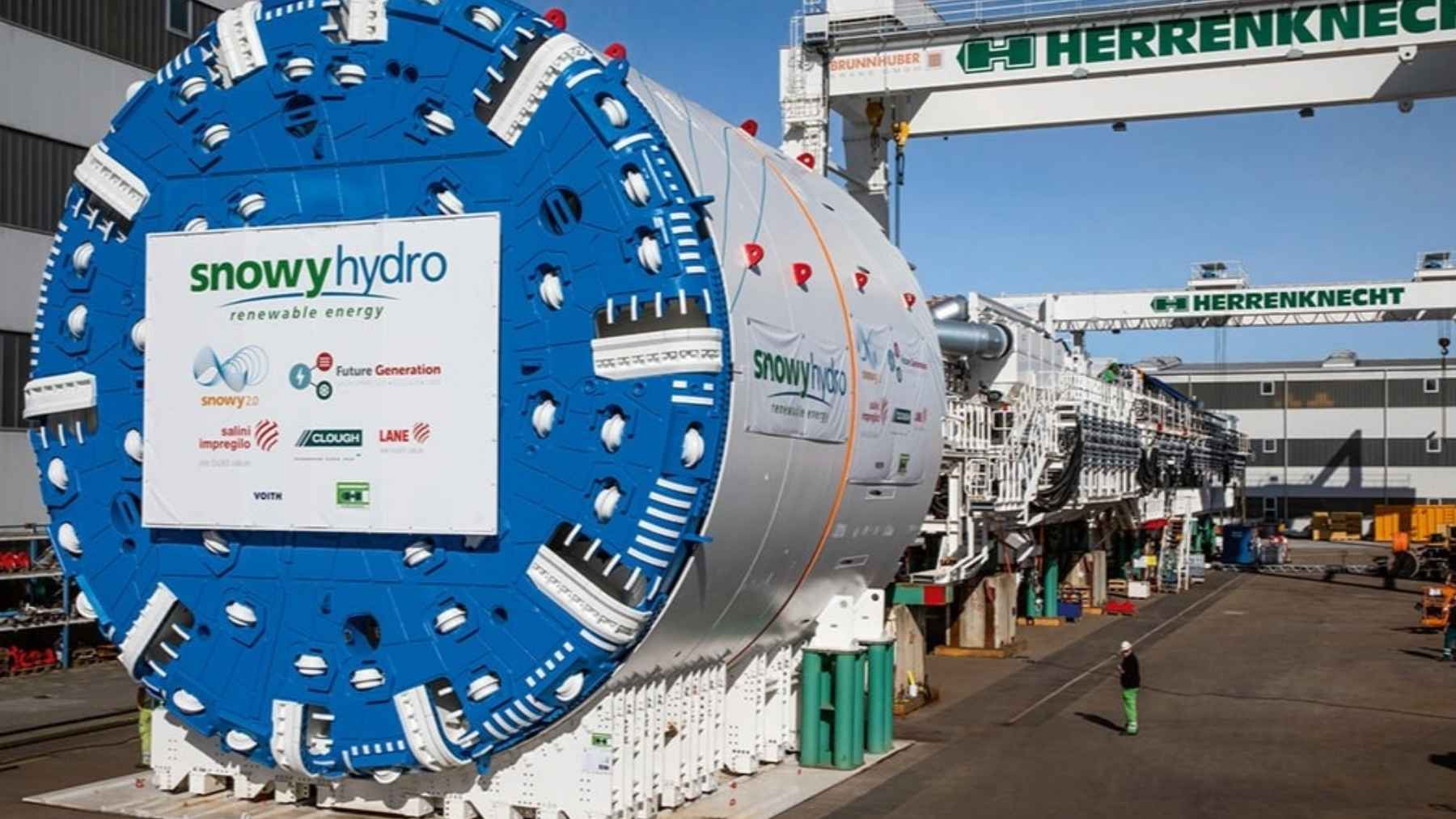
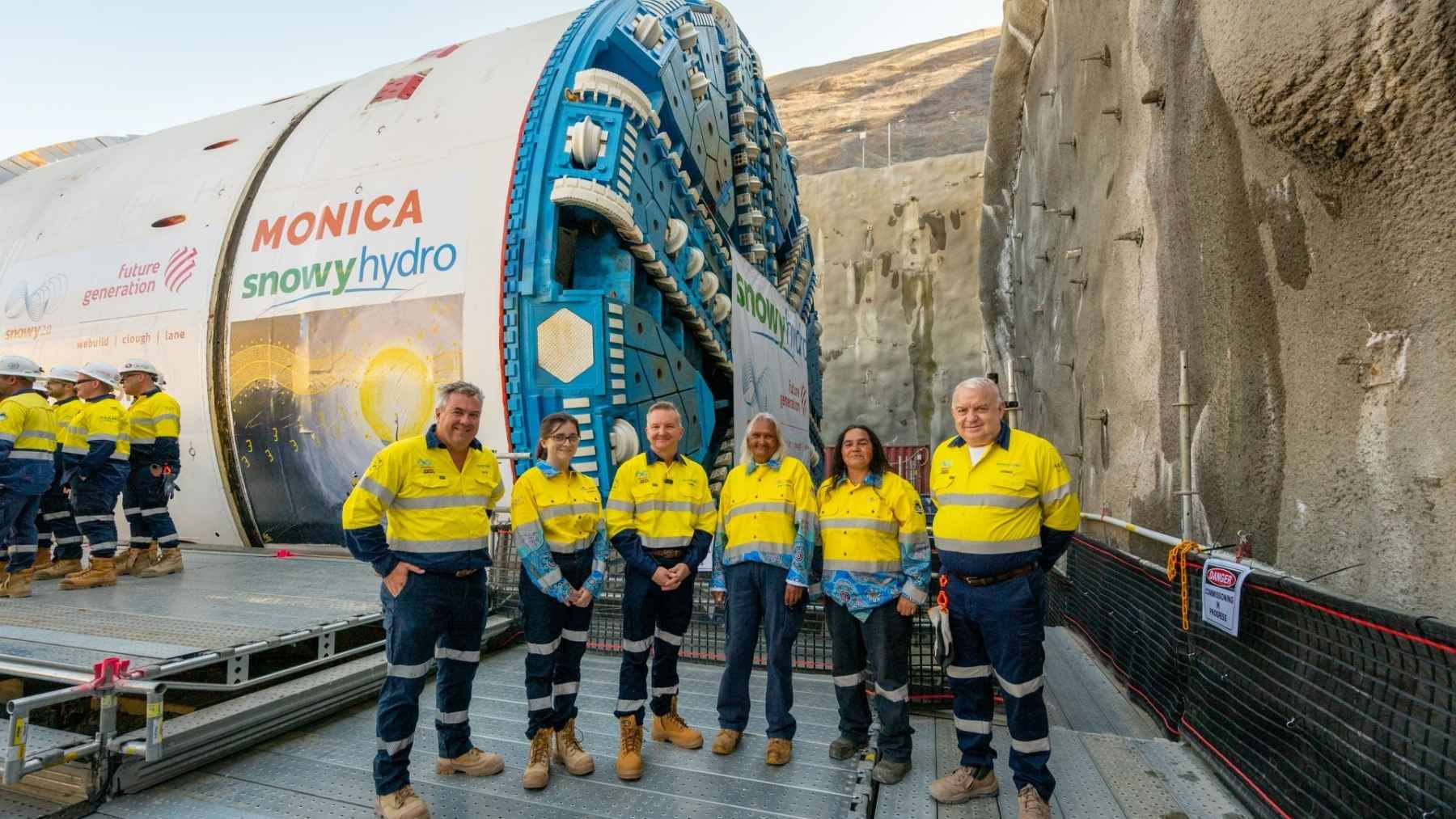
So for the stretch of geology everyone on the project fears most, an 850-meter band of crushed and broken rock called the Long Plain Fault Zone, Snowy Hydro ordered a different machine entirely. Her name is Monica. Herrenknecht designed her, and the smartest thing about her is not what the engineers added. It is what they left off.
The shield is short on purpose
Monica’s cutterhead spans 12 meters, about 39 feet, wide enough to swallow a three-story house. Behind it sits her shield, the steel cylinder that protects the crew and the works while the ground is still raw. And that shield was deliberately built just 11.2 meters long, according to Tunnelbuilder, specifically to minimize the risk of the machine being gripped by squeezing ground.
Squeezing ground is the fault-zone special. Fractured rock under hundreds of meters of mountain does not stay where you cut it. It creeps back into the hole, sometimes within hours, and it closes around whatever is sitting there.
A long shield gives that converging rock a big steel target to grab. A short one clears each freshly cut section faster, so the load lands on the concrete segments behind the machine, which are designed to take it, instead of on the machine itself, which is not. Less shield, less grip. That is the entire trick, and it is a genuinely elegant one.
The rest of her spec sheet reads like someone listed everything that has gone wrong at Snowy 2.0 and engineered a rebuttal. She switches between earth pressure balance, open and hybrid excavation modes as the geology changes, per Tunnelbuilder. Her structure is rated for 20 bar of pressure at the tail shield, around 290 psi, roughly what you would feel 650 feet underwater, and 8 bar of active support pressure at the face. Fault gouge, breccia, high-pressure groundwater, hard rock alternating with soft. She was built expecting all of it.
Florence already lost months to this mountain, twice
To understand why anyone would commission a fourth boring machine for one tunnel, you need Florence’s rap sheet. She is digging the headrace, the roughly 17-kilometer waterway that will connect Tantangara Reservoir to a power station buried about 850 meters below the surface.
In her first act, Florence bogged down in soft, waterlogged ground near the Tantangara end and did not restart until December 2023, after months of grouting and reinforcement work. In May 2024 she stopped again, this time because extremely hard and abrasive rock wore down her cutter disks and pinched her shield. Crews spent seven weeks blasting the rock apart with ultra-high-pressure water jets before she moved again on July 11 of that year.
Ground too soft, then ground too hard. And the worst was still ahead of her, because the Long Plain Fault Zone sat further along the alignment, and Tunnelbuilder reports that same fault had already cost her months of standstill. Sending her through 850 meters of crushed rock was an invitation to entomb her.
So Snowy Hydro flipped the problem around. Monica launched from the Marica worksite, just outside the old gold town of Kiandra, and is boring the downstream end of the same tunnel, a section of roughly 5 kilometers that includes the fault zone itself. Florence keeps coming from the Tantangara side, and by Snowy Hydro’s May update she was nearing the halfway mark of her drive, with CEO Dennis Barnes saying she is now “consistently achieving personal bests.” The two machines will meet somewhere in the middle and be dismantled underground.
This has become something of a house move at Snowy 2.0. A third machine, Lady Eileen Hudson, punched through into the underground cavern complex in May after finishing the 6-kilometer tailrace tunnel, and she is being taken apart down there too.
Getting her there took 5,257 tons of cargo and a 152-wheel trailer
Monica was built at Herrenknecht’s facility in China and passed factory acceptance testing in July 2025. Then somebody had to move her to a remote worksite in the Snowy Mountains.
The shipment, per contractor Clough, came to 54 breakbulk items, 23 forty-foot containers and 5,257 metric tons of freight. The 207-ton main drive alone rolled out of Port Kembla on a 73-meter trailer riding on 152 wheels, one of more than 140 oversized loads, International Water Power reported. The cutterhead had to be split into five pieces just to fit on a road. When the convoy crawled through the town of Cooma at night, more than 1,500 people turned out to watch, which tells you something about how much of a local celebrity a disassembled boring machine can be.
Fully assembled she stretches 178 meters, nearly 600 feet, with eight trailing gantries. Even her concrete is custom: the segments lining her section of tunnel are a bespoke reinforced design, produced at the project’s Polo Flat precast facility, because standard segments were not rated for what the fault zone is expected to do to them.
The name came from a competition. Monica Brimmer, a Tumut High School student and aspiring engineer, won a First Nations art and storytelling contest, and when the machine was powered up on February 1 she radioed in the command for the first rotation of the cutterhead herself, with federal Climate Change and Energy Minister Chris Bowen watching. “TBM Monica is among the world’s most advanced tunnel boring machines,” Snowy Hydro said at the commissioning. For once the press-release superlative has some engineering behind it.
The machines are moving faster than the accounting
Snowy 2.0 is now more than 70 percent complete, and the underground power station, a cavern complex nearly a kilometer down with the footprint of the Sydney Opera House, has moved from excavation to fit-out. The project is meant to add 2,200 megawatts of on-demand capacity and around 350,000 megawatt-hours of storage to Australia’s grid, with a completion target of December 2028.
The money is a rougher story. Pitched at 2 billion Australian dollars in 2017, the project was recosted at AU$12 billion, about US$7.8 billion, after a 2023 review. Last October, Snowy Hydro ordered its contractor to run a line-by-line cost reassessment and gave it nine months. As of early August, RenewEconomy reports, that review is overdue and Bowen has not seen it, telling reporters the original planning was immature and that “they hadn’t done their geotechnical work.”
Which is exactly the sentence that explains why Monica exists. Nobody priced the Long Plain Fault Zone correctly in 2017, and the bill for that guess includes an AU$75 million machine, per RenewEconomy, whose headline feature is a deliberately stubby shield. Herrenknecht has been down this road before, with one of its machines trapped for 329 days under the Gotthard, and German machines are grinding out the Brenner Base Tunnel right now. Mountains keep teaching the same lesson, and this time the answer was to build a machine with less to grab.
Somewhere inside that fault, Monica and Florence will eventually meet nose to nose. Both will be cut apart and hauled out in pieces through the tunnel they dug, because there is no other way home. Until then, the shortest shield on the project carries its biggest bet.