
When a navy commissions something, there’s usually a ship at the center of it. A band marches onto the jetty, a few senior officers give speeches, and a couple hundred sailors get formally handed the thing they’re going to live on for the next couple of years.
The Royal Navy went through most of that routine in Portsmouth on November 5. The Royal Marines Band showed up, the speeches happened, and more than 200 sailors, officials, reporters, families and friends watched from the naval base. But the boats at the center of it all aren’t meant to have anyone aboard.
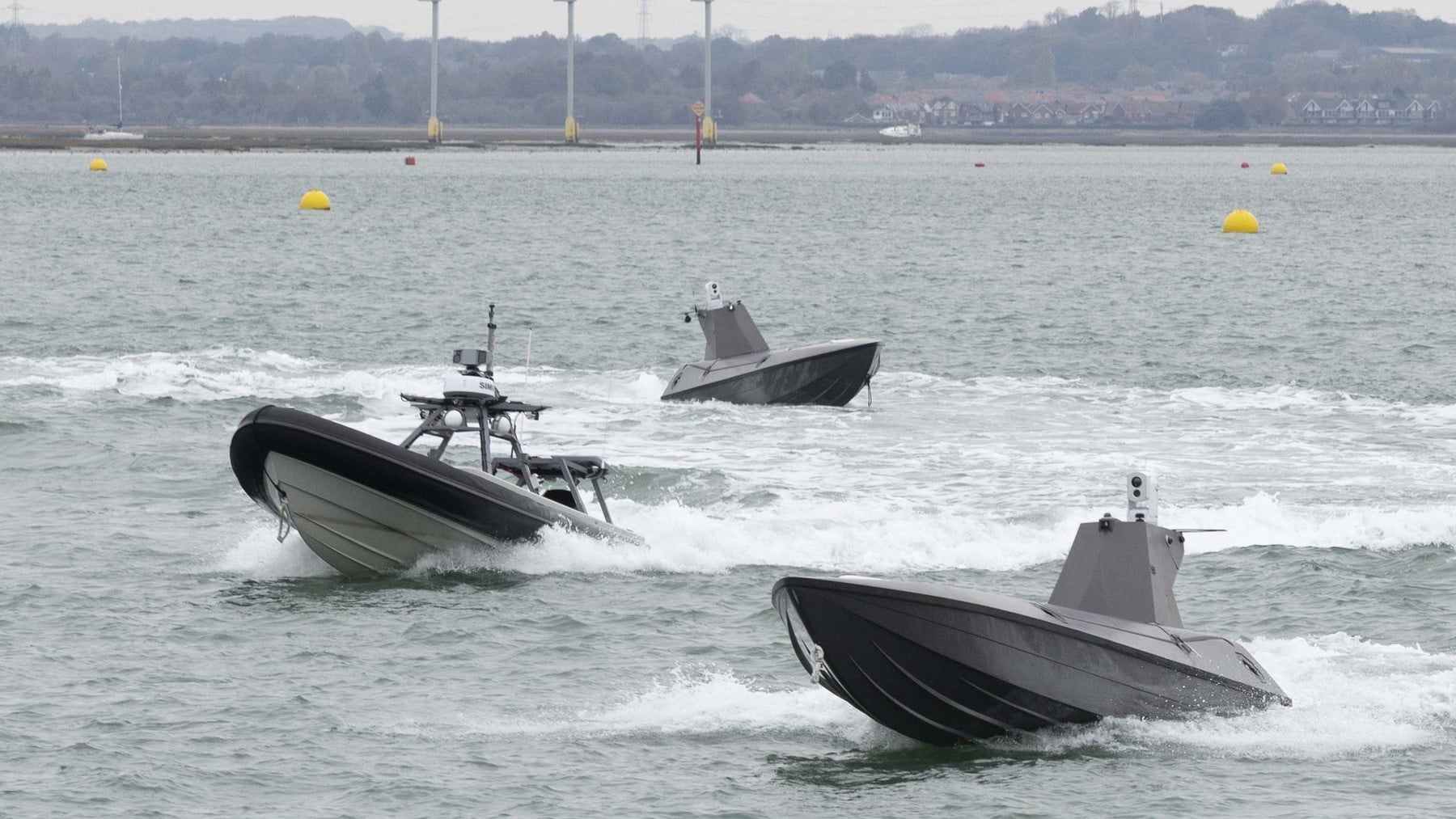
That’s because the unit getting commissioned was the 1st Autonomous Squadron, which the Royal Navy describes as its first autonomous squadron, set up to run uncrewed boats on front-line operations. Instead of a warship tied up alongside, guests got a demonstration of Kraken and Rattler drone boats being maneuvered around Portsmouth’s harbor from a control hub. The navy published the details on November 9.
So what did the navy actually commission?
Drone boats are officially part of the fleet now
Basically, it’s a unit of people whose whole job is operating boats that nobody rides in. The navy calls those boats uncrewed surface vessels, or USVs. That’s a mouthful, but it just means drone boats that run on top of the water, as opposed to the underwater drones (UUVs) you’ve probably read about. Everything the navy has named for this squadron so far is a surface boat.
Commissioning is the formal moment a ship or unit officially enters service. It’s mostly ceremony, but it’s also what turns a project into a permanent part of the fleet with its own commanding officer. In this case that’s Commander Helen Coxon.
Fleet Commander Vice Admiral Steve Moorhouse didn’t undersell it at the ceremony. “The Royal Navy is doing something it has never done before,” he said, according to the Royal Navy’s announcement. He also made a point of saying people stay at the heart of the whole thing, which is a pretty reassuring line to hear from a navy that’s buying robot boats.
It takes 180 people to run boats with nobody on them
The squadron is based in Portsmouth and has around 180 personnel. The navy itself points out that’s the same as a Type 23 frigate. If you aren’t up on British warships, the Type 23 is the frigate class the Royal Navy has leaned on for more than 30 years. So we’re talking about a full warship’s worth of sailors for a fleet of boats that don’t carry a single one of them. Those 180 people are split into two watches, which is navy-speak for shifts, so somebody’s running the boats around the clock.
That sounds like a lot. I’d argue it’s actually the most honest number in the whole announcement, because it shows you what drone boats really are right now. They still need people. They just need them on shore, in a control room, watching screens instead of the horizon.
You can see how that works from an earlier Royal Navy trial. When the navy ran five Rattler boats as warship escorts off Scotland last fall, each boat had a two-person team, a pilot and a systems operator. Those operators were sitting aboard the experimental ship XV Patrick Blackett, tied up in Portsmouth about 500 miles away.
I can’t tell you whether the new squadron uses that same two-people-per-boat setup. The navy hasn’t said how many boats the squadron operates, how many of each type it has, or exactly where its control hub sits. It also hasn’t listed specific missions beyond saying the boats will work on their own or as part of a task group alongside allies.
The squadron has two kinds of drone boat (that we know of)
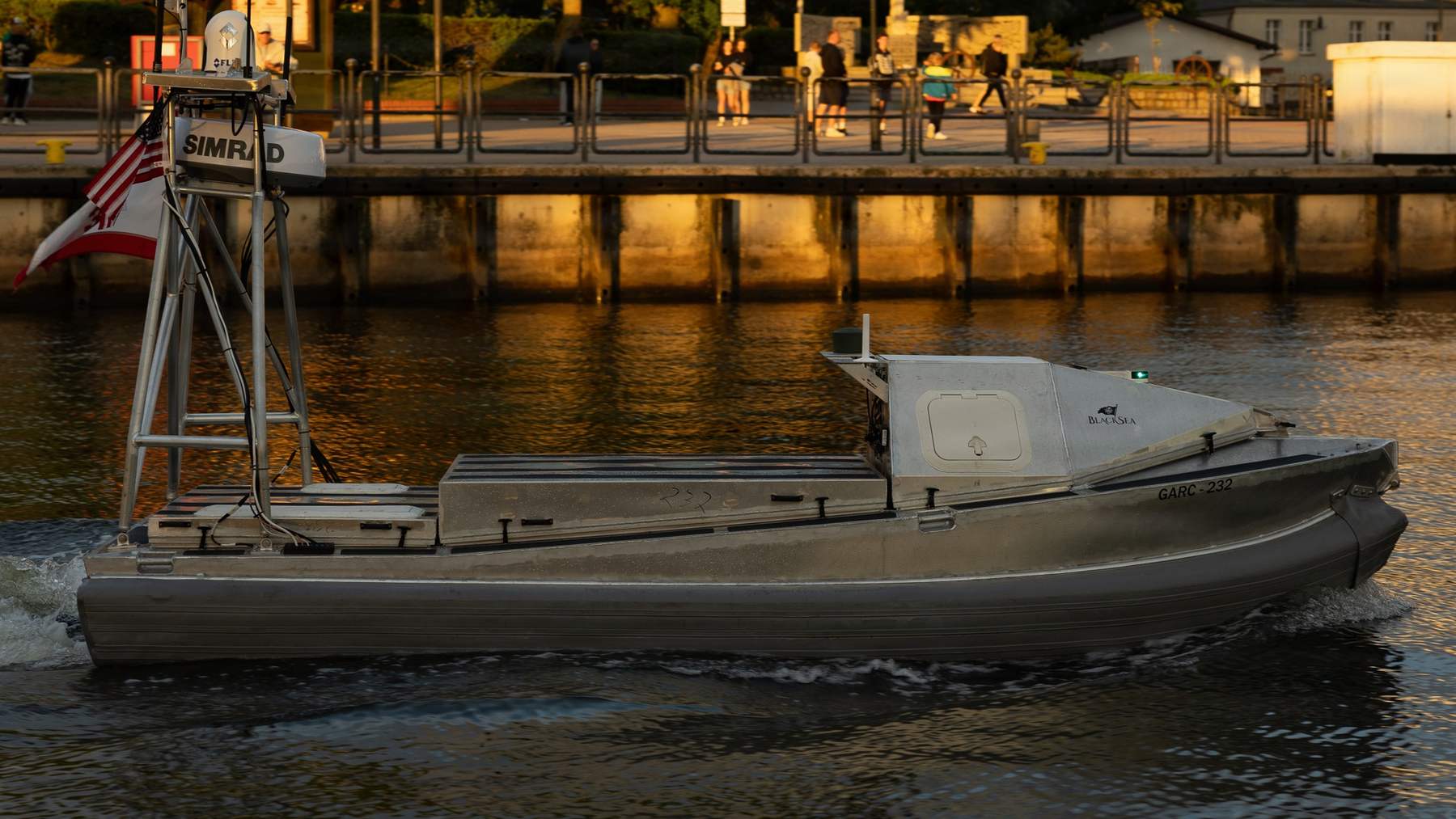
The Kraken in Portsmouth’s harbor is the K3 Scout, according to the navy’s own photo captions from the ceremony. It’s the bigger of the two, and it’s the one with the more impressive spec sheet.
According to the K3 Scout data sheet, the boat is about 27.6 feet long and 6.3 feet wide, and it weighs up to roughly 5,500 pounds. It can carry 1,323 pounds of payload and stay out for up to 30 days, depending on the mission.
Its top speed is 55 knots. A knot is one nautical mile per hour, and a nautical mile is a bit longer than a regular mile, so that works out to about 63 mph. That’s pretty quick for a boat this size running on an inboard diesel.
The navy ordered 20 Kraken boats back in March in a £12.3 million deal with Kraken Technology Group, a British company. At the time, those boats were earmarked for the Coastal Forces Squadron and 47 Commando Royal Marines. If you’ve been following along, we’ve already seen a K3 Scout go to sea with a drone-hunting radar in its payload bay.
The Rattler is the smaller, scrappier one. It’s a rigid inflatable boat, basically the same kind of hull you’d see a boarding team use, and it measures 7.2 meters, which is just under 24 feet. The navy says it was developed with a group of small and medium-sized companies working alongside sailors.
The navy has used Rattlers to train operators and to test running boats as a pack. One of them also made the news earlier this year when it ran into a racing yacht in the same harbor. So it’s fair to say the Rattler crews have had a bit of a learning curve.
Project Beehive was the test run
The new squadron replaces Project Beehive. That was the navy’s first program to buy a fleet of autonomous boats and use them as a proving ground for what Britain calls its “hybrid navy.”
The hybrid navy idea is simple enough. Traditional warships, submarines and aircraft keep doing their jobs, but they work alongside uncrewed and autonomous systems that can go places and take risks you wouldn’t want to put sailors through. So what started as an experiment now has a commanding officer, a full complement of sailors and a permanent spot in the fleet. That’s a pretty quick promotion for a project the navy was still calling a proving ground back in March.
The Royal Navy says the hybrid navy push is backed by £1.5 billion over four years. That money covers the whole effort, not just this squadron, and the navy hasn’t broken out what the 1st Autonomous Squadron itself costs to run.
Defence Secretary Wes Streeting tied the squadron to what he called the biggest sustained jump in defense spending since the Cold War. His argument was basically that the country that innovates fastest has the edge now, and that putting autonomous tech in sailors’ hands helps protect Britain and its NATO allies.
Why are the boats off-the-shelf?
The navy also says its Capability Accelerator team has formally opened a new hub at the Portsmouth base. That’s a group set up last year, partly funded by UK Defence Innovation, whose whole job is getting new gear to the front line faster.
The navy points to the Kraken and Rattler as examples of that approach. The navy describes both as off-the-shelf technology, which basically means starting from something that’s already on the market instead of designing a new boat from scratch, and says the accelerator team got them built and adapted for military use in less time. Commander James Wagstaffe, who leads the team, said the goal is shrinking the gap between spotting an operational need and actually handing sailors something that fixes it.
Frankly, that’s the smartest move here. Designing a warship from a blank sheet of paper can take the better part of a decade, and drone tech moves a lot faster than that. Buying a boat that already works and bolting on what the navy needs seems like a pretty sensible way to avoid fielding hardware that’s obsolete the day it shows up.
Commander Coxon said her squadron will keep working with Navy Develop, the Disruptive Capabilities and Technologies Office and the accelerator team to bring new uncrewed systems into the fleet. She also said the aim is to move as fast as is responsible.
So as of November 5, the Royal Navy has a commissioned drone boat squadron under Commander Helen Coxon, about 180 sailors working two watches in Portsmouth, and a new Capability Accelerator hub on the same base.