
Any equipment rental yard will tell you the same thing: a machine only makes money when it’s out on a job. Parked on the lot, it’s basically a very expensive lawn ornament.
West Seattle has spent most of the past year looking at a pretty spectacular lawn ornament. The Pacific Titan, a floating crane with a 330-foot boom, turned up off Harbor Avenue last December and stayed for just shy of 11 months. You really couldn’t miss it. One West Seattle Blog commenter griped at the time that it was parked right at eye level from their place.
Then, on the morning of October 29, it finally moved. The West Seattle Blog ran reader photos of it leaving its spot near Jack Block Park, the first of them shot at sunrise, and the West Seattle Herald reports that tugboats did the pulling.
So why did it sit there for so long?
The Herald says its operators were treating Elliott Bay as a stopgap while they waited on contracts. That’s not quite how a Port of Olympia spokesman described it to The Olympian a year ago, when he said it was headed for a permanent mooring near Alki Beach. Either way, I can’t find a record of it doing a job while it was there. That doesn’t prove it never left its spot, though the Herald’s talk of waiting on contracts points that way.
What is this thing, anyway?
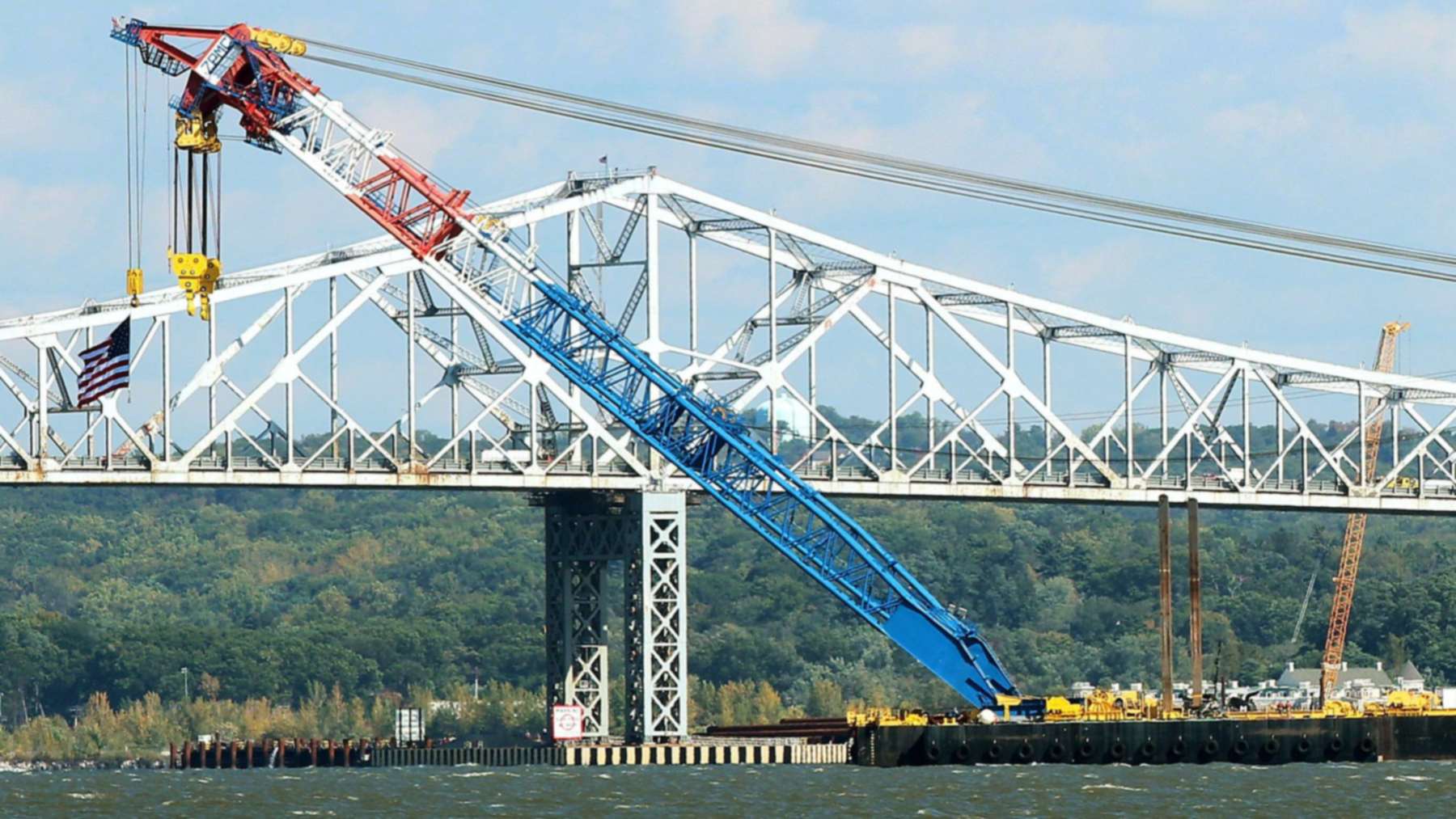
It’s a shear-leg crane, and it doesn’t work like the ones you see on a downtown high-rise. Those swing around on a turntable. This one is basically a giant A-frame hinged to one end of a barge, so its twin booms tilt up and down but can’t swing left or right.
If you’ve ever used an engine hoist in a garage, you get the idea. The arm goes up and down, and if you want the engine somewhere else, you roll the whole hoist over there. Only here, the hoist is a barge 400 feet long and 100 feet wide.
The crane alone weighs about 4,300 tons, going by Engineering News-Record’s numbers from when it was new. I can’t find an official figure for the whole rig. But ENR reported that the barge normally sits 6 or 7 feet deep, and a floating object weighs as much as the water it pushes aside. By my rough math, that puts crane and barge together somewhere around 8,000 tons.
ENR also said it only took a crew of four to run it, using joysticks and touch screens. Honestly, that sounds like a pretty great gig, as long as you aren’t in a hurry. Raising the booms from their lowest working angle to their highest takes about 75 minutes, according to the owner’s load chart, and a full load comes up at a little over 3 feet a minute.
You may know it by one of its old names. It started out as the Left Coast Lifter, built to help put up the new east span of the San Francisco-Oakland Bay Bridge, and it became the I Lift NY when it went east to work on the Tappan Zee replacement.
It’s also had a slightly odd career for a piece of construction gear. In San Francisco Bay, it hauled a sunken old tugboat off the bottom, and that helped put a stop to an oil spill.
So why does it need tugboats?
Because it can’t go anywhere by itself. ENR counted three main engines of 738 horsepower each plus a pair of 67-horsepower house engines, and all of them are there for the lifting. That’s about 2,350 horsepower. Frankly, that’s a lot of engine for something that has to call for a tow every time it changes address. If you read about the 1,526-ton submarine with no propellers that got dragged across Lake Michigan, you know the routine.
Once it’s on site, it holds position with spuds and anchors. Spuds are basically huge steel poles that drop through the barge into the seabed and pin it in place. The owner lists four of them, each 90 feet long, plus an eight-point mooring system, which means eight lines running out to anchors.
And it’s seen a lot of tow lines. Its barge was towed from Portland, Oregon, to Shanghai to get the crane built on top, and the finished rig rode home on a semi-submersible ship. Then came a trip of about 6,000 miles, California to New York by way of the Panama Canal, shrink-wrapped, apparently, like a very large leftover. The Associated Press reported a canal toll of about $70,000. That makes your E-ZPass statement look pretty reasonable.
Is it really a 2,000-ton crane?
That’s the number you’ve probably seen. Its owner, Stor Kran, uses it in its press release and on its website, and local coverage has repeated it. That’s a lifting number, by the way. The 4,300 tons from earlier is the crane’s own weight.
But the load chart Stor Kran posts on that same website tells a slightly different story. It’s a drawing from the manufacturer, stamped by ABS, the American Bureau of Shipping, which certifies ships and their lifting gear. Convert its metric figure and you get about 1,930 tons across both main hooks.
A note on the drawing says that figure only applies with the boom up at 65 degrees. Lower the boom and the number falls off quickly. It’s the same deal with the engine hoist in your garage, where the weight rating drops as you extend the arm.
The older numbers land in the same neighborhood. ENR put it at about 1,870 tons when it was new, then about 1,930 for the New York job, while New York officials and the AP went with 1,900.
So where does 2,000 come from? My guess is a mix of rounding and a test. ENR reported that the crane was load-tested in Shanghai with 2,000 metric tons (about 2,200 of ours) before delivery, and a test like that goes past what a machine’s rated to carry on a normal day.
I can’t find anything saying it’s been rerated since, and Stor Kran’s site doesn’t explain the gap. The blurb that page shows search engines even says “over 1,700 tons.” I’d call it a 1,930-ton crane with a generously rounded brochure. That’s arguably a pretty minor sin in the heavy equipment business.
It’s also probably more crane than most jobs will ever ask for. The heaviest bridge sections in New York were expected to top out around 1,100 tons, according to the AP. When workers load-tested the main hoist there, they picked up about 590 tons in the form of a barge full of water. That strikes me as a pretty clever way to find a test weight.
For scale, 1,930 tons is close to double the 1,000 tons listed for the Pacific Lifter, which wore the “largest floating crane on the West Coast” tag when it worked on Seattle’s Colman Dock ferry terminal. Stor Kran now markets that crane too, and rates it at 860 tons.
Still, nobody’s mistaking the Titan for the top of the global food chain. Pioneering Spirit, the 1,253-foot ship we looked at last month, has a deck-lifting system rated for about 66,100 tons, though it works more like a car jack than a crane.
It’s done plenty of waiting before
Long stretches with no work seem to come with the territory. When this crane was new, the project director for the joint venture that bought it told ENR the partners would have to decide whether to keep finding it work or sell it. “Who knows, maybe it will end up on eBay,” said Mike Flowers.
It didn’t, as far as I know. But the path it took was almost as strange. The San Francisco Chronicle reported that Bay Area commuters paid for the $50 million crane, only for it to be handed to the builders for free, which I imagine went over great at the toll plaza.
After New York, it left the Hudson River about seven years ago and went to a dry dock on Staten Island, where local press found it still parked during the pandemic. Stor Kran eventually bought it and brought it back to the West Coast last fall. I can’t find what it paid or exactly when the sale closed.
Where is it now?
I can’t tell you for sure, and the crane’s name isn’t helping. A West Seattle Blog reader tried tracking it on a ship-finder site and got a position in Canada from four days earlier, which made no sense.
I think I know why. The listing that reader linked is for a tugboat, because Western Towboat, a Seattle company, runs a 108-foot tug that’s also called Pacific Titan. So if you go looking for this crane online, you may wind up following the wrong boat. I don’t know if that tug had anything to do with this tow.
Another reader commented on October 31 that the crane is sitting at the Port of Olympia’s berth 2. That’s plausible, since it stopped at that port for maintenance a year ago. But it’s one comment, and I can’t find anything from the port to back it up.
The Herald, citing unnamed maritime operators, says it’s getting ready for heavy marine construction jobs in Puget Sound and elsewhere in the region. It hasn’t been reported who’s hired it or for what. Going by the owner’s sales pitch, LNG terminals, port work and naval projects would be my best guesses, but those are just guesses.
As of November 4, Stor Kran’s website still offers the Pacific Titan for rent or by contract. So if you’ve got something really heavy to move, the phone’s apparently still on.