
Fertilizer is one of those farm costs nobody outside agriculture thinks about until the price of corn starts moving. The K in a bag of NPK is potassium, nothing else on the periodic table does its job in a plant, and the United States buys 92% of what it uses from somebody else. Most of it comes from Saskatchewan.
Getting it out is the strange part. The potash at BHP’s Jansen mine sits roughly 850 to 1,100 meters down, and sitting on top of it is a slab of waterlogged sand that mining crews in the 1950s compared to quicksand. It has killed shafts and it has drowned an entire mine.
The fix has not fundamentally changed since a German mining engineer took out a U.S. patent on it in 1884. You freeze the ground solid, then you dig through the ice.
The Blairmore sits between the prairie and the money
Saskatchewan’s potash was found by accident in 1943, when drillers hunting oil near Radville punched through thick layers of potassium salts. The deposit is the Prairie Evaporite, the leftovers of a Devonian sea that dried out and got buried.
The problem is what got buried on top of it. The Blairmore Formation, also logged as the Mannville, is a poorly consolidated mess of sand, shale, clay and siltstone saturated with brackish water. The Canadian Mining Journal puts it 310 to 372 meters below surface and up to 124 meters thick, which is a little over 400 feet of pressurized wet sand standing between a drill rig and the payload.
An account from the early industry, republished in CIM Magazine’s archive, pegged Blairmore pressure at 475 psi and up, and then pointed out the part that really matters: roughly a dozen more water-bearing layers are stacked underneath it.
Through the 1950s the Blairmore beat everyone who tried it. Crews would breach the formation and the wet sand would flow into the excavation and keep flowing, all the way back up to the surface. Millions of dollars went into holes that never reached ore.
An 1884 patent for digging through quicksand is still the answer
The technique that broke the deadlock came out of European coal mining. Artificial ground freezing was first used on a mine shaft in Swansea, South Wales, in 1862, and German mining engineer F.H. Poetsch refined it and patented it in Germany in 1883.
His American patent, No. 300,891, was granted on June 24, 1884, and the title is worth reading twice: Method of and Apparatus for Sinking Shafts Through Quicksand. His claim describes a ring of sealed outer pipes with open inner pipes inside them, a refrigerating fluid pumped down the middle and back up the outside, and water-bearing strata frozen solid so miners can work through them as if they were ordinary rock.
That is, almost line for line, what happens on the Canadian prairie today. Saskatchewan imported the method in the 1950s, and by CIM Magazine’s count around 15 potash shafts went down that way in the late 1950s and 1960s.
The modern version runs on brine chilled by ammonia plants, circulated through freeze pipes ringed around the future shaft, from surface all the way down past the bottom of the Blairmore. Shaft-sinking contractors in the province describe the freeze as roughly a year of work and fully reversible, leaving the ground undamaged once it thaws.
BHP drilled 89 freeze holes before it dug anything
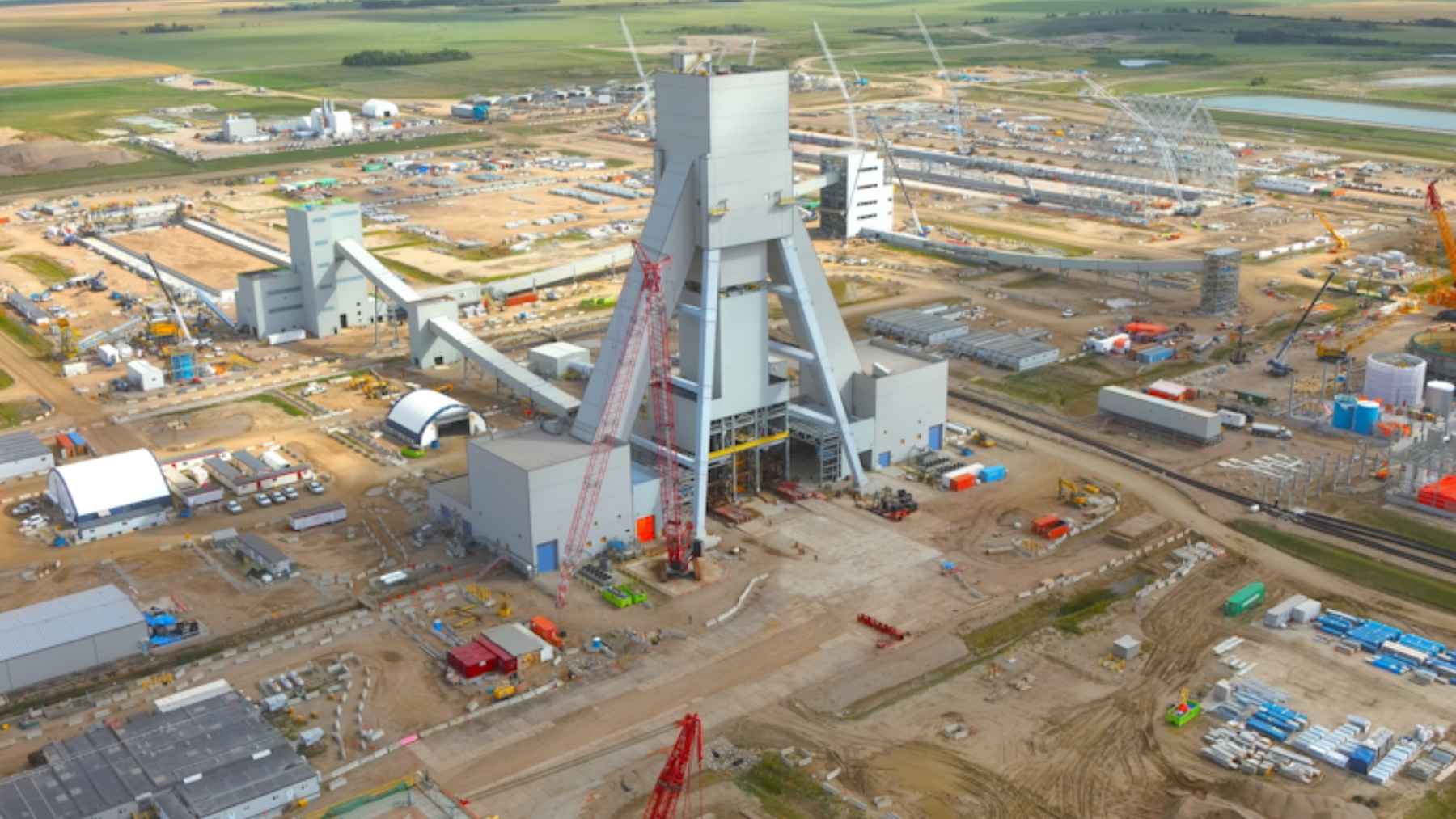
Jansen is the largest version of this anyone has attempted in Saskatchewan. Before a single meter of shaft was excavated, BHP built a refrigeration center on site and, by its own June 2011 disclosure, drilled more than 55,000 meters of wells to complete the 89 freeze holes and monitoring wells the two shafts needed.
That is about 34 miles of hole drilled purely to make the ground cold. None of it produces anything. It exists so that the actual digging is survivable.
BHP says the ground was frozen to a depth of 800 meters, about 2,625 feet. Herrenknecht, the German firm that built the boring machines used at Jansen, describes the freeze installed in 2011 as reaching roughly 650 meters, so the published figures vary depending on which stage you are measuring.
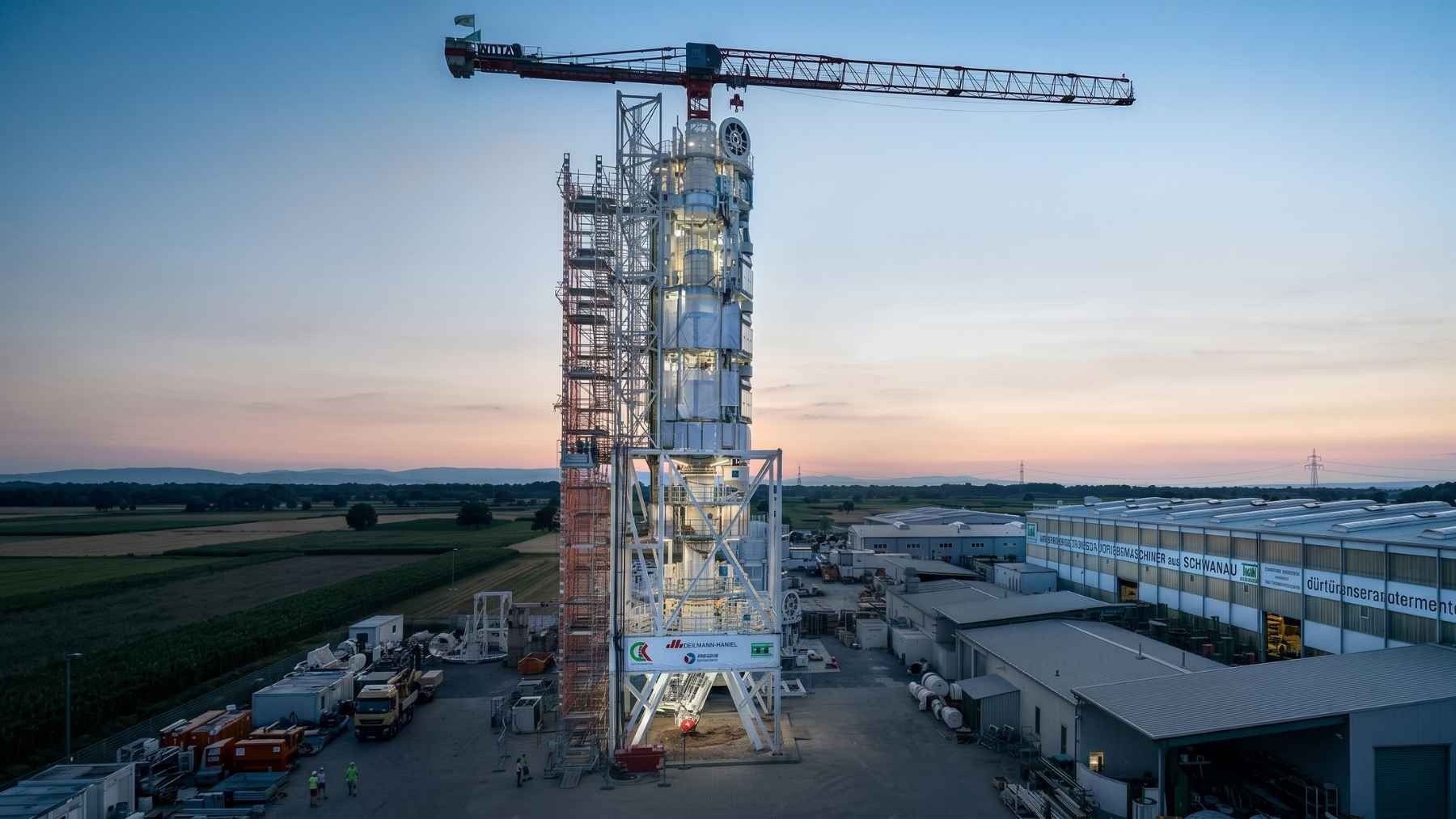
What went down inside that frozen cylinder was a pair of shaft boring roadheaders, the first mine shafts anywhere sunk by mechanical excavation with no explosives. We covered those machines and how they stack up against China’s new full-face vertical borer in a separate piece. The shafts finished at 1,005 meters and 975 meters, both 7.3 meters across once lined, which is a hair under 24 feet.
The ice is temporary. The steel is the part that has to last
Freezing buys time, not a permanent seal. The moment the brine warms up, the Blairmore goes back to being wet sand under pressure, and by then the hole has to be able to defend itself.
So the shafts got a two-pass lining. Herrenknecht’s project notes describe a mechanical ring erector installing steel tubbing segments straight through the Blairmore aquifer, building toward a composite steel and concrete watertight liner in both shafts.
The scale of that liner is easy to underestimate. BHP put it at roughly 30,000 cubic meters of concrete and 7,500 metric tons of steel plate, in pieces weighing one to four tons each, installed from about 900 meters up to the surface.
Then comes the slowest part of the whole operation. Rather than shutting the plant off, crews raise the brine temperature by degrees over months and, in places, years, thawing the ground back to normal while watching how the rock and the water respond. Turning a kilometer of frozen prairie back into wet prairie is a project in its own right.
Patience Lake shows what water does when it finds another way in
None of this is theoretical caution. About 22 kilometers east of Saskatoon sits Patience Lake, the first potash mine in Canada to sink a shaft and reach production, collared in late 1955 using freeze tubes.
The shaft held. The orebody did not.
A 1996 technical paper by D. Gendzwill and N. Martin laid out the sequence. Water first showed up during routine mining in 1975 at the southern boundary of the lease. Grouting and bulkheads slowed it without stopping it, and seismic surveys eventually explained why: the workings had crept toward the edge of a large collapse structure where groundwater had already dissolved away part of the salt and potash.
In 1986 the trickle grew. Fresh grouting did not hold, the inflow outran the pumps, and in early 1987 the mine was abandoned to flooding.
The source turned out to be an extensive network of vertical fractures that no amount of drilling and grouting from underground was going to seal.
Patience Lake came back in 1988 as Saskatchewan’s first converted solution mine, and it still works that way, circulating brine through its own drowned tunnels to dissolve the potash back out. The freeze protects the shaft, and it does that job well. It does nothing about what a mine runs into once it starts cutting sideways.
Jansen is 84% built and $2.3 billion in the hole before it sells a ton
The shafts were excavated between 2012 and 2018, given their final waterproof liners by October 2022, and have spent the years since waiting for the mine around them to catch up.
In its operational review published July 16, BHP put Jansen Stage 1 at 84% complete as of June 30, with US$8.4 billion committed and first production targeted for mid-2027 at 4.15 million metric tons a year. Stage 2 is 16% complete, carries a US$6.9 billion price tag and is now aimed at late FY2031.
The financial picture got worse in June. BHP said it expects to book an impairment of roughly US$2.3 billion against Jansen, and flagged around US$150 million of negative EBITDA from the project in the second half of its financial year. Chief executive Brandon Craig’s line in July was that “Jansen is on track to begin potash production next year.” The full results land on August 18.
Combined, both stages are meant to reach 8.5 million metric tons a year, close to 10% of world potash production, from a company that had never mined the stuff before.
Potash went on the U.S. critical minerals list last November
Potash went onto the U.S. Final List of Critical Minerals on November 7, 2025, alongside copper, lead, silicon and silver. The numbers behind it explain why.
The USGS put U.S. net import reliance at 92% in its February 2026 assessment, with Canada accounting for 79% of imports and Russia 12%. Domestic mines in New Mexico and Utah produced an estimated 500,000 metric tons of K2O last year. Canada produced 15 million.
There is no workaround. The USGS is blunt on the point: no substitute exists for potassium as a plant nutrient, and the low-potassium alternatives like manure and greensand only pencil out over short hauls. That puts fertilizer in a different category from the supply chains getting most of the attention, where the U.S. is at least building alternatives, whether that is a rare-earth magnet plant on American soil or Canada’s push into graphite for EV anodes.
For potash, the alternative is a bigger hole in Saskatchewan. Jansen is the largest one under construction anywhere, and the reason it exists at all is that somebody in 1884 worked out how to dig through quicksand by turning it into ice. Everything since has been a matter of scale.