
Greenpeace is better known for hanging banners off buildings and chasing fishing boats around in inflatables than for heavy construction. But every so often, the group’s UK arm fills a ship with rocks and does a bit of seabed landscaping of its own.
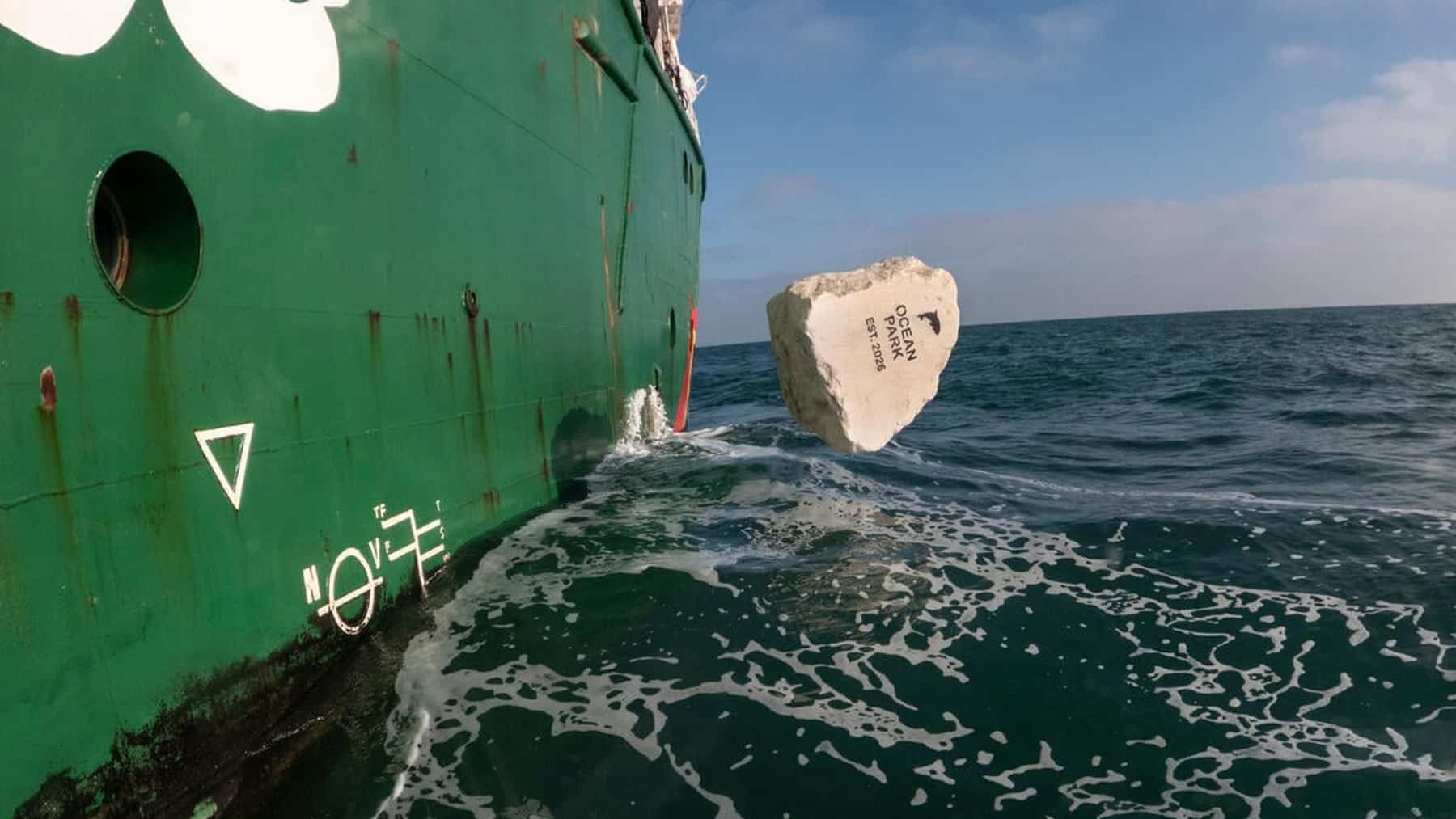
It’s done it again. Over the weekend before its November 2 announcement, Greenpeace UK says its activists put giant boulders on the floor of the Southern North Sea Marine Protected Area, off England’s east coast. Each one weighs up to about 4,400 pounds. The goal is to turn one patch of seabed into somewhere no bottom trawler wants to drag its gear.
Press reports say the rocks went in off the side of the Arctic Sunrise, one of the group’s ships. The drop lined up with the BBC One premiere of Blue Planet III, which is a pretty good way to make sure people are already thinking about the ocean when the news drops.
So how does a rock stop a fishing boat?
A bottom trawl is basically a huge net bag that a boat drags along the seabed. On a lot of rigs, two heavy steel plates called trawl doors hold the mouth of the net open, and they plow along the bottom with the rest of the gear. Beam trawlers use a long steel bar instead, often with chains hanging in front to stir up whatever’s living in the sand. Now picture that gear running into a 4,400-pound boulder at towing speed. The rock isn’t going anywhere, and best case you’re looking at a torn net, while worst case the gear snags hard and the boat has a real problem on its hands.
That’s why skippers keep track of known snags on the bottom and steer around them. So if you scatter enough heavy rocks across an area, you don’t need a law to keep trawlers out. You just need them to know the rocks are there.
Rock on the North Sea floor isn’t exactly new, to be fair. Offshore wind builders dump it by the shipload to keep currents from scouring the seabed around turbine foundations, and one contractor put about 300,000 tons of it around 52 foundations off the Netherlands this summer. Greenpeace’s version is a lot smaller and a lot more pointed.
So who tells the trawlers where the rocks are?
The government posted the boulder positions
On November 2, the Marine Management Organisation, the agency that regulates activity in English waters, published nine positions Greenpeace had reported to HM Coastguard. The MMO says it’s sharing them so fishing vessels and other boats can navigate safely, and it tells anyone working the area to factor them into their plans. It also says it hasn’t independently verified all of them.
I plotted the coordinates against the coastline, and by my rough math they sit somewhere between 45 and 55 miles off Norfolk. End to end, the nine points span about 10 miles. What I can’t tell you is how many boulders that adds up to. Greenpeace hasn’t said how many it dropped, and the MMO’s list doesn’t say whether each position is a single rock or a cluster.
Publishing the positions is arguably the most sensible thing anyone has done in this story. The National Federation of Fishermen’s Organisations warned back in June, according to the Irish trade outlet The Skipper, that a net catching one of these rocks could capsize a boat, and it called the barriers dangerous and irresponsible. A boulder nobody knows about is just a hazard, while one that skippers can find on a list works as a deterrent.
The barrier covers a tiny corner of a huge protected area
Greenpeace says the barrier has effectively closed about 45 square miles of the site to bottom trawling, and it’s declared the zone an “Ocean Park.” As far as I can tell, that name has no legal standing. It’s Greenpeace’s label.
The protected area itself is enormous. The government’s nature adviser, JNCC, lists it at roughly 14,270 square miles. It stretches from north of Dogger Bank all the way down to the Strait of Dover, and most of it is shallower than about 130 feet.
So the boulders cover about 0.3% of the site. I don’t think anyone at Greenpeace believes nine points on a chart will fix the North Sea. This is a protest you can’t hose off a building, and that’s pretty much the point.
Why this patch of the North Sea?
The site was set up to protect harbor porpoises, which are small, shy relatives of dolphins. JNCC says it supports about 17.5% of the UK’s North Sea porpoise population (Greenpeace rounds that up to nearly 20%). Greenpeace says most of the site has no fishing restrictions at all, and JNCC only lists bottom-gear rules where it overlaps Dogger Bank and another protected site off Norfolk.
Greenpeace argues trawling hurts porpoises three ways. It damages seabed habitat, it thins out the fish they eat, and the noise gets in the way of their hunting. The group points to an Oceana report for that last part.
Then there are the hours. Greenpeace ran Global Fishing Watch vessel-tracking data and says bottom trawlers logged at least 37,200 hours in this one protected area last year, more than in any other UK offshore protected area. That’s a little over four years of nonstop trawling squeezed into 12 months. I can’t independently check that analysis, so treat it as Greenpeace’s number.
The group’s other headline figure needs a bit of explaining. It says trawlers and dredgers dragged gear across about 21,500 square miles of seabed inside UK offshore protected areas last year. That number counts every pass, so if a boat trawls the same strip of sand five times, it counts five times. It’s a measure of how much scraping happened, which is a different thing from how much seabed exists.
Rocks don’t do anything about mid-water nets
Not every trawl touches the bottom. Mid-water trawls hang in the water column and chase fish swimming above the seabed, so a boulder sitting on the sand won’t bother them at all.
Greenpeace seems to know that. It says the Arctic Sunrise will patrol the area over the coming days to deter other destructive fishing, and it specifically mentions mid-water gear as a concern for porpoises. How much one ship can actually deter is anyone’s guess, but it’s a fair admission that the rocks only deal with nets that touch the bottom.
A handful of MPs and a couple of actors (Simon Pegg and Benedict Cumberbatch, if you were wondering) signed boulders before they went over the side. That’s the celebrity angle, and I promise that’s all of it.
Greenpeace has done this before
The group has dropped boulders in British waters before, at Dogger Bank, Offshore Brighton and a site off Cornwall called South West Deeps (East). When it went after Dogger Bank, Greenpeace said it would pull the rocks out if the government properly protected the area. Dogger Bank does now have its own bylaw restricting bottom-towed fishing gear, according to JNCC. Whether the boulders had anything to do with that is a fair question, and I’d say the honest answer is “maybe a little.”
If you’re wondering whether this is legal, it’s complicated. The MMO’s November 2 statement doesn’t say a word about legality. After the South West Deeps drop, the MMO called the activity potentially illegal and opened an investigation, The Skipper reports. A Defra spokesperson told reporters this time that all of the UK’s marine protected areas are safeguarded by legislation, that damaging fishing is already banned in more than 100 sites, and that activities at sea “should be carried out lawfully.”
Greenpeace counts differently. It says 43 of the UK’s 378 marine protected areas, about 11%, are fully protected from bottom trawling. Both numbers can be true at once, since banning some damaging gear in part of a site isn’t the same thing as a full bottom-trawling ban across all of it.
The UK has committed to protecting 30% of its land and sea by 2030. A government consultation proposed bottom trawling bans in 42 more protected areas, and Greenpeace says the results still haven’t been published. The Southern North Sea is in line for a later round of that process, and there’s no date for it yet.
Until that happens, the closest thing this corner of the North Sea has to a trawling ban is, from the looks of things, a pile of rocks. The MMO posted its list of nine boulder positions on November 2, and that’s the list trawler skippers working the area are now being told to plan around.