
- 5 MONTHS AGO · INDUSTRYA California company built a seabed mining drone that hovers above the ocean floor instead of crawling it, picking up battery metals one nodule at a time with 16 arms, and leaving nearly a third behind on purpose, the ones with living things attached
- 4 MONTHS AGO · INDUSTRYA neon submarine drone just spent a month hopping across the deep Pacific floor nearly four miles down, dropping onto the mud to grab a core, then skipping to the next spot to map a seabed almost nobody has ever seen
- 3 MONTHS AGO · INDUSTRYA 132-pound American drone two people can lift off a tailgate went into the North Sea instead of a crewed survey ship and picked out everything down to a one-meter cube on the bottom, and its own maker says do not use it below 20 meters of seabed
- 2 MONTHS AGO · INDUSTRYA 9,700-pound drone with 28 lights on it set a 10-inch square down on the seafloor 16,863 feet off American Samoa, scooped out the metal lumps growing inside that square, and bottled the water just above them to test whether a radioactive gas can find more
- TODAY · THIS ARTICLEAn American seabed drone went more than 13,000 feet down in the Pacific, deeper than the Titanic, and picked potato-sized metal nodules off the seafloor one at a time, skipping any with life on them, then floated about a pound back up with no pipe to its ship
You probably know the Titanic is a long way down. The wreck sits about 12,500 feet below the North Atlantic, which goes a long way toward explaining why it took explorers more than seven decades to find it. So when a company wants you to understand how deep its robot went, the Titanic is a pretty handy yardstick.
Impossible Metals reached for exactly that comparison on November 9. In its announcement, the company says its Eureka robot went more than 2.5 miles down to the floor of the Pacific, deeper than the Titanic, and collected seabed nodules on its own, choosing them one at a time before bringing them back to the surface. Reuters reports the dive itself took place during a scientific expedition in September, and the company only went public with it now.
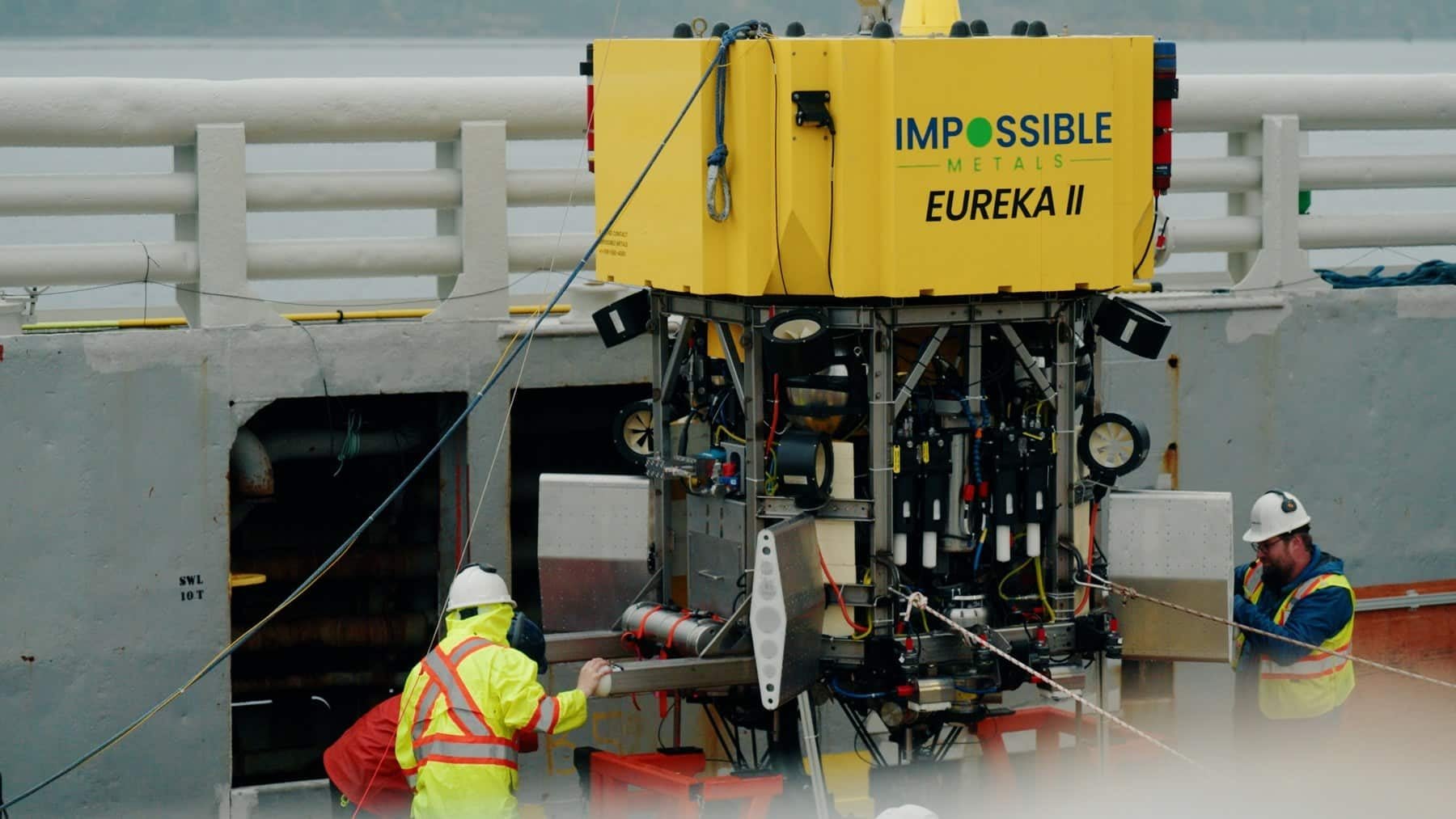
If the name sounds familiar, that’s because we’ve covered Eureka twice already. In July we looked at the 16-arm production robot Impossible Metals wants to build, and in September we wrote about Eureka II finding its own ship off Halifax and getting hauled aboard with nobody at the controls. This dive is the one the company is calling proof that the whole concept works.
So what’s a nodule, anyway?
Polymetallic nodules are lumps of rock, usually around the size of a potato, that sit loose on the abyssal plain. That’s the flat, muddy floor of the deep ocean, miles below the surface. The nodules grow incredibly slowly over millions of years, and they’re loaded with nickel, cobalt, copper and manganese, which is why battery makers and governments keep eyeing them.
The Clarion-Clipperton Zone, where Eureka made this dive, is a huge stretch of Pacific seabed between Hawaii and Mexico that’s covered in them. Most companies that want those nodules plan to collect them with what’s basically a giant vacuum cleaner on tracks. It crawls across the bottom sucking up rocks and sediment, and a riser pipe that’s miles long pumps the whole mix up to a ship.
That approach has already been trialed. A Belgian company ran a tractor-style collector called Patania II through this same zone a few years ago. Environmental groups really don’t like the vacuum idea, though, and it isn’t hard to see why. You’re scraping up the top layer of seabed along with whatever happens to be living on it.
Eureka hovers instead of driving
Impossible Metals went a different way. Eureka stays off the bottom entirely, hovering over the seabed instead of landing and rolling across it. It checks out what’s underneath with cameras and software, and uses robotic arms to pick up individual nodules. If a nodule has visible life on it or right next to it, the company says Eureka leaves it alone.
So how do the rocks get back to the surface without a pipe?
Basically, the robot plays with its own buoyancy. When it weighs more than the water it displaces, it sinks, and when it weighs less, it floats. It’s roughly the same trick a submarine pulls with its ballast tanks, just on a much smaller machine. Impossible Metals calls the system that handles this a buoyancy engine, and the company says it means you don’t need a riser pipe at all. You also skip the water that riser systems pump up along with the rocks and then have to discharge back into the sea.
It’s a pretty elegant idea, and frankly a lot easier to picture than a pipe several miles long hanging off a ship. Whether it scales is a different question, and we’ll come back to that.
Impossible Metals says this makes Eureka the first fully autonomous underwater robot to selectively collect polymetallic nodules from the deep ocean. That’s a pretty specific claim, and the details matter. Nodules have been hauled up from the deep plenty of times before, by dredges, sleds and collector trials like the Belgian one. What the company is claiming is a robot that picked its own rocks, hovered instead of driving, and didn’t need a pipe to get them home.
About a pound of rocks for a bacteria lab
How much did Eureka actually bring back? About a pound. That won’t keep any battery factory busy, and to be fair, Impossible Metals isn’t claiming it should.
The company says the dive was run as marine scientific research and that the amount it collected reflects that. The nodules are headed to Viridian Biometals, a research partner working on bacterial methods for recovering metals from nodules. Viridian plans to study the bacteria populations that live inside the rocks.
I’ll admit there’s something a little funny about sending a robot deeper than the Titanic and coming home with a lab sample. But if you’re trying to show a concept works without anyone accusing you of quietly opening a mine, a pound of rocks for microbiologists is probably the smart amount to grab.
Impossible Metals also says it’ll publish all the scientific data from the dive, the same way it did with the Eureka II dives on the Blake Plateau, off the US Southeast coast, a couple of years ago. It works with a standing group of nine independent scientists, too, and says they’re allowed to criticize the company publicly if they want to.
Who’s paying for this?
The announcement names two backers. One is In-Q-Tel, or IQT, which Impossible Metals describes as the strategic investor for America’s intelligence and national security community. The other is the Smith family of FedEx.
Richard Smith, who’s CEO of FedEx Airline and COO of FedEx International, says in the release that his father cared about the US locking down a supply of nodules for its industry and its national security. Reuters adds that the company has backing from startup accelerator Y Combinator as well.
So yes, a seabed robot now has an intelligence-community investor in its corner. I wouldn’t read too much into that, though. The dive was a science mission, and the release pitches Eureka purely as a way to collect nodules.
Steve Curnutte, Impossible Metals’ executive chairman and CEO, sounds pretty confident about where things stand. “Eureka is proven, patented, and ready,” he says in the release, adding that the job now is manufacturing and scaling up, with the inventing already done. The patent is US patent 12,704,065, granted on August 11, 2026, and it lists company co-founders Oliver Gunasekara and Jason Gillham as the inventors.
“Proven” is a big word for one dive and a pound of rocks, if you ask me. Still, the business plan makes sense on its own terms. Impossible Metals wants to offer Eureka as robots-as-a-service, working with contractors that hold licenses to nodule areas. Curnutte’s argument is that you expand the operation one robot at a time, without sinking money into massive infrastructure on day one.
Eureka III gets the bigger test
The next test is the one I’d actually keep an eye on. Impossible Metals says Eureka III, the scaled-up version, will run in 2027 in front of an independent scientific team aboard RV SONNE, a German research vessel. It’s part of an environmental impact study started by BGR, Germany’s Federal Institute for Geosciences and Natural Resources.
That trial has already slipped once. When we wrote about Eureka III in July, the company had pushed it back from an earlier target, so I’d treat 2027 as the current plan rather than a promise.
Eureka still can’t mine anything
The catch is that none of this gives Impossible Metals permission to start mining. According to Reuters, the company still needs approval from either the International Seabed Authority or the US government.
If you haven’t heard of the ISA, it’s the organization set up under the UN’s Law of the Sea treaty to oversee mining in international waters, which cover most of the Clarion-Clipperton Zone. It hands out exploration contracts, but it hasn’t approved commercial mining there for anyone yet. The US never ratified that treaty, which is why a US government route even comes up.
So what don’t we know?
Quite a bit, actually. Impossible Metals hasn’t given an exact depth beyond saying it was more than 2.5 miles, a date for the dive, or how long Eureka spent on the bottom. It also hasn’t said how many nodules the robot looked at and decided to skip. That’s the number I’d most like to see, since the whole pitch rests on Eureka leaving the living stuff alone.
Then there’s the robot itself. The photos and video Impossible Metals offered with the announcement are of Eureka II, but the release doesn’t say that’s the vehicle that made this dive, so I can’t tell you how big or heavy the machine down there was. The company hasn’t shared how much it raised from In-Q-Tel or the Smiths, either.
What we do know is when the next proper look comes. Impossible Metals says Eureka III will be tested aboard RV SONNE in 2027 with independent scientists watching, and that’s when we’ll find out how the hovering approach holds up at a bigger scale.
 A 400,000-square-foot nuclear building left unfinished in South Carolina has been stripped of its ducts, piping, tanks and gloveboxes to be rebuilt as a factory for at least 50 plutonium cores a year, and a structure first due a decade ago now won’t be done for another 12 yearsIndustry · 3 hours ago
 A 591-foot bulk carrier that can load about 40,000 tons struck a 97-year-old drawbridge on the Delaware River while its span stood open for ships, and the bridge then stayed stuck in the air, backing up cars on both banks between Philadelphia and New Jersey, with no one hurtIndustry · 6 hours ago
 An Idaho silver mine flooded to about its 3,400 level traded the hoist it had used for 110 years for one that lifts 3,500 tons a day, and the shaft it hangs in is the only way down to a deposit that gave up about 365 million ounces of silver and that its owner wants back in productionIndustry · 1 day ago