
- 2 MONTHS AGO · MILITARYThe Navy rewired a destroyer from 450 volts to 4,160, dropped in generator sets making 4 megawatts apiece and a bigger chilled-water plant to carry the heat away, and every bit of that exists to feed one radar that it says does the work of two ships
- 2 MONTHS AGO · MILITARYA 115-pound underwater drone runs like a torpedo on two tail thrusters and spins a third pointing straight down to stop and hover over anything shaped like a mine, and the Spanish Navy launches the 5.2-foot machine from small boats so a diver doesn’t have to go down first
- 1 MONTH AGO · MILITARYA 9,138-ton nuclear attack submarine smashed her sonar dome and forward ballast tanks into an undersea mountain nobody had charted, limped home on the surface, and has sat on blocks in a Washington dry dock ever since, waiting for a nose the Navy has to build from scratch
- 4 WEEKS AGO · MILITARYAn 80-ton American drone submarine 85 feet long drove itself more than 1,000 nautical miles across the Pacific with nobody aboard, surfacing to run its diesels and recharge before diving again, the first long haul the Navy has let one of its big drone subs make alone
- TODAY · THIS ARTICLEA 6,500-nautical-mile drone submarine built to lay mines with nobody aboard is about to reach the Navy as the third of three prototypes, nine years after the program began, and the officer running it says the plan now is to find out what it really does well and what it doesn’t
There’s an old rule a lot of car people swear by: never buy the first model year of anything. Let someone else deal with the electrical gremlins and mystery rattles, then buy the version after the fixes. It’s pretty good advice if you’re shopping for a pickup.
Unfortunately, the Navy doesn’t get that luxury with its biggest drone submarine. Orca has basically been one long first model year since the program started in 2017, and the officer running it now says that stretch is ending.
Capt. Michael Linn, the program manager for the Navy’s Undersea Warfare Program Management Office, said on Friday, November 13, that two of Orca’s three prototypes have already been delivered and the third is due soon. Breaking Defense reported his comments on Monday. He added that the Navy’s production plans for Orca are nearly wrapped up.
Linn was pretty candid about how the program got here, too. He called the road to this point long and grueling. For a Navy captain speaking on the record, that’s pretty much a sigh.
So what happens once the third one shows up?
According to Linn, the Navy wants to put it to work and characterize it. In his words, the goal is to “figure out what it really does well and what it doesn’t do well.”
So what does “characterize” actually mean?
In this case, it means taking the vehicle to sea and measuring what it really does, not what it’s supposed to do on paper. Anyone who’s checked an EV’s real-world range against the number on the window sticker already gets the idea.
Linn didn’t say how long that testing will take. I also can’t find a delivery date for the third prototype in anything the Navy or Boeing has published. For now, all we have is Linn’s word that it’s coming soon, and the Navy hadn’t announced a delivery date when this went up.
The hardware hasn’t changed
If you read our earlier coverage, you already know the basics. (You’re welcome!) But let’s do a short version.
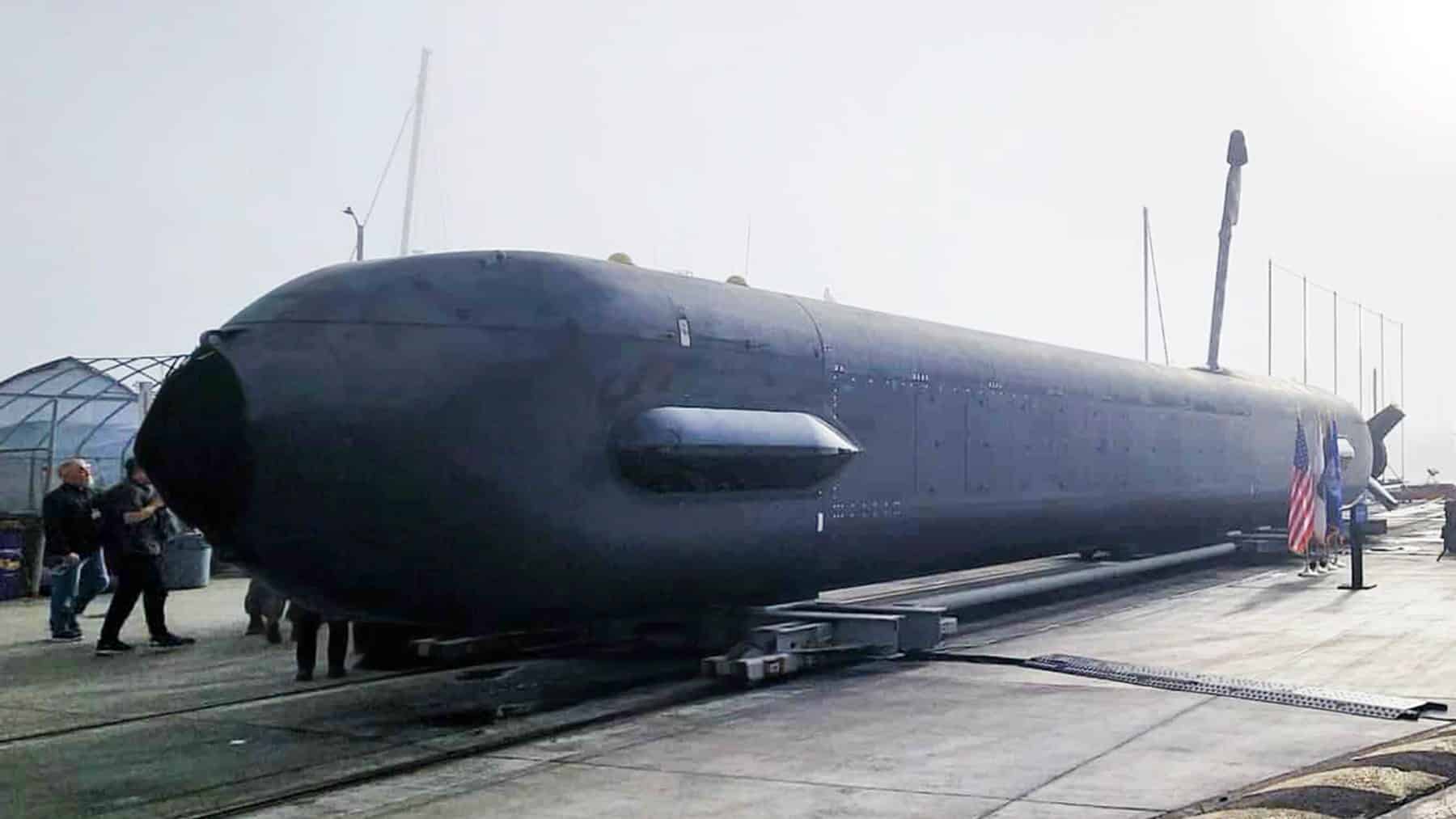
Boeing’s spec sheet lists the core vehicle at 51 feet and pairs it with a removable 34-foot payload section that holds up to 8 tons, which Boeing says is room for nine 21-inch medium drones or 48 smaller 12.8-inch ones. Slot that section in and you’re at about 85 feet, the length Capt. Scot Searles, the Navy’s program manager for unmanned maritime systems at the time, gave reporters in early 2024, according to DefenseScoop. It runs on batteries backed by marine diesel generators, has a range of up to 6,500 nautical miles (roughly 7,480 regular miles), and can go in and out of the water from a pier without a support ship tagging along.
Navy officials have put its weight at 80 tons in one briefing and 85 in another, so I’d treat that one as a ballpark rather than a spec. You can see the full list on Boeing’s Orca page.
Its first job, according to Breaking Defense, is laying undersea mines. And it’s already done some real distance. In July, an Orca made a solo run of more than 1,000 nautical miles in the Pacific, the first time one had gone that far, which we covered back in October.
Why are there still prototypes after nine years?
You might be wondering why a program that started in 2017 is still talking about prototypes instead of finished boats. The short answer is that the Navy never bought Orca like a normal ship.
Navy budget documents describe it as a multi-phased accelerated acquisition effort, according to DefenseScoop, and those same documents tied future orders to how the first five vehicles performed. In plain English, the Navy bought a handful, learned from them, and made the next buys depend on the results. That’s a reasonable way to handle a vehicle type no one had built before.
It’s also, frankly, a recipe for exactly the kind of slow grind Linn was describing.
Here’s roughly how long that grind has been. The Pentagon handed design contracts to Boeing and Lockheed Martin on September 28, 2017, and Boeing won the job of building the first vehicles on February 13, 2019, according to the Congressional Research Service.
Then came a dedicated test vehicle called XLE0. It started in-water testing off Huntington Beach, California, in spring 2023, and NAVSEA announced on December 20, 2023, that the Navy had accepted it. That release skipped the acronyms and simply described Orca as a diesel-electric submarine with no one on board, which is refreshingly honest for a Navy press release. The first actual prototype followed in 2025, according to the Government Accountability Office.
Which brings up a slightly awkward detail. The public counts don’t quite line up. NAVSEA’s 2023 release talked about Orca vehicles one through five, the budget documents mentioned above refer to the first five, and Linn is now talking about three prototypes. On top of that, the Navy’s May shipbuilding plan lists 16 Orcas through fiscal 2031, as we reported in June. I haven’t seen an official explanation of how those numbers fit together, so I’m sticking with Linn’s: three prototypes, two delivered, one on the way.
What comes after Orca?
The Navy’s next extra-large drone sub effort is called CAMP, short for Combat Autonomous Maritime Platform. It’s a joint push with the Defense Innovation Unit to prototype these vehicles and get them into the fleet faster, and Linn said the Navy plans to build on what it learned from Orca.
Which makes sense. If you’ve spent nine years learning things the hard way, you’d probably like the next program to skip a few of those lessons.
Rear Adm. Chris Cavanaugh, who commands submarine forces for the U.S. Pacific Fleet, spoke the day before Linn and grouped Orca with CAMP and Dragonfish. Dragonfish is a large drone submarine that replaced the Navy’s canceled Snakehead program. Cavanaugh said all three are moving toward real operational use and are meant to work alongside crewed submarines.
He also argued that uncrewed boats can be sent into situations where the Navy wouldn’t risk a crewed submarine and its sailors. I’d argue that’s the most interesting thing Cavanaugh said. A drone sub that’s slow to build is still one the Navy can send into trouble without putting a single sailor aboard.
So when the third Orca finally arrives, it’s headed for a test schedule rather than a ribbon-cutting. Linn said on November 13 that the delivery is coming soon, and that once it’s in Navy hands, the job is finding out what it can actually do.
 Here’s Some Crazy Stuff You Can Buy Instead of Spending $230,000 On the Bentley TorcalPerformance & Luxury · 2 months ago“Looks Like China Copied a Rolls-Royce”: The 2028 Bentley Torcal Was Fully Revealed, And It’s Ugly and UninspiredPerformance & Luxury · 2 months ago
 A 39-foot Danish drone boat that once had a Russian corvette pass within about 650 feet of it in the Baltic has now been steered live in Danish waters from a control room across the North Sea in Scotland, its sensor feed piped into a test of how one frigate could run a pack of drone boatsMilitary · 4 hours ago