
If you have ever wrestled a couch up to a third-floor apartment, you know the couch is rarely the problem. The doorway is. Hydro Tasmania just finished a version of that job where the couch weighs more than 110 US tons and the doorway is a 0.6-mile tunnel cut through rock, and the crew still had to strip the lights off the walls to make everything fit.
The first of three new main inlet valves has arrived at Gordon Power Station, the biggest hydro plant in Tasmania, Hydro Tasmania announced on September 2. The valve is 19 feet wide, just under 16 feet high, and heavier than 110 US tons (100 metric tons). Hydro Tasmania paid A$8 million for it, about $5.8 million in US money, and had it built on the other side of the planet.
Components were manufactured, assembled and tested across Portugal, Spain and Austria, with the German company Voith Hydro handling the design work alongside Hydro Tasmania’s engineers. The finished valve went onto a ship in Belgium, sailed around Africa to Melbourne, then crossed to Devonport in Tasmania. From there, a local hauler called Gradco put it on a truck that extra prime movers had to push and pull down the Midlands Highway. The load took up two lanes.
So why is anyone going to this much trouble for a valve?
What does a main inlet valve actually do?
Gordon Power Station sits about 600 feet underground, below Tasmania’s tallest dam, and its three turbines drink from Lake Gordon. Hydro Tasmania says the lake, together with neighboring Lake Pedder, forms the largest water storage in Australia, and Lake Gordon alone holds around 10.1 million acre-feet. Each turbine gets its own main inlet valve, and that valve is basically the only barrier between the machinery and all of that water.
Hydro Tasmania compares the valve to a giant kitchen tap. I can get behind that image, as long as your kitchen tap can slam shut against the push of an entire lake and then hold it back while somebody works on the turbine downstream. The originals have been doing exactly that since the station was built, and the engineers who designed the replacements went back to the original 1971 drawings to do it.
Hydro Tasmania has not published the new valve’s bore diameter or its working pressure, which are frankly the two numbers I most wanted to see. The company has said the valve swap belongs to a wider Gordon Power Station overhaul that started with major outages in 2024, runs about a decade, and also covers turbine runners, distributors, generator thrust blocks and a transformer.
A tunnel with an inch or two to spare
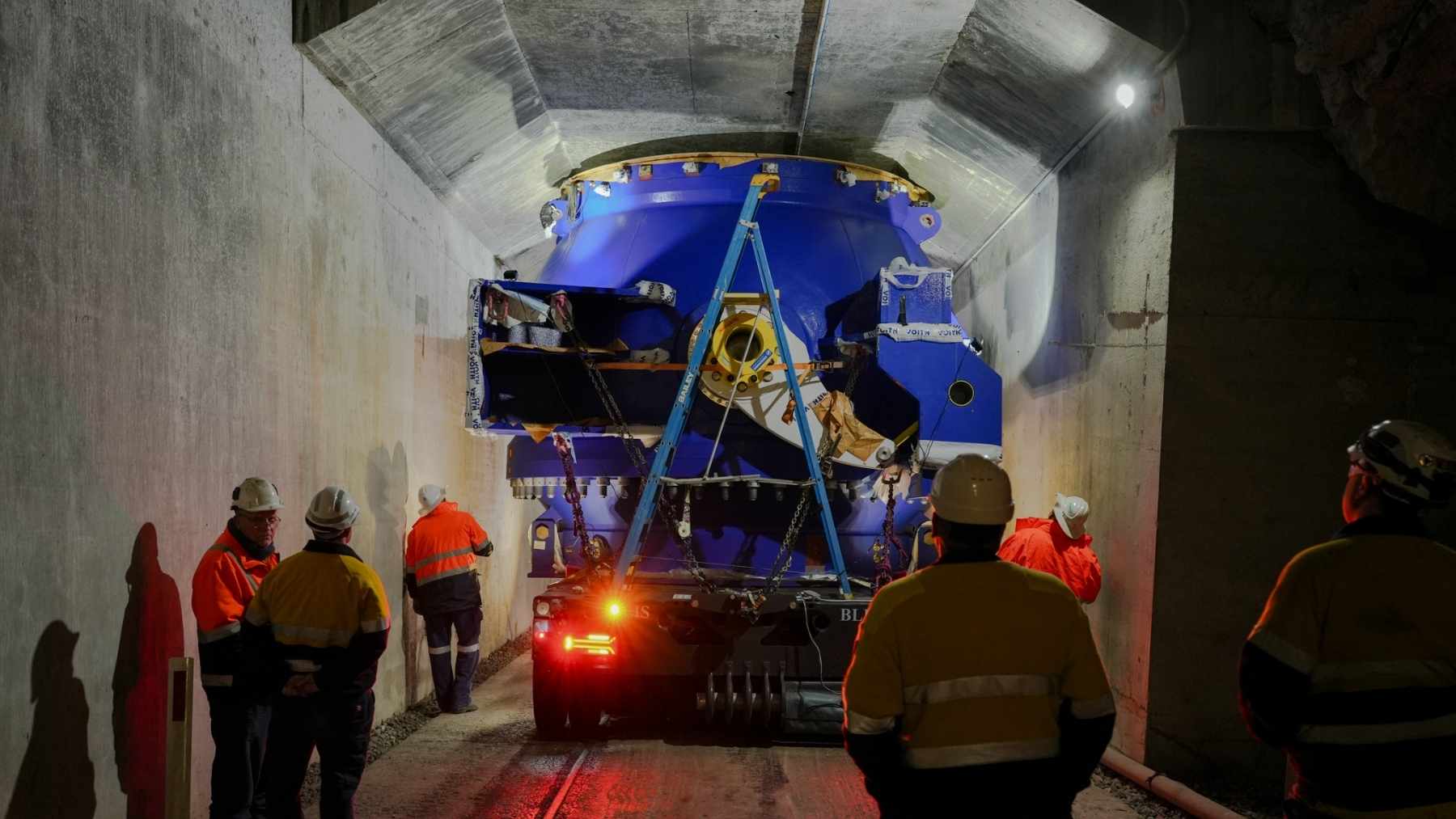
At Strathgordon, the valve came off the highway truck and onto a specialized remote-controlled trailer for the last leg: the station’s access tunnel, which runs about 0.6 miles (1 kilometer) through rock. Nobody sized that tunnel for a 19-foot-wide valve back in the day. Hydro Tasmania removed the tunnel lights and cut back sections of rock, and some stretches still left clearance you would measure in single centimeters, an inch or two in American terms. That is not much margin.
According to Jesse Clark, Hydro Tasmania’s Executive General Manager, “the most delicate part of the journey was the final kilometre.” Clark’s cargo had just sailed around an entire continent, so he was grading that trip on a pretty serious curve.
America is working through the same cycle
Hydro plants across the world are hitting the age where their biggest original parts wear out. The US Army Corps of Engineers is doing the same job under the Cumberland River, where a seven-blade runner is replacing a five-blade one that had been spinning at Old Hickory since 1957. That runner lasted 69 years before its replacement showed up, and Gordon’s original valves will come out after roughly half a century of service.
Hardware this heavy is routine in the hydro business. The two pump-turbines at Foyers on Loch Ness have been pushing water uphill since the mid-1970s, and each weighs more than 990 US tons (900 metric tons). Next to a 990-ton pump-turbine, a 110-ton valve almost counts as carry-on luggage.
Gordon makes 13 percent of Tasmania’s electricity
Gordon Power Station runs three Francis turbines rated at 144 megawatts each, for 432 megawatts in total, and Hydro Tasmania says the plant covers around 13 percent of Tasmania’s electricity needs every year. All of it sits in the shadow of the Gordon Dam, a double-curvature concrete arch standing 459 feet (140 meters) tall, the tallest dam in Tasmania. You can actually walk across the top of the dam wall if you visit, which I would rate as either a great idea or a terrible one depending on how you feel about heights. The first two generating units came online in 1977, and the third followed in 1988. Water reaches the machines by dropping down a vertical shaft, and the main inlet valves are the last thing it meets before the turbines.
Hydro Tasmania plans to bolt this first valve into place during 2027. The remaining two face the same boat, the same highway and the same tunnel.
Hydro Tasmania announced the first arrival on September 2, 2026, and says valves two and three are due at Gordon within the next 24 months.