
- 2 MONTHS AGO · MILITARYA 10.5-foot, 8,710-pound seabed drone found its own ship off Nova Scotia, latched onto a camera-guided hook and rode onto the deck with nobody at the controls. That job is still done by crews leaning over the rail with poles, on a machine built to pick potato-sized rocks off the ocean floor
- 2 MONTHS AGO · MILITARYA 38-foot drone boat that once spent 192 hours alone at sea came up behind a float towed by a Navy ship off Virginia, pushed a fuel probe into it, took on 400 gallons over dozens of hookups and let go each time, and somebody was steering the probe on every one
- 3 WEEKS AGO · MILITARYA 6,900-ton nuclear attack submarine lost permission to dive while she waited for an overhaul, was towed three times between Norfolk and a private shipyard and sat in dry dock with less than a quarter of the work done, and the Navy is now sending her shipyard workers to new submarines
- 2 WEEKS AGO · MILITARYA 97,000-ton nuclear aircraft carrier has now spent more than 2,000 days at the Virginia shipyard that built her, getting a new mast and work on over 600 tanks, and Navy documents point to one more year of it, with her sister ship already there for a five-year overhaul
- TODAY · THIS ARTICLEA 9,600-ton guided-missile cruiser that spent eight years in an overhaul once reported 85 percent done, and never deployed again, was towed out of Philadelphia by an ocean tug for a Texas scrapyard, with its gun barrels gone and its parts stripped for its sister ships
When the Navy’s done with a warship, it’s got a handful of options. It can sell or give the ship to an ally, hand it over to become a museum, sink it as a target during an exercise, or send it off to be cut up for scrap. Recently, we’ve covered a World War II submarine towed back to its museum berth across Lake Michigan and a frigate that left Philadelphia’s mothball fleet to be sunk off Scotland.
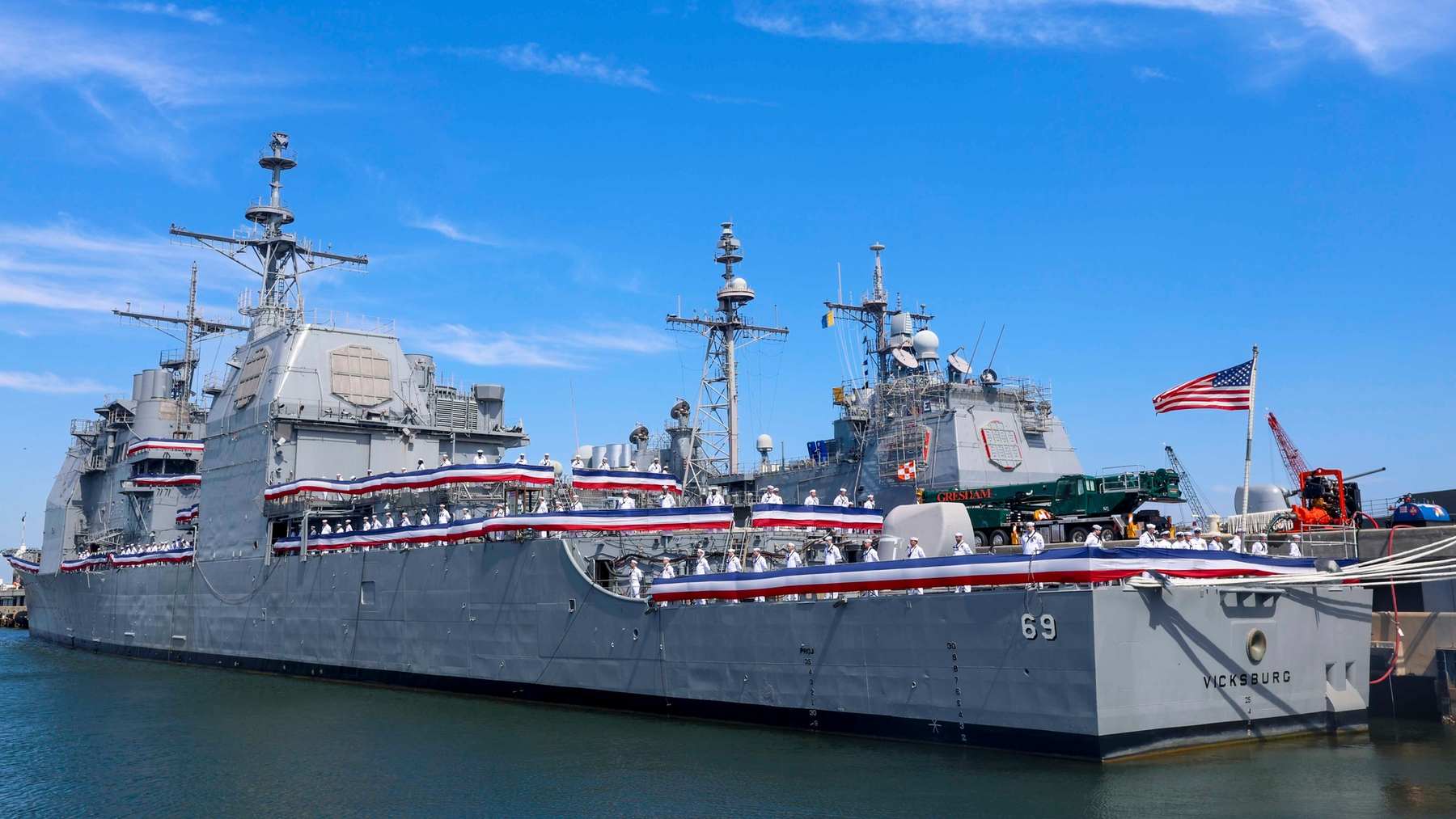
The USS Vicksburg (CG-69) got the last option. And frankly, its story is a lot more awkward than either of those.
The Vicksburg is a Ticonderoga-class guided-missile cruiser, and it spent its last eight years in a modernization program that was meant to keep it in the fleet longer. It never deployed again. The Navy decommissioned it in 2024, pulled parts off it to keep other cruisers running, and has now had it towed out of Philadelphia for a shipbreaking yard in Brownsville, Texas.
So how does a ship get reported as 85 percent done and still end up as scrap?
There’s a lot of cruiser here
Ingalls Shipbuilding built the Vicksburg in Pascagoula, Mississippi, and the Navy commissioned it on Nov. 14, 1992. It’s 567 feet long and 55 feet wide, and the Navy’s fact file for the Ticonderoga class puts these ships at 9,600 long tons at full load.
If you’re wondering what a long ton is, it’s 2,240 pounds, a bit heavier than the 2,000-pound ton most of us use. Full load basically means the ship with its fuel, ammunition, crew and everything else aboard. The Navy’s paperwork doesn’t quite agree with itself, though. A Naval Sea Systems Command (NAVSEA) historical evaluation of this specific ship lists 9,992 tons and doesn’t say which kind of ton that is.
For most of its career, the Vicksburg did what cruisers do. It deployed again and again from 1994 to 2015, from the Mediterranean and the Persian Gulf to the Black Sea, according to NAVSEA. That’s a pretty full résumé.
Eight years in the yard didn’t get it back to sea
On July 1, 2016, the Vicksburg left Carrier Strike Group Twelve and joined the cruiser modernization program. Its home port moved to Norfolk, Virginia, and its crew dropped from 350 to fewer than 50. A lot of the work was done by BAE Systems’ ship repair yard in Norfolk.
The idea was basically a midlife overhaul. The Navy would open up an older ship, update its systems and keep it in service longer. In May 2022, Navy acquisition official Jay Stefany told a House subcommittee the Vicksburg was in the 85 percent range, USNI News reported. NAVSEA’s record says the work was expected to wrap up by the summer of 2023. It didn’t.
But the Navy had already asked to decommission the ship in its fiscal 2023 budget, and it asked again in fiscal 2024.
When auditors from the Government Accountability Office (GAO) toured the Vicksburg in September 2023, they found the modernization was largely incomplete. Consoles in the combat information center, which is the room where the crew runs the ship’s sensors and weapons, were wrapped up and disconnected. The crew told the GAO that 22 tons of electronic equipment had been left unused without any air conditioning, and officials said a large portion of it probably wasn’t salvageable.
I can’t tell you exactly how a ship goes from roughly 85 percent done to largely incomplete in a little over a year. To be fair, an official’s estimate to Congress and an auditor’s walk-through aren’t the same kind of measurement. Still, they’re a pretty jarring pair to read side by side.
So what was wrong with the sonar dome?
A cruiser’s sonar dome is the big rounded housing under the bow that holds its main sonar. It’s essentially how the ship listens for submarines, and the GAO describes it as critical to the ship’s submarine-hunting job.
According to the GAO, the contractor’s work on the Vicksburg’s sonar dome was poor quality and had to be redone, which added cost and delays. When officials priced out finishing the ship, the dome was nonfunctional. Fixing it meant dry dock.
That dry dock wasn’t included in the Mid-Atlantic Regional Maintenance Center’s estimate that another $100 million could finish the job by fiscal 2025. The program office put the cost of completing the modernization at about $120 million. The Navy divested the ship instead, with significant work still left to do.
The Vicksburg became a parts donor
Cannibalizing a ship sounds dramatic, but it basically means pulling working parts off one ship to keep others running. It’s the naval version of keeping a junkyard car around so you can grab its alternator when yours dies. Fleet officials told the GAO the Vicksburg had been cannibalized to keep the USS Gettysburg and other cruisers supplied with parts.
By April 2024, it had been towed from the BAE yard to Naval Station Norfolk with the barrels gone from both 5-inch gun mounts and its topside gear stripped off, according to photos published by Naval News. The crew held a decommissioning ceremony in Norfolk on June 28, 2024. NAVSEA lists the formal decommissioning, and the date the ship was struck from the Navy’s rolls, as July 26, 2024.
In January 2025, NAVSEA also found the Vicksburg ineligible for the National Register of Historic Places. If you were hoping to tour it someday, that doesn’t automatically rule out a museum, but it doesn’t exactly help the case for one either.
The Vicksburg wasn’t the only cruiser left unfinished
In a December 2024 GAO report, auditors found the Navy spent about $3.7 billion modernizing seven Ticonderoga-class cruisers from 2015 through fiscal 2023. Four of those ships, the Hue City, Anzio, Cowpens and Vicksburg, were “divested prior to deploying,” and they accounted for $1.84 billion of that spending.
The Vicksburg’s own share was $754.1 million, according to USNI News. The three that made it through, the Gettysburg, Chosin and Cape St. George, were picked to stay in service past their expected lifespans. It’s a bit of an odd outcome, frankly. The Vicksburg ended up helping keep its sister ships at sea instead of getting back there itself.
The last trip is a dead ship tow
A stripped, decommissioned cruiser isn’t going to sail itself to Texas, so the Vicksburg moved as what’s called a dead ship tow. That basically means the ship has no propulsion of its own and no crew running it. A tug does the work, and the cruiser just follows at the end of a line.
Reports don’t agree on exactly when it left Philadelphia, so I won’t pin a date on it. The Texas end is better documented. On Oct. 22, the Coast Guard published a rule in the Federal Register setting up a 500-foot safety zone around the Vicksburg and the towing vessel Caitlin for the run from the sea buoy up the Brownsville Ship Channel to International Shipbreaking’s dock. The zone covered Oct. 20 through Oct. 24, but it was only going to be enforced on the one day the tow actually moved.
The federal notice only names the Caitlin for that Brownsville leg. And as far as I can tell, neither the Navy nor International Shipbreaking has publicly confirmed the cruiser’s arrival.
What we do have is the Port of Brownsville’s arrival chart for Oct. 19, which listed the Vicksburg as due around Oct. 21, at 567 feet, with Philadelphia as its last port and scrapping as its job.
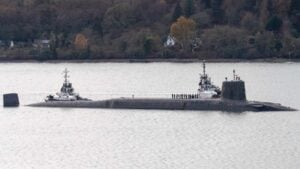 A 17,500-ton British nuclear missile submarine just came home to its Scottish base after an estimated 217 days hidden underwater, about 12 days longer than any Royal Navy patrol before it, and the Ministry of Defense will not confirm how long the boat was at seaMilitary · 21 hours ago
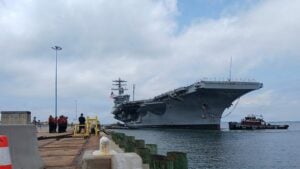 A 100,000-ton nuclear carrier left her Pacific home port for the last time, rounded South America and tied up in Virginia to be retired, and she is still in commission and landing jets months later because her replacement is late, with her reactors to be emptied once she retires in MarchMilitary · 3 days ago
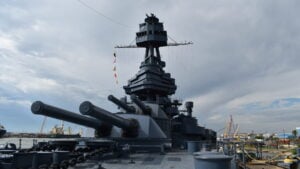 A 27,000-ton battleship that once had 45 pumps taking thousands of tons of water out of her hull is having a 32,000-square-foot wood deck finished at a Texas yard she has occupied since 2022, and she’ll move about a mile to a pier where officials hope to open her by the end of 2027Military · 4 days ago