
When someone says “grid battery,” you probably picture a shipping container full of lithium cells parked next to a solar farm. That is the version getting built by the thousand right now. Australia is building a different kind, and it does not fit in a container. It involves two lakes in a national park, a tunnel bored almost a kilometer straight down through the Snowy Mountains, and a machine that weighs 2,300 tons.
On May 18, that machine punched through the last of the rock and into a cavern complex deep underground, finishing its part of what is now the largest renewable energy project ever built in the country. The thing it is helping to carve out is a power station the size of a 20-story building, buried 800 meters below the surface, designed to act as a battery that two mountain lakes can charge and discharge on command. It has also run years late and billions over budget, which is the other half of this story.
The machine that just broke through weighs 2,300 tons
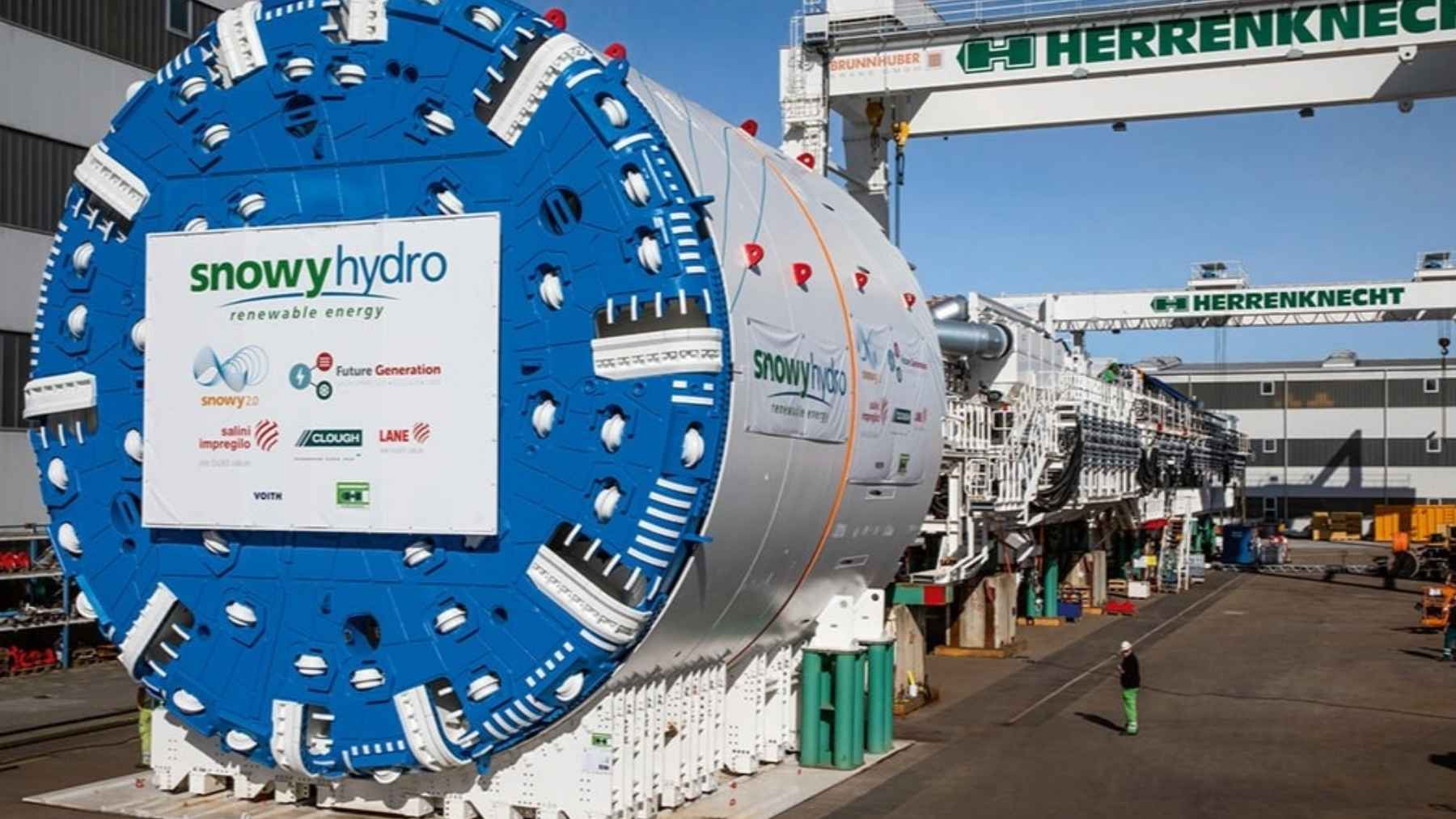
The borer that finished its job on May 18 is called Lady Eileen Hudson, and at 2,300 tons she weighs about as much as a small navy frigate, except hers was driven sideways into a mountain. Her last assignment was a six-kilometer tunnel called the tailrace, which will eventually carry water from the underground power station back down to the lower reservoir.
Before that she ground out a 2.85-kilometer access tunnel that crews now use to reach the worksite. When she broke through into the cavern complex, Snowy Hydro said her tunneling work on the project was finished, and according to the trade outlet Trenchless Australasia, attention is now shifting to building the power station itself.
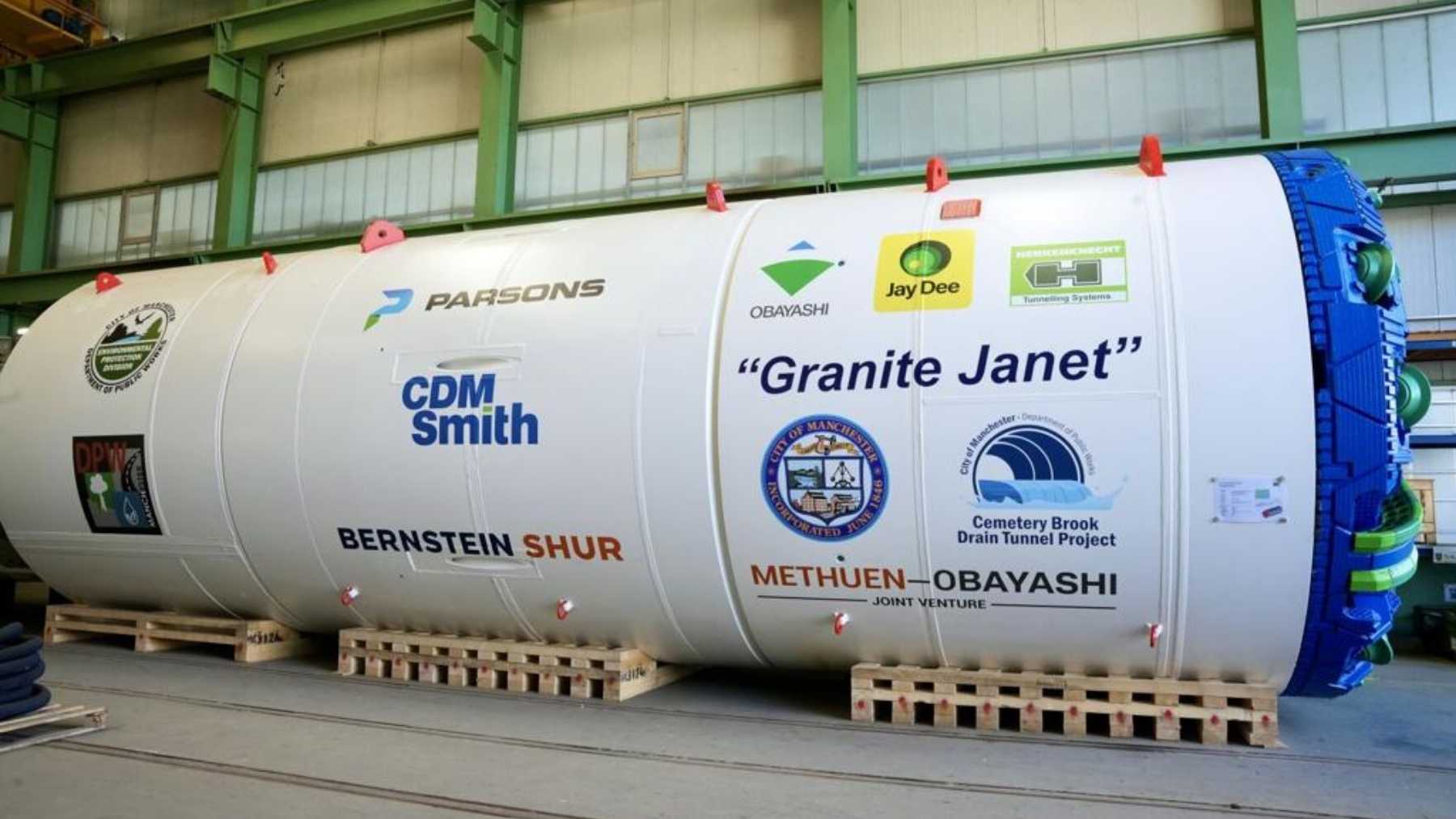
She is one of four of these machines on site, all named after women. Lady Eileen Hudson was an ambassador to the original Snowy Scheme in the 1950s; Florence is named for Florence Violet McKenzie, Australia’s first female electrical engineer; Kirsten for astrophysicist Kirsten Banks; and Monica for Monica Brimmer, a Tumut High School student who won a First Nations art and storytelling competition tied to the project. Monica is the newest and the most quietly absurd of the bunch. Her cutterhead (the spinning steel face that actually grinds the rock) is almost 12 meters across, too big to move down a public road in one piece, so it was cut into five.
The center section alone weighed more than 300,000 pounds, and getting it to the remote worksite meant rolling it through the town of Cooma after dark on a transporter with 152 wheels, in a convoy 73 meters long. Chief Delivery Officer Dave Evans called it “an amazing sight to watch the huge pieces” travel through town, which is a generous way to describe shutting down the main street for a machine part.
Two lakes, 800 meters of drop, and a power station the size of a 20-story building
All of this digging comes down to a height difference between two lakes. Snowy 2.0 connects two reservoirs that already exist inside Kosciuszko National Park: Tantangara, sitting up high, and Talbingo, roughly 800 meters lower down. The tunnels and the power station turn that drop into storage. When the grid has more wind and solar than it knows what to do with, usually on a sunny, breezy afternoon, Snowy 2.0 uses the cheap surplus to pump water uphill from Talbingo to Tantangara. When demand spikes and the renewables fade, it lets the water fall back down through six reversible turbines and generates electricity on the way through.
The same water gets recycled between the two lakes, which is why everyone keeps calling it a battery. It is a battery. It just stores energy as the height of a lake instead of as charge in a lithium cell.
This is not a new trick. Pumped hydro has quietly handled most of the world’s grid storage since the early 1900s, and it is the same basic principle behind the block-stacking gravity tower a company recently switched on in China, only with water and a mountain instead of concrete blocks and a crane. What is unusual here is the scale and the depth. Snowy 2.0 will add 2,200 megawatts of fast-dispatch capacity and around 350 gigawatt-hours of storage, enough to run flat out for up to 175 hours. That is not the few hours a lithium farm buys you. That is a week.
To house the machinery, crews are carving a power station out of solid rock 800 meters down, which Snowy Hydro describes as the equivalent of a 20-story building, 250 meters long. The caverns are being shaped by precise drilling and blasting, with Orica handling the explosives, and the team has already bolted 196 enormous brackets into the rock walls to hold the cranes that will build the station from the inside out. It is one of the largest and deepest cavern excavations anyone has attempted.
Florence got stuck for something like 19 months and nearly took the schedule with her
Not every machine on this site has had Lady Eileen Hudson’s good day. Florence, the borer assigned to the long headrace tunnel that will feed water down from Tantangara, launched in March 2022 and almost immediately ran into trouble. She hit soft, waterlogged ground her cutterhead could not handle, and at one point a sinkhole opened at the surface above her, outside the project’s approved construction zone, in the middle of a protected national park. She spent something like 19 months effectively stuck, and by the time she was boring properly again she had managed only about 150 meters of a tunnel meant to run 15 kilometers.
Getting her moving was not glamorous. The fix meant pumping grout into the ground to stabilize it and converting the machine to run in a sealed, pressurized “closed” mode, so it could push through the soft material without pulling the roof down behind it. It worked. Florence is now past the halfway point on her drive and, by the company’s account, setting personal speed records.
Monica is boring toward her from the far end of the same tunnel, custom-built by Herrenknecht to handle the worst stretch of geology on the route, a fractured mess called the Long Plain Fault Zone. The two machines are supposed to meet somewhere in the middle and then get taken apart underground, because there is no practical way to drive them back out.
This part of the story has gotten told elsewhere as if the project hit something mysterious and got quietly shelved. That is not what happened. What Florence hit was bad rock, in a spot where the original geological surveys guessed wrong, in a fault zone everyone knew was there and underestimated. Snowy Hydro CEO Dennis Barnes put it plainly when he said “the ground under the Snowy Mountains is making us work for every metre.” That is not a paranormal event. That is tunneling.
Why Australia is boring a hole in a national park to begin with
The case for spending this kind of money comes down to what happens to a grid when its coal plants switch off. Australia is retiring five coal-fired power stations over the next several years, and the wind and solar coming in to replace them have one obvious weakness: they stop when the weather does not cooperate. Batteries cover the short gaps, an hour here, four hours there.
They do not cover a still, overcast week in the middle of winter. That is the gap Snowy 2.0 is built to fill. According to the Australian Energy Market Operator, it will supply more of the national grid’s storage than every other storage asset combined.
This is the same reason a lot of heavy, expensive, deeply un-photogenic machinery is going into the ground around the world right now. The energy transition gets sold with pictures of solar panels and sleek battery packs, but a fair amount of it actually looks like this: night convoys, fault zones, and crews drilling shafts hundreds of meters down.
Canada is running its own version, having just lowered a 953-tonne reactor module into a 35-meter shaft in Ontario to start up a small nuclear plant. Different technology, same basic plot: if you want firm power without burning something, you end up moving very large objects into holes.
The price tag started at $2 billion. It’s now six times that
None of this has come cheap, and Snowy 2.0’s budget is the part its critics have never let go of, with good reason. When then-prime minister Malcolm Turnbull announced the project in 2017, the price was floated at around 2 billion Australian dollars, with the whole thing supposedly finished by 2021. Neither number survived contact with reality.
After a major reset in 2023, the official figure sits at roughly 12 billion Australian dollars, about $7.8 billion in US dollars, with the COVID years, supply-chain chaos, the fault zone and some genuinely immature early design all pushing it there. Snowy Hydro has since ordered its contractor, the Webuild-led Future Generation Joint Venture, to redo the cost estimate line by line, so even that figure may not be the last word.
The schedule slipped too. First power from the first of the six turbines is now targeted for the second half of 2027, with all units running by December 2028, seven years later than the original promise. So this is not a story about Australia flipping a switch on a finished giant battery. It is a story about a country grinding, slowly and expensively and almost a kilometer underground, toward one. The 2,300-ton machine breaking through in May was a real milestone. It was also one of many still to come.
 georgeh ROOKIE3 months ago