
Every pier you’ve ever walked past has a few rubber pads bolted along its face, sitting between the concrete and whatever ties up alongside. They’re called marine fenders, and on a normal pier you swap a couple out in a morning with a crane, two guys and a long lunch. You’ve seen a thousand of them and never once thought about them, which is more or less the job description of a fender.
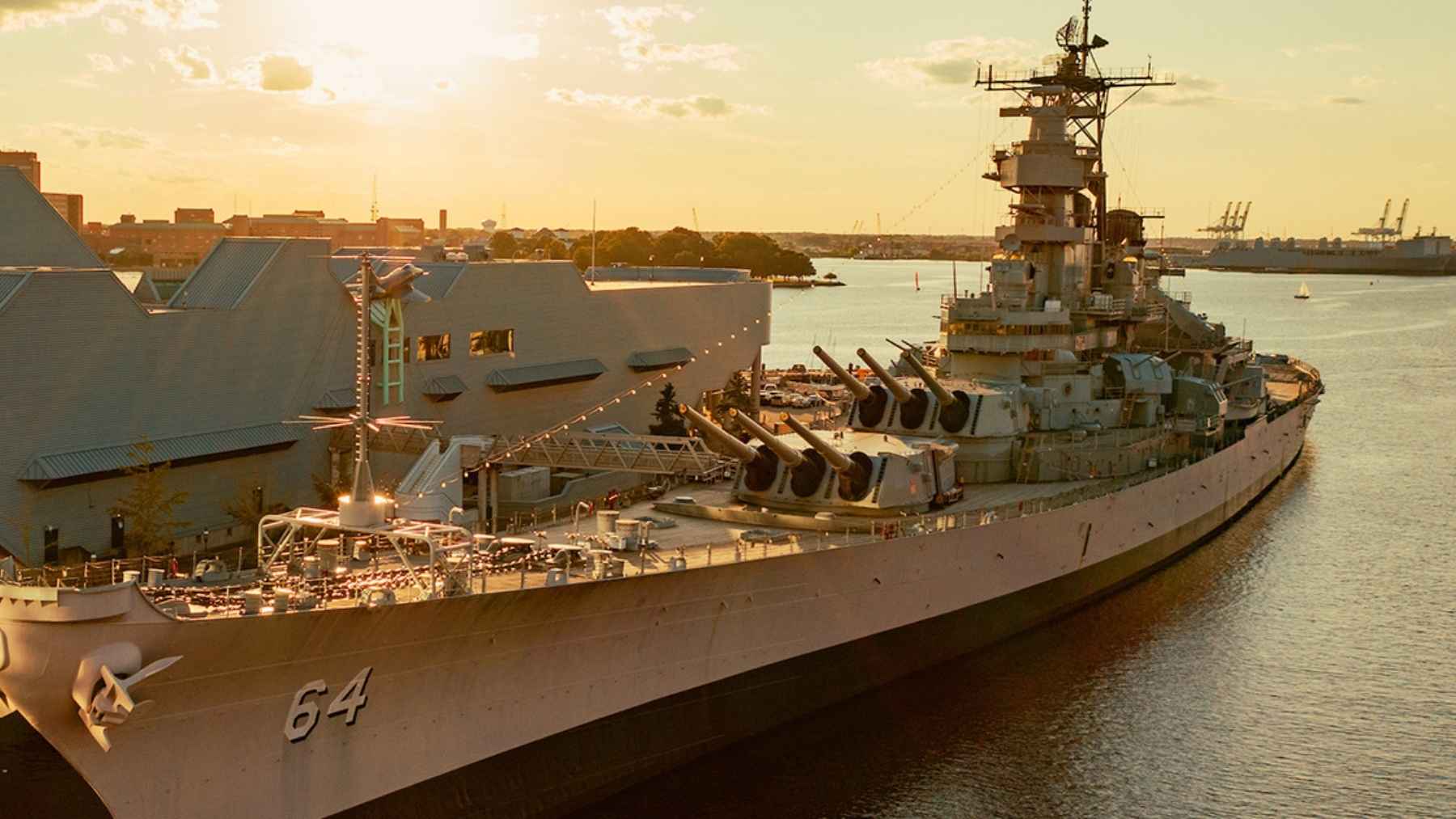
At Nauticus in Norfolk, swapping two of them took about a year of planning and the first movement of the battleship Wisconsin since she tied up there on December 7, 2000.
On the morning of September 8, workers pulled the pedestrian bridge off the ship around 7:30, let go the chains holding her against the pier, and tugboats from Crofton pushed 887 feet of Iowa-class battleship four or five feet out into the Elizabeth River. One fender came out before noon. The second had clearly been doing more of the work, and it brought some of the ship’s paint up with it. If you’re picturing a battleship steaming off somewhere, it wasn’t that. Nobody started an engine. The tugs did the pushing and the ship just leaned away from the wall.
“It takes a lot of planning, it takes a lot of physics,” Nauticus executive director Stephen Kirkland told WTKR.
He’s not exaggerating, and the hard part probably isn’t what you’d guess. Shoving her out into the river is the simple part, and a pair of tugs will do that all day. What’s complicated is everything bolted across that gap after 26 years of a warship working as a building, because the phone lines, the IT lines, the shore power and the water hookups all run over there, and none of it stretches. Kirkland says tracing all of that is what ate the year. None of it is glamorous work, and all of it has to be right before anybody lets go of a chain.
So what’s the big deal about four feet?
Roughly 45,000 tons of big deal. That’s the Wisconsin’s standard displacement in the Navy’s own history of the ship, and she’s listed at 57,540 tons fully loaded. She isn’t carrying fuel oil or ammunition these days, so the real number that morning sat somewhere underneath that, and as far as I can tell nobody publishes what a museum battleship weighs on a given day. Either way, you’re not nudging it by hand, and you can’t tap the brakes once it’s moving.
She fired the last shots any American battleship has fired
The Wisconsin’s one of four Iowa-class ships, the biggest and fastest battleships this country ever built, and all four are museums now: the Iowa in Los Angeles, the New Jersey in Camden, the Missouri at Pearl Harbor, and this one. She came out of mothballs in October 1988 as part of the Reagan-era push for a 600-ship Navy, and on August 7, 1990, five days after Iraq rolled into Kuwait, she left Norfolk for the Persian Gulf. The Naval History and Heritage Command has her on station and ready to fight 16 days later. On the first night of Desert Storm she ran the Tomahawk launch sequence for the entire Gulf.
Then she went to work with the guns, and the ammunition’s worth a sentence here. Those 16-inch rifles fire two different things. One’s a 2,700-pound armor-piercing shell built to punch through the side of another battleship. The other’s a lighter 1,900-pound high-capacity round for hitting things on land, and that’s the one Iraq got. The Navy calls them one-ton high-explosive projectiles, which gives you the general idea. Neither one is subtle, but only one of them was ever meant for a beach.
She wasn’t alone out there, and this is the part a few of you asked about last time. Her sister ship, the Missouri, was working the same stretch of coast, and the two of them took turns on the gunline. The Navy’s history has the Wisconsin relieving the Missouri near the Kuwaiti border on February 6, and the two ships traded places like that for the rest of the war. So when you read about shells landing on a Kuwaiti island in late February, either battleship could have fired them.
By the time she was done the Wisconsin had put 528 of those rounds ashore across 36 separate fire missions.
On the morning of February 26, 1991 she anchored 11 miles off Kuwait City, inside the range of Iraqi Silkworm missiles, and fired the final gun mission of the war. No American battleship has fired a shot in anger since. The Navy buys reach a different way now, and you can see where the money went in a destroyer rewired end to end so that one radar can do the work of two ships.
So where does the drone come in?
During the 1980s refit the Wisconsin picked up eight RQ-2 Pioneers. If you haven’t seen one, it’s a propeller drone about the size of a car, shot off the stern with a rocket booster and caught in a net on the way home, with a TV camera or an infrared one in a turret under the nose. Its job was watching where the shells landed and telling the gunners how far off they were, and it was sending video back to the ship from more than 60 miles out.
That worked well enough that the Iraqi troops on Faylaka Island figured out what the buzzing overhead meant. A drone showed up, and a couple minutes later so did the shells. You can probably see where this is going, and it went there faster than anyone expected.
By the Navy’s account, a Pioneer flight over Faylaka on March 1, 1991 found hundreds of Iraqi soldiers underneath it with white flags up. It’s the first time on record that troops surrendered to a drone. That’s arguably the strangest thing that’s ever happened to an American warship, so I went looking for a clean date on it, and here’s where it gets annoying. The Navy’s own entry says the first of March. Naval History magazine says February 27, and counts 40 men. The National Air and Space Museum, which asked for that exact airframe when the Navy offered it a Pioneer, doesn’t give a date at all. Its version is that the Missouri’s guns had just hit the island and the Wisconsin’s crew launched the drone to see what the damage looked like, so the shells were one sister’s and the drone was the other’s. I’m going with the Navy on the date, and with the Smithsonian on whose drone it was, because they’re the ones who have it.
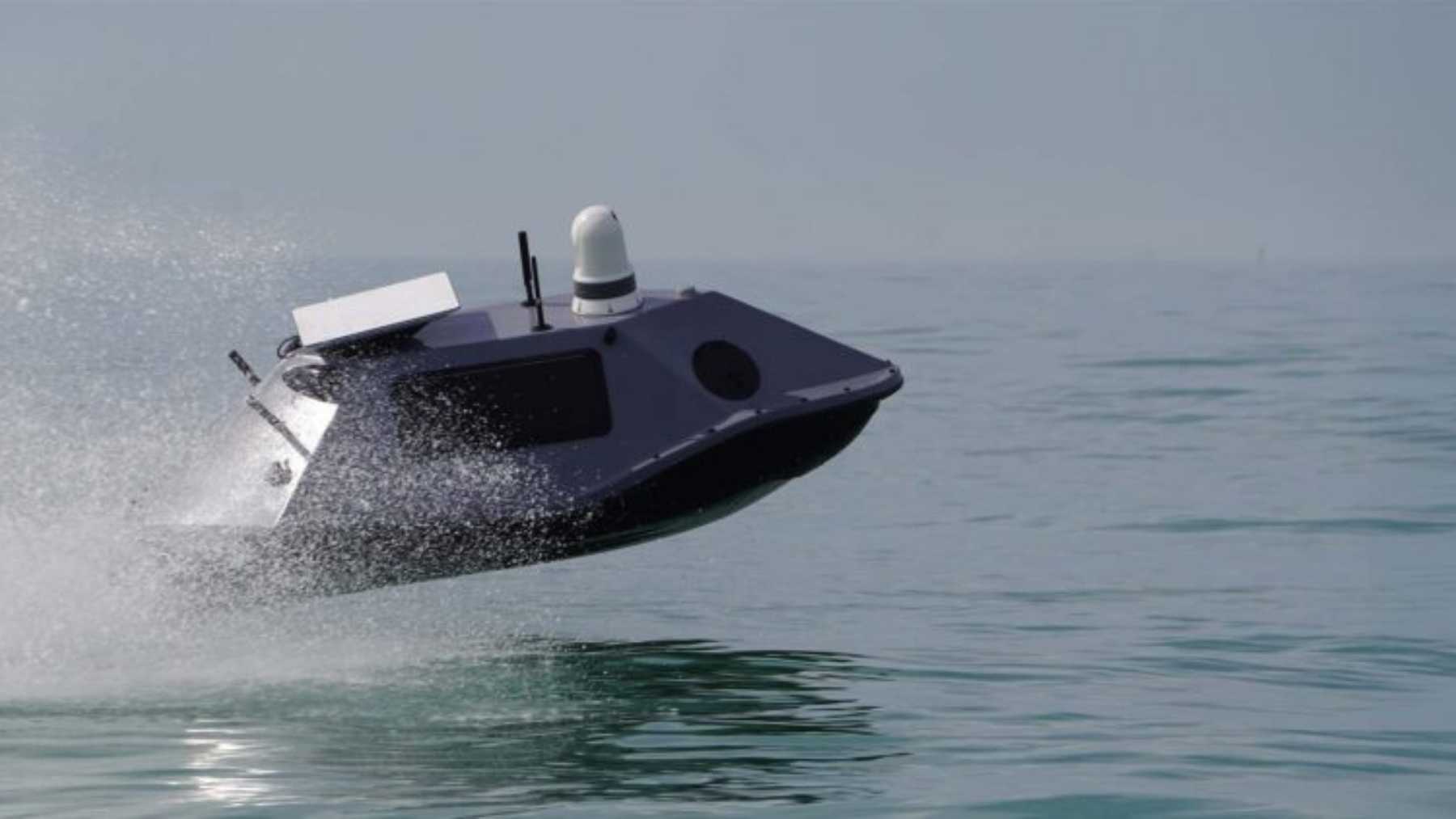
The drone itself, Air Vehicle 159, sits in Washington now. Its descendants are doing the same job in a different shape, and the current version of the idea is a drone boat that carries its aircraft sealed inside the hull.
The Navy isn’t coming back for her
The Wisconsin was open to visitors long before Norfolk owned her. Her weather decks opened to the public on April 16, 2001, while the Navy still held the title, kept sailors aboard and roped off most of the interior. She was struck from the Naval Vessel Register on March 17, 2006, and on December 14, 2009 the Navy formally handed her to the city. The transfer ceremony the following April ended the requirement to keep her fit for a recall to active duty, which is a fairly polite way of saying the paperwork finally caught up with reality.
You’ll still hear the recall story on the tour. It was true for a long stretch, and it isn’t now.
What’s left is a 45,000-ton artifact leaning on two rubber pads in downtown Norfolk, plus a maintenance job most people will never think about again. Nauticus says nearly 3,000 people came through over Labor Day weekend to see her before the move, about twice the weekend before, which tells you a decent number of you would happily spend an afternoon watching a tugboat move a battleship four feet.
Kirkland’s deadline for getting her back alongside was Friday, September 11. I couldn’t find a press release for the trip back, which is about what you’d expect for two rubber pads, and as of October 6 the self-guided tour of the Wisconsin is back inside the museum’s regular $19.95 admission.
 @pauldavis ROOKIE3 weeks ago