
Lt. John Kosich's F-14 went to full power on its own with the throttles at idle, then kept rolling toward the deck edge with the brakes on.
The AIM-54 Phoenix weighed 1,024 pounds and had a range of more than 100 nautical miles.
The NR-1 stopped roughly 20 feet short of a wall of fishing net after Holifield ordered an emergency reverse.
The NR-1 closed a set of tines on its belly around the Phoenix and surfaced with it just before midnight on October 30.
Ask The Box:
Most of us have dropped something expensive somewhere we couldn’t reach. A phone off a dock, car keys through a storm drain grate, that kind of thing. You swear a bit, you poke around with whatever’s handy, and eventually you call somebody who’s got the right tool.
The Navy went through its own version of that in the fall of 1976. Only what it dropped was one of its newest fighter jets, an F-14 Tomcat with a Phoenix missile on board, into the North Atlantic off Scotland. And the right tool turned out to be a nuclear submarine so small and so low-profile that, according to the Navy’s official submarine museum, staff officers at a nearby submarine squadron had never heard of it.
The jet finally came out of the water on November 11, 1976. That makes this week the 50th anniversary of what’s arguably one of the weirdest salvage jobs of the Cold War.
So how do you lose a fighter jet off an aircraft carrier?
It happened on September 14, 1976, during a big NATO exercise the museum calls Teamwork 76. The USS John F. Kennedy was at the center of it, and reporters had been invited along to photograph its aircraft.
According to the Submarine Force Library and Museum, pilot Lt. John Kosich was sitting at the number three catapult running his final checks when the engines went to full power on their own, with the throttles still at idle. He stood on the brakes and the jet kept rolling anyway. On its way to the edge of the deck, it ran over a crew member and clipped two parked aircraft.
Kosich and his backseater, Lt. (jg) Les Seymour, ejected seconds before the Tomcat went over the side. The Birmingham Daily Post reported two days later that both men landed on the carrier’s deck. Orkney aviation researchers say Seymour fractured his knee, which is a pretty rough way to end a shift, but it beats the alternative.
The Kennedy wasn’t done having a bad day, either. That same paper reported the carrier later collided with the destroyer USS Bordelon during refueling, and six sailors were hurt.
Why couldn’t the Navy just leave it down there?
There were two big reasons, and the first was the missile. The AIM-54 Phoenix was the Navy’s only long-range air-to-air missile, and the F-14 was the only aircraft that carried it. NAVAIR’s fact sheet lists it at 13 feet long and 1,024 pounds. Its range was more than 100 nautical miles, which basically means an F-14 crew could fire at a bomber long before they’d ever see it out the canopy. If you’re the Soviet Union, a lightly used example lying on the seabed is about the best present you’d ever get.
The second reason was where it sank. The museum says the jet went down in international waters, so in its telling, whoever got there first could claim it. Maritime lawyers would probably tell you a sunken military jet stays the property of whoever lost it, no matter where it lands. I’d guess that argument feels a lot less convincing when somebody else already has your missile in their hold, though.
And the Soviets were watching. The Scotsman, looking back at the episode last month, reports that a Soviet spy trawler and a naval cruiser were shadowing the exercise. The museum adds that when the Navy marked the spot where the jet went over, the Soviets marked it too.
A month of searching came up empty
At first, the Navy didn’t sound too worried. Capt. Hubert Moss, its salvage chief, told reporters in Washington the job was relatively routine and put the cost at about $100,000, according to the Leicester Daily Mercury.
Then the North Atlantic got involved. The Navy’s Supervisor of Salvage put together a small fleet: a Norwegian vessel called Constructor carrying CURV, an unmanned submersible run by remote control; a British ship called Oil Harrier with winches big enough to haul a fighter jet up; and the Navy tug USS Shakori, fitted with side-scan sonar.
If you haven’t come across side-scan sonar, it basically builds a picture of the seabed out of sound echoes, one strip at a time on either side of the ship. It’s great in calm water. It’s a lot less great when the weather turns ugly and the thing you’re hunting is a jet-sized lump in the mud nearly 1,900 feet down.
The Navy’s figure at the time was 1,890 feet. Later retellings say 1,850. The museum says the salvage team spent a month out there and found nothing.
So what was the NR-1?
This is where a Sperry engineer named Roger Sherman comes in. Sherman knew the Navy had a boat built for exactly this kind of job, parked not far away at Holy Loch on Scotland’s west coast. According to the museum, he took the idea to the staff at Submarine Squadron Two, and they asked him, “What’s the NR-1?”
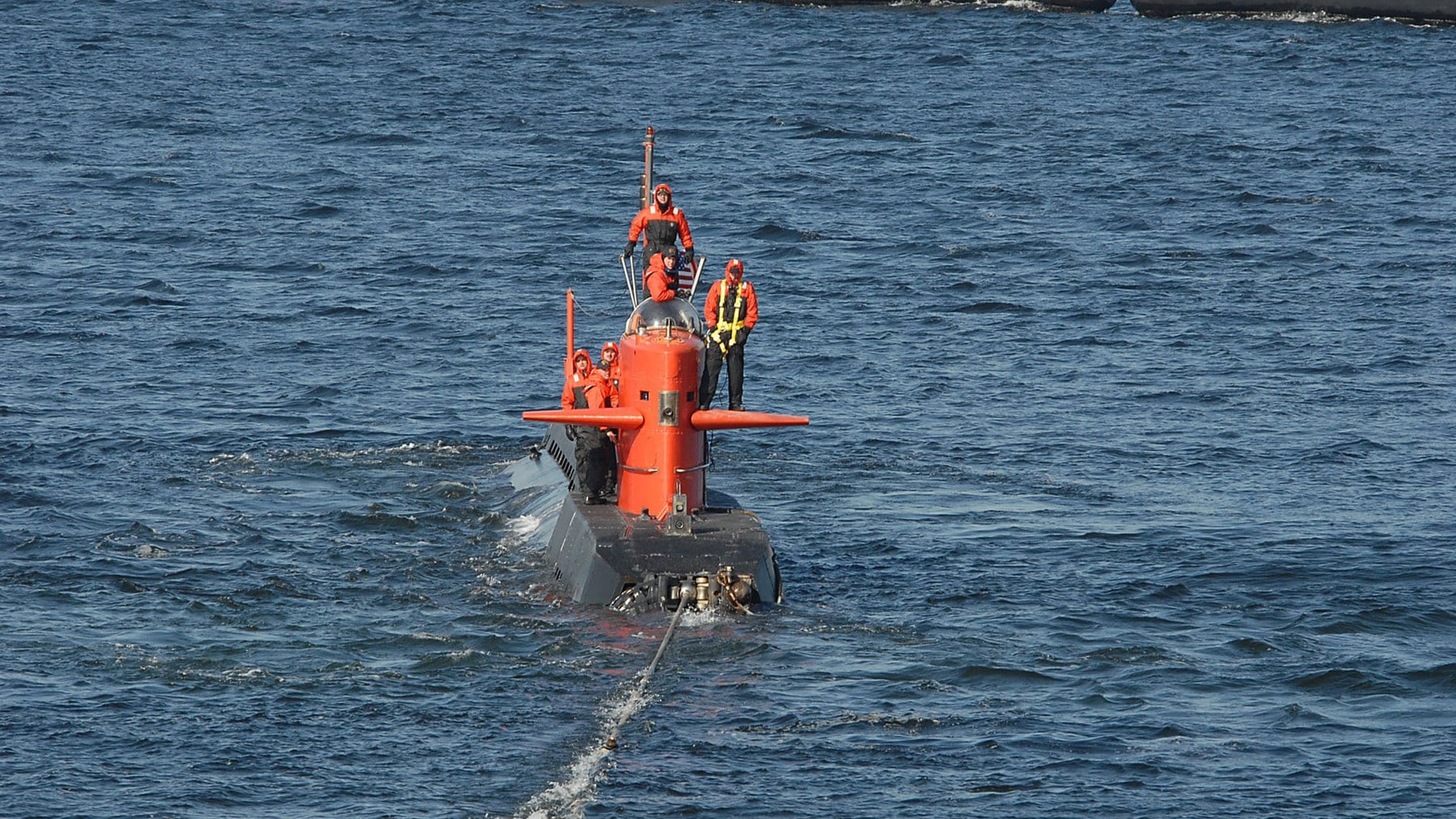
That’s a fair question, honestly. The NR-1 was a nuclear-powered research submarine, and it was tiny. NAVSEA says the hull was only 13 feet in diameter, and it was the only Navy submarine known to have retractable wheels. So it could settle on the bottom and roll along it, with viewing windows, outside lights and a manipulator arm for picking things up. When the Navy retired it in 2008, its own news service listed the boat at 150 feet long and 450 tons, although the AP later gave the length as 140 feet.
Adm. Hyman Rickover conceived it, the Navy built it after losing USS Thresher, and it launched in January 1969, per NAVSEA. So the boat’s existence wasn’t exactly a secret. What it got up to was another matter. The AP called it one of the most secretive vessels in the US undersea force in 2013, and veterans told the agency they assume some of its missions are still classified.
Life aboard was, by all accounts, pretty grim. That same AP report says the crew of about 10 ate frozen TV dinners, and the boat was so slow it had to be towed out to sea by a surface ship. Allison J. Holifield, who commanded it in the mid-1970s, put it this way to the AP: “Everybody on NR-1 got sick.”
The museum says it took some strong-arming from Rickover before the Atlantic submarine command agreed, reluctantly, to send the boat. That detail’s only in the museum’s account, so I’d take it with a grain of salt.
Upside down in a pile of fishing nets
The museum says the NR-1 dropped its tow from the support ship Sunbird and settled on the bottom on October 21, some 1,800 feet down. London’s Daily Express was reporting the next day that the US had located the jet.
The boat was hovering about 100 feet over the seabed with its sonar running when the crew picked up a strong contact. When they crept closer, it turned out to be a wall of fishing net, and Holifield ordered an emergency reverse. The NR-1 stopped roughly 20 feet short, per the museum.
The F-14 was underneath the nets. It was lying upside down with one wing damaged, the opposite of what the engineers had expected. And the Phoenix wasn’t on it.
So whose nets were they?
We don’t know for sure. The museum says it was speculated that a trawler had snagged the jet, couldn’t lift it and cut it loose. Later retellings, including The Scotsman’s, say the crew suspected a Soviet boat had gotten there first, since local fishermen weren’t thought to trawl that deep. I can’t find anything that proves either version, so I’d file the Soviet angle under strong suspicion rather than fact.
Then the rope snapped
The plan for getting the jet up was simple enough on paper. Holifield would use the NR-1’s manipulator arm to loop a rope around one of the main landing gear wheels, which is about as delicate as it sounds 1,800 feet down. A lifting line from Constructor would get hooked to the other end, and Oil Harrier would winch the whole thing to the surface.
It took several days in bad weather just to get the lifting line attached. Then, with Oil Harrier getting pounded by the waves and the jet acting like an anchor in the mud, the line snapped. The F-14 fell back to the bottom, landing wheels down this time and sinking even deeper into the mud.
I’d guess the language on the surface that day wasn’t fit for print.
Finding the Phoenix
With the jet back on the bottom, the NR-1 went looking for the missile. The crew laid out another search grid and crawled back and forth over it about 25 feet off the seabed, with two men lying flat at the viewing ports watching the mud go by.
They were running out of time. The museum says the mission had a hard end date of November 1, and Holifield had already asked for more. Then, on what was supposed to be one of the last passes, someone at a viewport spotted the missile.
Getting it up was its own headache, since nobody knew how a live missile would behave after more than six weeks on the seabed. The museum says the NR-1 lined up over the Phoenix, eased down and closed a set of tines on its belly around it, then surfaced with it just before midnight on October 30. Which means the boat Submarine Squadron Two’s staff hadn’t heard of brought the missile home before anyone managed to bring up the jet.
The NR-1 kept working for another 32 years
The AP’s 2013 report says publicity from this mission was one of the things that pulled back the curtain on the NR-1. It didn’t slow the boat down much. NAVSEA says it went on to recover pieces of the Space Shuttle Challenger in 1986 and survey HMHS Britannic, the Titanic’s sister ship, in 1995, before it was inactivated on November 21, 2008.
The Navy’s still after this kind of seabed capability, too. It’s converting a Virginia-class attack boat into a dedicated seabed warfare submarine that will eventually take over from the USS Jimmy Carter. And the F-14 stuck around on American carrier decks for a long time after this, long enough to be launching off the USS Theodore Roosevelt in 1999 when a Dutch submarine slipped through its escort screen.
The jet came home behind a German ship
Eventually, the Navy brought in outside help. A Kent Evening Post interview from late 1976 says Desmond Bloy, a salvage officer based at Chatham Dockyard, and David Morrice, Britain’s chief salvage officer, hired the German salvage ship Taurus and a British vessel, the Boston Halifax. Bloy told the paper, “The aircraft won’t fly again, but it was complete.”
That might’ve been a bit generous. Orkney aviation researchers say the jet was battered to pieces during the salvage and ended up a total wreck, and I can’t find a public record of what the Navy did with what was left.
The bill didn’t hold up well, either. Moss’s $100,000 estimate turned into somewhere between $1.5 million and $2.4 million, depending on which later account you read, and I haven’t found an official Navy figure. Estimates of what the jet itself cost run from $14 million to about $22 million, so the Navy probably came out ahead on the math even before you count the missile.
Taurus finally towed the Tomcat into sheltered water between the Orkney islands of Egilsay and Shapinsay on November 11, 1976, 58 days after it rolled off the Kennedy. The Daily Express reported the next morning that the jet had been salvaged off the Orkneys.
 Drone boats that ride almost awash like a drug smuggler’s semi-submersible just went to three American companies to prototype, and the Pentagon’s spec asks each one to haul 18,000 pounds of Marine supplies up to 2,000 nautical miles alone and sink itself on commandMilitary · 6 hours ago
 A torpedo-shaped American underwater drone carrying a synthetic-aperture sonar just beat three rival bidders to hunt sea mines for the Royal Navy, which picked 24 of them in sets of three, each set with its own machine that lowers them into the water and hauls them back aboardMilitary · 8 hours ago
 An underwater combat drone weighing more than 11 tons and over 30 feet long was just put under contract for the French Navy, designed to fly in on a cargo plane, slip off a pier or a warship and run long missions on its own under human supervision, and only one is on orderMilitary · 21 hours ago