
- 1 MONTH AGO · MILITARYA 55-pound American drone built to be launched by hand off a pier found practice mines for the Navy, held itself within 6.5 feet of each in a 2-knot current until an operator said go, and came out one of three winners among 80 companies
- 3 WEEKS AGO · MILITARYA Pittsburgh robot rolls across a warship’s flight deck like a paint roller and reads the steel under the non-skid coating without stripping it, cut one repair job from 1,200 square feet to 300, and the Navy just quadrupled its five-year contract six months after signing it
- 2 WEEKS AGO · MILITARYA 97,000-ton nuclear aircraft carrier has now spent more than 2,000 days at the Virginia shipyard that built her, getting a new mast and work on over 600 tanks, and Navy documents point to one more year of it, with her sister ship already there for a five-year overhaul
- 6 DAYS AGO · MILITARYA 600-ton drone warship slid into the water at a Korean shipyard on Thursday, built to scout and watch at sea, and after trials in local waters it is due in the United States early next year for more testing aimed at the Navy’s growing unmanned fleet
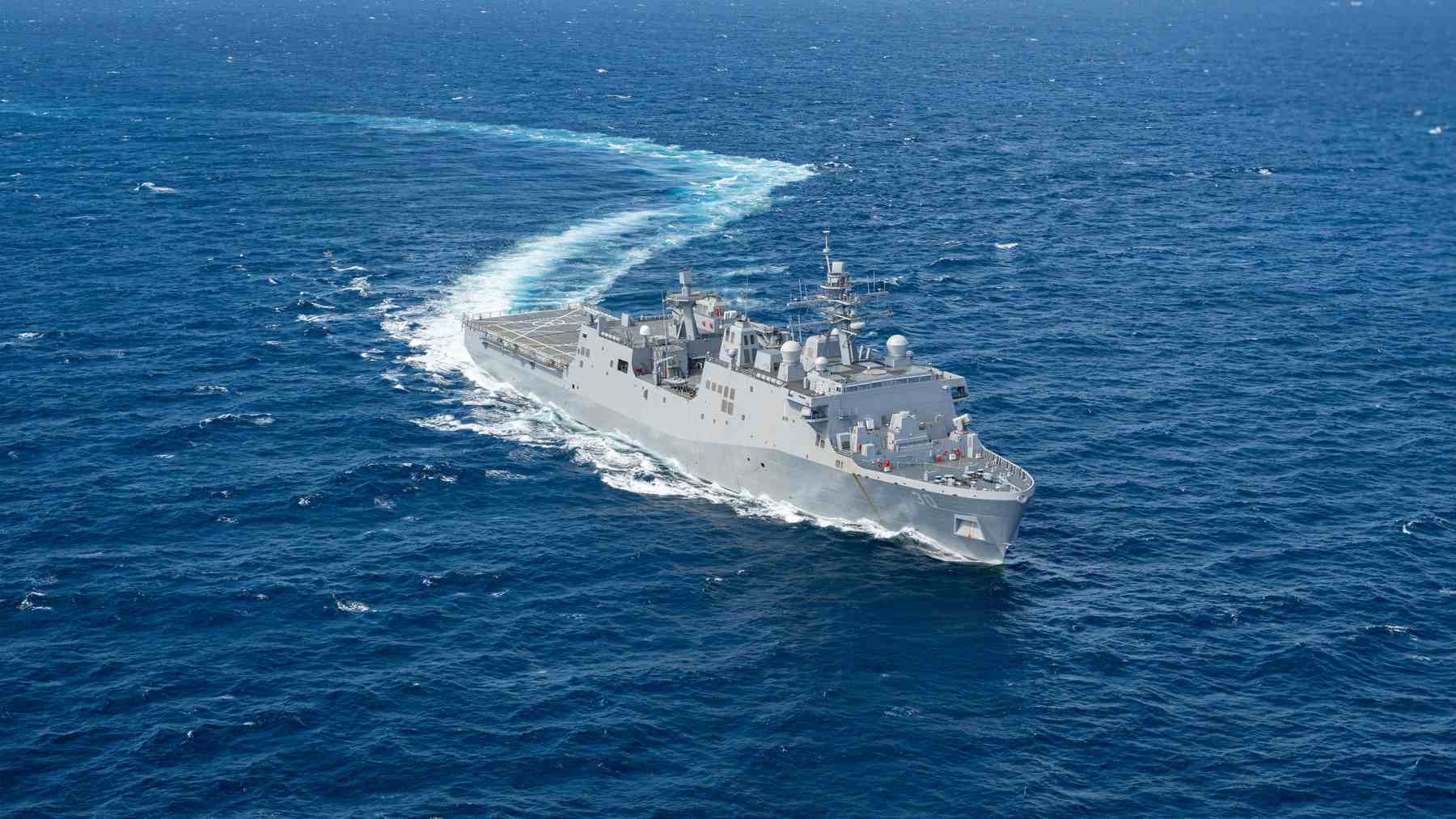
- TODAY · THIS ARTICLEA 24,900-ton Navy warship built in Mississippi has come back from its shipyard sea trials as the first of a redesign with some 200 changes from the ships before it, a rotating radar and plain steel masts among them, and the yard expects to hand it over before the year is out
If you’ve ever seen a photo of a Navy amphibious ship tied up in Norfolk or San Diego, there’s a decent chance the masts caught your eye. For years, the San Antonio class went to sea with tall, enclosed towers where you’d normally expect a skeleton of steel covered in antennas. They gave a 684-foot ship a pretty sci-fi look.
But the newest one doesn’t have them. Harrisburg (LPD 30) is being built at HII’s Ingalls Shipbuilding yard in Pascagoula, Mississippi, and it came back from its builder’s sea trials at the end of October wearing plain steel masts instead. It’s the first ship of what the Navy calls Flight II, a reworked version of the class, and the shipyard expects to hand it over before the year’s out.
HII announced the milestone on November 3. The trials ran for several days and wrapped up on Saturday, October 31, according to Defense War Room. HII says the ship got back to the yard having met its major test objectives. Ingalls used the time at sea to check the propulsion and steering, the systems that control the ship, and communications. It also tested the mission and combat systems, including how well they work together.
Stephen Janowski, who manages Ingalls’ amphibious ship program, called the trials “a critical step toward delivering this ship to the fleet.”
So did it hit its top speed?
We don’t know. HII didn’t publish the speed it reached or list any problems that are still open, as Defense War Room pointed out, and as far as I can tell that’s pretty standard for this kind of announcement. The Navy’s own figure for the class is more than 22 knots.
So what is an amphibious transport dock?
Basically, it’s a ship built to haul Marines and their gear across an ocean and then get them ashore. Its stern hides a well deck, a big space low in the hull that floods so hovercraft and landing craft can float in and out through a gate in the back, while helicopters and MV-22 tiltrotors fly off the deck above.
The Navy’s been putting Marines on beaches from ships since at least World War II, and one of its tank landing ships from that era is still running rivers on its original engines.
According to the Navy’s fact file for the class, the well deck takes two LCAC hovercraft or one LCU landing craft. Up top, a San Antonio-class ship can operate two CH-53E helicopters or two MV-22s, or up to four smaller AH-1Z, UH-1Y or MH-60 helicopters.
The ship’s company is 383 sailors and 3 Marines. On Flight II ships, the Navy lists an embarked landing force of 631, down from 699 on the original Flight I ships.
As for size, it’s 684 feet long and 105 feet wide, and it draws 23 feet of water. The Navy puts the class at about 24,900 tons fully loaded, measured in long tons. If you haven’t run into those before, a long ton is 2,240 pounds, and it’s the unit the Navy still uses for displacement. That figure covers Flights I and II together. I haven’t seen a separate one for Harrisburg.
Four Colt-Pielstick diesels turn two shafts for a combined 41,600 shaft horsepower. For self-defense, the class carries two Mk 46 30mm guns, two Rolling Airframe Missile launchers and ten .50-caliber machine guns, which frankly isn’t a lot of firepower for a ship this big.
Flight II ships are meant to take over from the Navy’s Whidbey Island and Harpers Ferry-class dock landing ships as those retire.
There are about 200 changes, and two are easy to spot
A 2022 GAO report counted about 200 changes compared with the previous flight, The War Zone reported. I haven’t found a full list. Which is a bit surprising, since the program manager told Seapower back in 2019 that Flight II keeps the Flight I hull and engines.
So where do 200 changes go? Seapower’s 2019 list gives you an idea. It included a new air search radar, the CANES shipboard network, a destroyer-style mast, an SLQ-32 electronic warfare suite and the ability to handle the CH-53K King Stallion, the Marines’ newest heavy-lift helicopter.
The radar is the AN/SPY-6(V)2 Enterprise Air Surveillance Radar, or EASR, and it replaces the older AN/SPS-48 on the class, according to The War Zone. It still spins, like the old one did. But it’s built from nine radar modules, Defense War Room says, so you can think of it as a set of building blocks put together into one antenna.
Neither of those two visible changes debuts on Harrisburg, though. The steel masts first showed up on Fort Lauderdale (LPD 28), per The War Zone, and the Navy says Richard M. McCool Jr. (LPD 29) was the first ship with EASR when it was delivered in April 2024. So the last two Flight I ships got a head start.
Arguably, the radar’s the bigger upgrade of the two. Still, I’ll admit I’m going to miss those enclosed towers a little. They were the most distinctive thing about these ships.
So when does the Navy get it?
Builder’s trials are the shipyard’s own test drive. Ingalls takes the ship out, runs its systems at sea and fixes whatever it finds before the Navy runs its own tests.
Acceptance trials are the Navy’s turn. Its inspectors come aboard and put the ship through its paces before the service agrees to take ownership.
HII says acceptance trials and delivery are both expected later this year. That’s a fairly tight window with mid-November already here, and HII hasn’t put a specific date on either one. If you’ve been following the 97,000-ton carrier that’s spent more than 2,000 days at its builder’s yard in Virginia, you’ll know Navy ship dates have a way of moving. The Navy also hasn’t announced when Harrisburg will be commissioned, according to Defense War Room.
Harrisburg won’t be the only Flight II ship for long. Pittsburgh (LPD 31) and Philadelphia (LPD 32) are already under construction at Pascagoula, and HII says it’s already planning and lining up materials for Travis Manion (LPD 33), LPD 34 and LPD 35, all three of which the Navy lists as under contract.
Harrisburg is back at Pascagoula getting ready for acceptance trials, and if HII’s timeline holds, the Navy will take delivery of the first Flight II ship before the end of 2026.
 A 6,500-nautical-mile drone submarine built to lay mines with nobody aboard is about to reach the Navy as the third of three prototypes, nine years after the program began, and the officer running it says the plan now is to find out what it really does well and what it doesn’tMilitary · 20 hours ago
 A 17,500-ton British nuclear missile submarine just came home to its Scottish base after an estimated 217 days hidden underwater, about 12 days longer than any Royal Navy patrol before it, and the Ministry of Defense will not confirm how long the boat was at seaMilitary · 2 days ago
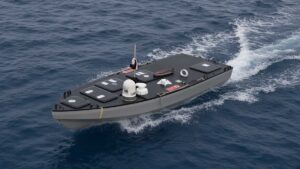 A 16-foot kamikaze drone boat weighing about 1,100 pounds went from first sketch to sea trials in six months, designed by the French government’s own engineers at a lab that normally builds scale models of warships, and because the state owns the plans, any shipyard can now be handed themMilitary · 6 days ago