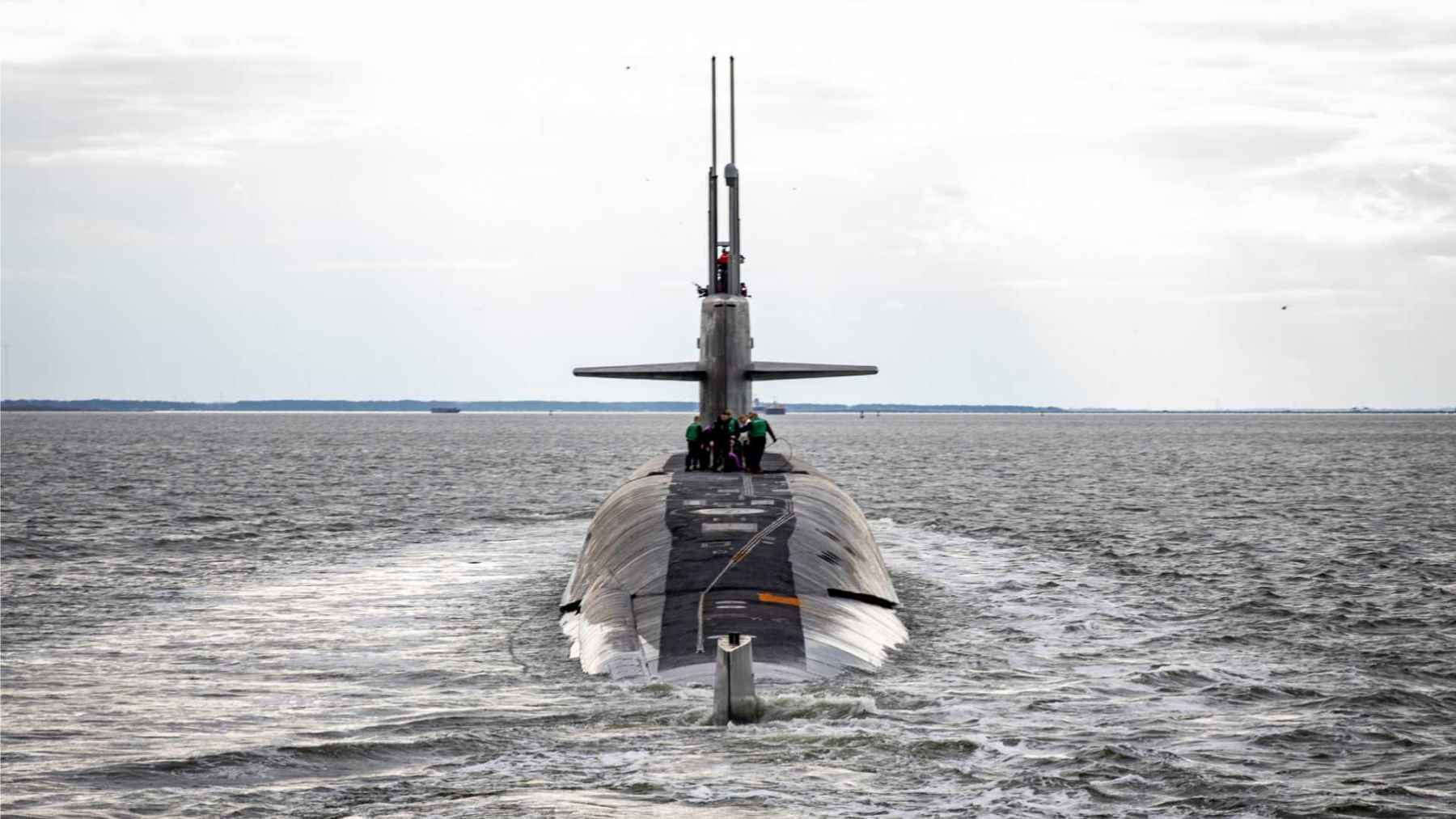

The last time we checked in on Ukraine’s Sargan-3000, it was shooting at another boat. Back in September the Navy put out a clip of the 23-foot drone boat running down a Russian drone boat in the Black Sea and sinking it with a machine gun, which the Navy billed as the first fight between two uncrewed boats in history. Fair enough. Since then, the same boat has apparently decided the water is too easy and started working on the sky instead.
On October 21 the Ukrainian Navy posted a new video on its social channels. In it, a Sting interceptor drone pops out of a container sitting on the Sargan’s deck, climbs, and flies straight into a Russian Shahed. The Shahed comes apart. The boat, as far as you can tell from the footage, just keeps going.
So that’s a drone boat launching a drone to kill a drone, with nobody aboard any of the three. I had to watch it twice to keep track of which one was which.
So what exactly did the Navy show?
Not a lot, frankly. The Navy’s reel runs a few seconds of the launch and the hit, and the accompanying text, as relayed by the Ukrainian outlet Militarnyi, says the interceptor was a Sting built by Wild Hornets and that it went up from a “container-based platform” on the boat. The Navy didn’t give a date for the shootdown, didn’t say where it happened, and didn’t say whether there were more Shaheds in the area. That’s pretty standard for them. They post the kill and skip the paperwork.
What we do know is that it’s the third time in about six weeks the Sargan has knocked something out. On September 12 it sank that Russian drone boat with its turret. On October 7 the Navy posted a second clip, this time of the same turret firing several bursts at a Shahed, which drops into the sea and explodes. And now the Sting.
If you’re wondering why a boat with a perfectly good machine gun would bother carrying interceptors as well, hold that thought. I’ll get to it.
The boat is small, and the numbers are secondhand
Sargan means needlefish in Ukrainian, which tells you roughly what the thing looks like: long, thin and low in the water. A company called Nordex builds it, and Volodymyr Zelensky introduced it on April 14 as a multi-purpose platform that had finished testing and gone into Navy service. Its first known kill came in July, when the Navy said one sank the FSB patrol ship Izumrud near Novorossiysk.
I want to be straight with you about the specs. Militarnyi quotes a combat radius of up to 1,600 kilometers, which is a hair under 1,000 miles, a speed of 40 to 55 knots (46 to 63 mph) and a payload of 450 kilograms, or 992 pounds. Those figures have been floating around since the spring, and when we dug into them last month they traced back to open-source reporting rather than anything the Navy has published. The Navy has treated the full specification as classified since the boat first showed up. The 23-foot length is in the same boat, so to speak. Treat all of it as the best available guess.
The gun, at least, isn’t a mystery. It’s a 12.7 mm, or .50-caliber, machine gun sitting in a Protector remote weapon station that Kongsberg builds in Norway and NATO navies bolt onto crewed warships. A remote weapon station is basically a gun in a powered, stabilized cradle with cameras on it, run by somebody at a screen a long way away. The stabilized part is what matters on a small boat, because a hull that’s pitching and rolling in open water would otherwise turn every burst into a lot of wasted brass.
So why carry interceptors when you already have a gun?
Because hitting a Shahed with a machine gun from a moving boat is hard, and I suspect the Navy would rather not make a habit of it.
A Shahed is a delta-wing drone with a piston engine that weighs around 440 pounds and cruises at roughly 115 mph, going by the figures most analysts use, and it’s typically flying a couple thousand feet up. A .50-cal has the range to reach it, in theory, and there’s no shortage of footage of gunners doing it from land. In practice you’re asking a gunner, through a camera, to track a small fast target from a platform that’s bouncing, and to put enough rounds into it before it’s gone. The October 7 clip shows several bursts before the drone goes down. That’s a lot of ammunition for one kill, and ammunition on a drone boat is whatever it left the pier with.
An interceptor flips the problem. The Sting is an electric quadcopter from Wild Hornets, a Kyiv outfit that started as a volunteer group and now cranks these things out in bulk. It weighs roughly nine pounds, leans heavily on 3D-printed parts, carries a small warhead and a camera, and Wild Hornets says it has recorded one at 195 mph in level flight. Each one costs around $2,100 to $2,500, depending on who you ask and what optics are on it. A pilot flies it by first-person view into the target, which means a human does the “aiming” by steering the warhead the last few hundred feet, rather than a gunner hoping the geometry works out.
Which is a long way of saying the Sting is a guided bullet that costs less than a used motorcycle. And it doesn’t have to come from the boat, either. Wild Hornets’ launch boxes are standalone, the kind that work from a truck bed or a patch of flat ground, and the company’s Hornet Vision CTRL setup lets a pilot fire one remotely from, by its own claim, up to about 1,240 miles away. Drop a box on a deck and you’ve got a launch pad.
You may be thinking this sounds familiar, and it should. UFORCE showed off a 39-foot Magura in August with 18 Stings standing upright in boxes on its deck, and Ukraine’s Unmanned Systems Forces say they’ve already used a sea-launched Sting to down a Shahed earlier this year. So the Navy isn’t first to the idea. It’s just the first time the Navy itself has shown it working off one of its own boats, as far as I can tell.
Why a boat at all?
Because a lot of these Shaheds come in over the water. Russia launches them in batches, often hundreds in a night, and a good share of the ones headed for Odesa and the ports around it cross the Black Sea first. Ukrainian air defense crews on land are stretched catching drones and missiles over the cities, so a boat loitering offshore gets to start thinning the swarm before it ever reaches the coast. It does that without risking a sailor, and without pulling a land-based missile battery off something that actually needs a missile.
Then there’s the mesh network bit, which the Navy mentioned in its October 7 post and which deserves two plain sentences. Newer Shaheds reportedly carry radio modems that let them talk to each other and pass control signals along in a chain, so the Russians can keep steering a drone well beyond the range of any single ground station. A drone boat parked out at sea is one of the few things that can get underneath that chain while it’s still over the water.
The Navy’s own line on the October 7 kill, posted on Telegram, was that a Shahed on a mesh network “was hit by fire from a turret mounted aboard” the Sargan, and that the Navy “continues to carry out missions to protect Ukraine’s coastline and airspace.” Airspace isn’t a word you’d expect to find in a navy’s job description, and it’s in there now.
What I’d want to know next
How many Stings the Sargan carries, for a start. The video shows one container. A 992-pound payload, if that figure holds, would fit a lot of nine-pound interceptors, but a container also has to leave room for whatever else the boat is doing that day, and the Navy hasn’t said what else is in the box. I also can’t find any statement on whether a missed Sting can be recovered back onto the deck, which is a trick Wild Hornets advertises for land launches and which strikes me as a much harder problem when the launch pad floats.
And I’d be curious whether the turret stays. Carrying both makes sense on paper, there’s a gun for anything on the surface and Stings for anything in the air, but every pound of Kongsberg hardware is a pound of interceptors you aren’t carrying. My guess is the Navy keeps the gun, because the September fight showed exactly what it’s for, and the other side’s drone boats haven’t gone anywhere.
The Navy took the Sargan-3000 into service in April. By October 21 it had used the boat to sink a patrol ship, sink a drone boat, shoot a Shahed down with a machine gun and launch an interceptor that killed another, and the last of those is on video, per Militarnyi, with Wild Hornets now cleared by Ukraine’s Defense Ministry to run air-defense operations of its own.
Image Credit: navalnews.com