
- 3 WEEKS AGO · ENERGYA 243-ton turbine assembly nearly 24 feet across was lowered back into a French hydro plant with only millimeters between its blades and a new ring set in concrete, and the rebuilt unit later climbed to 45 megawatts on its way back to the grid
- 2 WEEKS AGO · INDUSTRYA 111-year-old lock and dam that holds back a North Carolina river for the intakes feeding Wilmington’s drinking water has a channel carved under it by the current, and the Army Corps of Engineers says more erosion could undermine the riverbed holding it up
- 2 WEEKS AGO · ENERGYA 650-ton beam and two gantry cranes just hoisted a generator rotor out of a 72-year-old Columbia River dam to make room for the first of 14 new turbines, and the last one isn’t due for another 11 years
- 1 WEEK AGO · ENERGYA 154,000-pound rotor came from Austria by way of Rotterdam, took a 200-mile detour behind a police escort and rolled through an access tunnel into a power station built inside a Scottish mountain, where two half-century-old generating units are being rebuilt to add 40 megawatts
- TODAY · THIS ARTICLEA 400-ton generator at a South Dakota dam was taken apart for the first time in 70 years, its 275-ton rotor lifted out by two cranes working as one, and the first new turbine runner has now rolled into the powerhouse to take each unit up to 52 megawatts
Nobody rips out a furnace that’s still heating the house. You wait for the weird noise, or for the repair guy to make that face, and then you start shopping.
The Army Corps of Engineers is taking pretty much the opposite approach at Fort Randall Dam, which holds back the Missouri near Pickstown, South Dakota. All eight of its hydroelectric generators are coming apart, and the Corps says none of them is broken.
So why bother?
Mike Schenkel, who manages maintenance and operations at the dam, gave the Yankton Press & Dakotan a pretty simple answer. Generators like these usually get a design life of around 40 years, and Fort Randall’s have been spinning since the mid-1950s without ever being disassembled. “We’re doing this just because it’s due,” he said. Nothing’s wrong with them right now. Honestly, I’d call 70 years out of a 40-year machine a win. Most of us can’t get a dishwasher past its warranty.
The job also just hit the first milestone you can actually watch. On September 23, the first of eight new turbine runners was moved from a temporary storage site into the powerhouse, and the Omaha District put a 64-second clip of it on DVIDS on October 15. As of November 18, the Corps hasn’t said the first rebuilt unit is generating again. We’ll get to that.
So what got delivered?
The runner is the big wheel at the base of each unit, and it’s what the river shoves against to make everything turn. Fort Randall’s are the Francis type: water rushes in from all sides, spins the wheel, then falls away underneath.
A tall vertical shaft connects that wheel to the generator’s rotor, which is basically an enormous electromagnet. The rotor turns inside the stator, a fixed ring of copper coils, and that’s where your electricity comes from.
Here’s the catch. Everything’s stacked, with the runner on the bottom, so you can’t swap the wheel without first clearing out whatever’s above it. And the biggest piece up there is the rotor.
The rotor’s too heavy for either crane
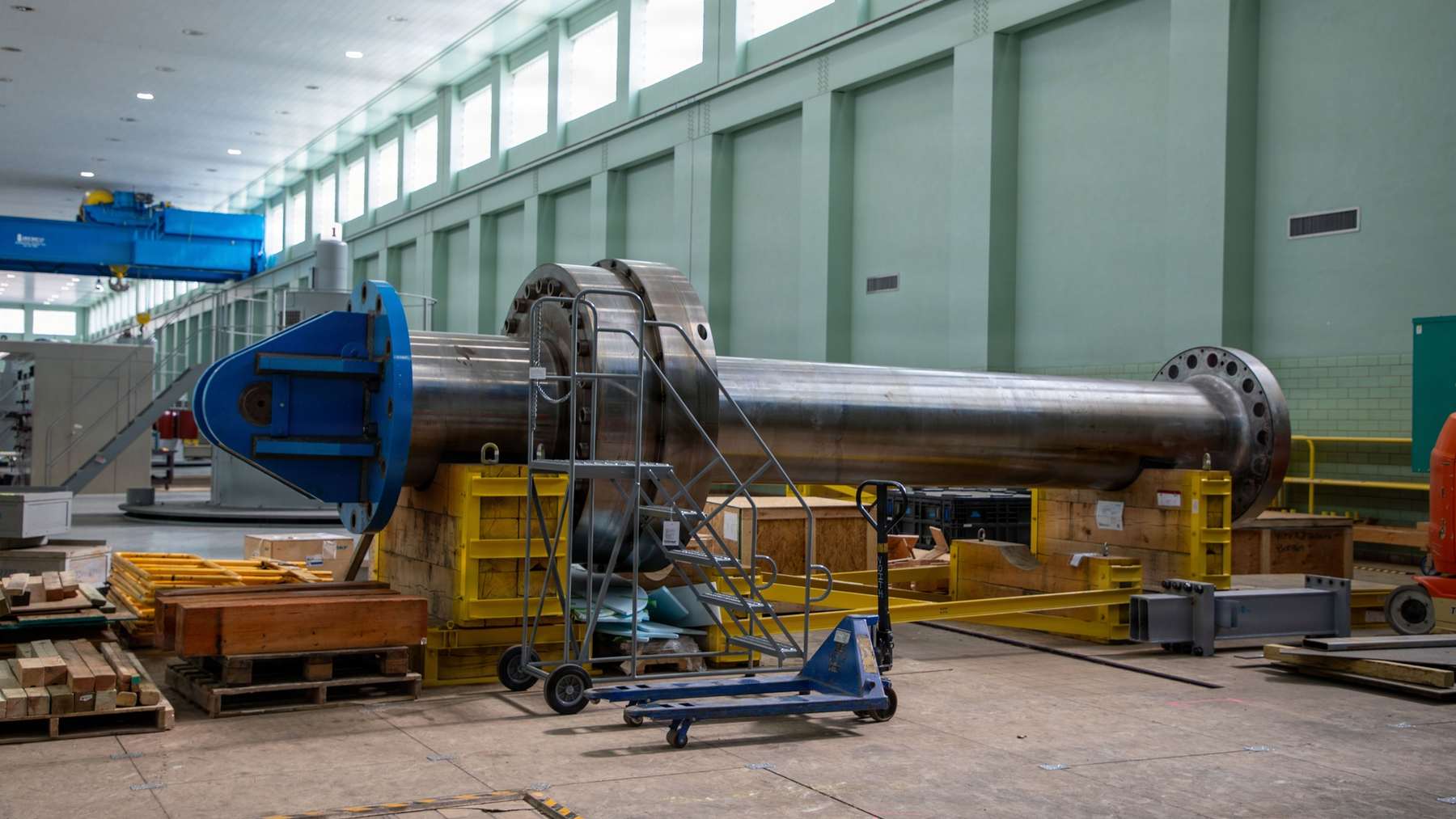
Schenkel says a full unit, generator through turbine, comes to roughly 400 tons and more than 40 feet from top to bottom. The Mitchell Republic put the rotor by itself at 275 tons.
The powerhouse’s two overhead cranes are rated for 155 tons apiece, so neither can do that lift solo. Working in tandem, the pair can handle 310 tons, which leaves a 35-ton cushion. That sounds like plenty until you picture what’s hanging off the hooks. Personally, I’d want the operator to have skipped the second coffee that morning.
Both cranes were originally rated at 150 tons, and the Corps had them rebuilt and re-rated, along with their 280-ton lifting beam, well ahead of this job. You don’t do that on a whim, so it’s safe to assume this lift sat on someone’s whiteboard for years. Schenkel told the Press & Dakotan the planning started roughly a decade before the work.
What does the Corps get for the money?
The rehab costs about $150 million. Each rebuilt unit is rated for 52 megawatts, up from about 42 in Schenkel’s Press & Dakotan interview or 43 in the Mitchell Republic’s. The Corps calls Fort Randall a 320-megawatt plant today and expects roughly 400 when the last unit’s done.
Eight units at 52 apiece actually comes to 416, so I’d treat 400 as rounding rather than a guarantee. You’ll also see 50 megawatts in some older coverage, including the Corps’ own contract-signing story, but both recent print interviews say 52.
Turbine efficiency climbs as well, to about 92% from roughly 89%. Frankly, that’s my favorite part of the project. The river isn’t getting any bigger, so getting more out of every gallon that already flows through the turbines is about as cheap as extra power gets.
The contractor is Voith Hydro, which makes the runners at its York, Pennsylvania, shop. According to Schenkel, the turbine design took a year or so, and manufacturing took another. Besides the runners, the contract covers work on the generators’ stators.
The plant doesn’t go dark while all this happens. Fort Randall is a peaking plant, which means it’s there to cover the hours when demand is highest instead of humming along all day. Schenkel says it usually runs hard through the evening rush, then sits idle from roughly midnight until 6 a.m.
That’s also why the schedule is so cautious. The contractor has to finish one unit before it’s allowed to work on two at once, and even then the outages overlap, with one unit coming apart while the other is going back together. The rest keep making power.
So is Unit 6 back online yet?
Unit 6 went first. Work started last summer, and a Corps photo the Press & Dakotan ran shows its first big section being hoisted clear on August 27 of last year. By February, its shaft and original runner were both lying on the floor of the powerhouse, and Corps captions from that February tour say the shaft is being reconditioned to go back in with new stator casings, a new runner and the refurbished rotor.
Every forecast I’ve seen points at right about now. The Press & Dakotan reported last fall that the first outage would run into fall 2026, the Mitchell Republic reported the first new generator was due online late this year, and a rural electric co-op’s June newsletter said the Corps expected it offline until November.
So is it back? As of November 18, I haven’t found an announcement from the Corps, the Omaha District or the local press that Unit 6 is generating again. That doesn’t mean it’s late. November isn’t over, and the Corps doesn’t exactly live-tweet its powerhouse. I just can’t tell you it’s done.
The September video also never says which unit gets the new runner. Nobody’s reported any other unit as open, so Unit 6 is my guess, but it’s a guess. And there’s still no published diameter or weight for the new runner, which feels like a strange detail to skip when it’s the star of the video.
How long will all eight take?
The Mitchell Republic described each unit as an 18-month build-and-test job, and the finish date shifts depending on who you ask. When Voith won the work, the estimate was December 2031. Local coverage has said summer 2031. The Corps’ February captions say the contract runs to September 2032. I’d lean on that one. It’s the newest, and it’s the Corps’ own paperwork.
For comparison, the New York Power Authority spent 33 months on the first of Niagara’s 13 turbines, so a year and a half per unit would be a pretty brisk clip. And Fort Randall isn’t the Corps’ only patient. It’s been swapping in new Kaplan runners for the 1950s originals at Old Hickory Dam in Tennessee, and on October 20 it lifted a generator rotor out of McNary Dam‘s Unit 14 on the Columbia.
Seven more runners still have to make the same trip from storage, and the first one has been inside Fort Randall’s powerhouse since September 23.
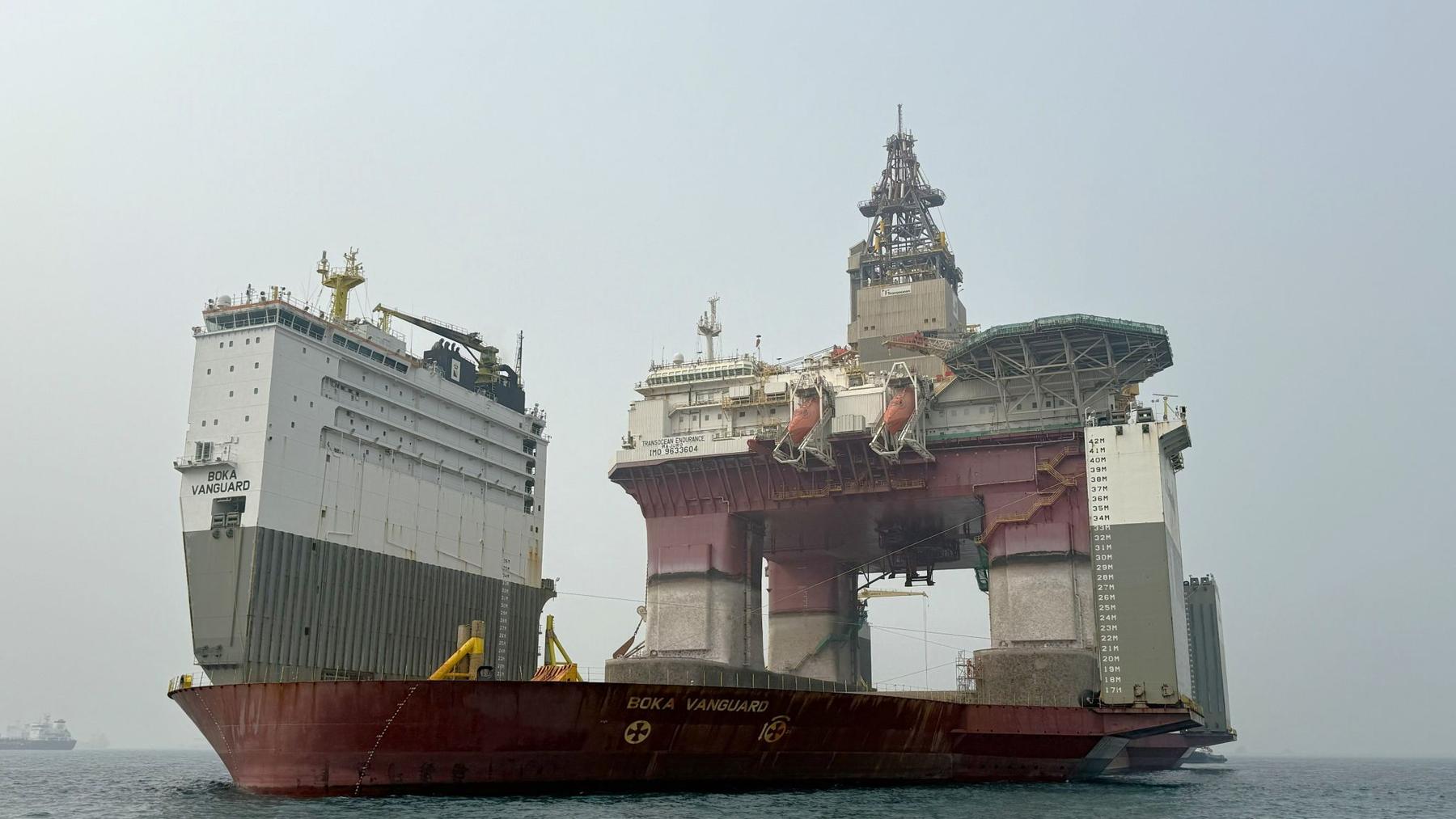
 A 45,000-ton semi-submersible drilling rig built to work in 1,640 feet of water and drill as deep as 27,887 feet was floated onto the sunken deck of a 902-foot carrier and now hangs about 28 feet past each side of it on the voyage to a two-year job off NorwayEnergy · 39 minutes ago
 A 1.88-inch setup error on a Washington campus reactor sent a pulse rod out of its cylinder at 9.13 inches instead of 7.25, because the operator used the numbers for the wrong control rod, and the fuel peaked at about 1,598°F, some 72 degrees over the pulse limit but under the safety limitEnergy · 21 hours ago
 A 170-foot concrete tower in a California reservoir has had 40 feet cut off its top, ring by concrete ring from a crane on a floating barge, because the dam beside it was built 33 feet lower than planned and left the tower that is the lake’s only safe drain too tall for an earthquakeEnergy · 24 hours ago
 @hollycaines ROOKIE2 weeks ago