
Until the middle of November, a lot of New Jersey commuters are starting their workday in Hoboken instead of Penn Station. That’s because NJ Transit has sent its weekday Midtown Direct trains there and pointed riders toward PATH, ferries and buses for the rest of the trip.
Amtrak and NJ Transit are finally retiring the Portal Bridge, a swing bridge that’s carried trains over the Hackensack River between Kearny and Secaucus since 1910. It’s Amtrak’s bridge, and this is the last big step in getting trains off it.
On the evening of Friday, Oct. 9, crews started moving the last track off the old bridge and onto the new Portal North Bridge right next door. Until that’s done, every train between Newark and Secaucus has to share a single track over the new bridge, according to Amtrak’s briefing on the cutover. Which means the old Portal Bridge has already carried its last train.
So why does a train bridge need to swing?
The Hackensack’s a working river, so boats need to get up and down it. A railroad bridge low enough for trains to roll straight across has to get out of the way when something tall shows up, and a swing bridge does that by pivoting.
The whole steel span sits on a pivot in the middle of the river. It turns sideways to open a channel, then turns back once the boat’s gone.
The catch is getting it to stop in exactly the right spot. The rails on the bridge have to line up with the ones on land, and there isn’t much wiggle room.
The Portal Bridge handled that with what a Gateway program board presentation called 19th-century miter rail technology. That’s basically rail ends cut at an angle so the two sides slide together, and it’s fine right up until the bridge stops a little out of place.
When that happens, trains can’t cross until someone fixes it. NJ Transit CEO Kris Kolluri told WABC-TV earlier this year that crews sometimes had to “go out there with a hammer” to get the tracks back in. That’s not exactly what you want to hear about the thing carrying your morning train into Manhattan.
The old bridge kept causing trouble right up to the end, too. In March, the new bridge’s first track went into service two days early after a power problem knocked out the old one, and Trains magazine reported that the culprit was leaning catenary poles, which hold up the overhead wires that power the trains.
Boats had their own problems with it. The old span sits just 23 feet above the water, according to that Gateway presentation, and it opened about 25 times a month, based on a Coast Guard review of its logs. Coast Guard rules let it stay shut through most of the morning and evening rush, and the rest of the time boats had to call two hours ahead.
Then the new bridge started going up beside it. Last year, the Coast Guard limited how far the old span could swing, because opening all the way would’ve hit the new bridge, so it couldn’t open more than a 55-foot gap in its east channel, and the west channel closed to boats completely. I’d say that’s a fairly undignified way to spend your last year and a half on the job.
The new bridge never has to open
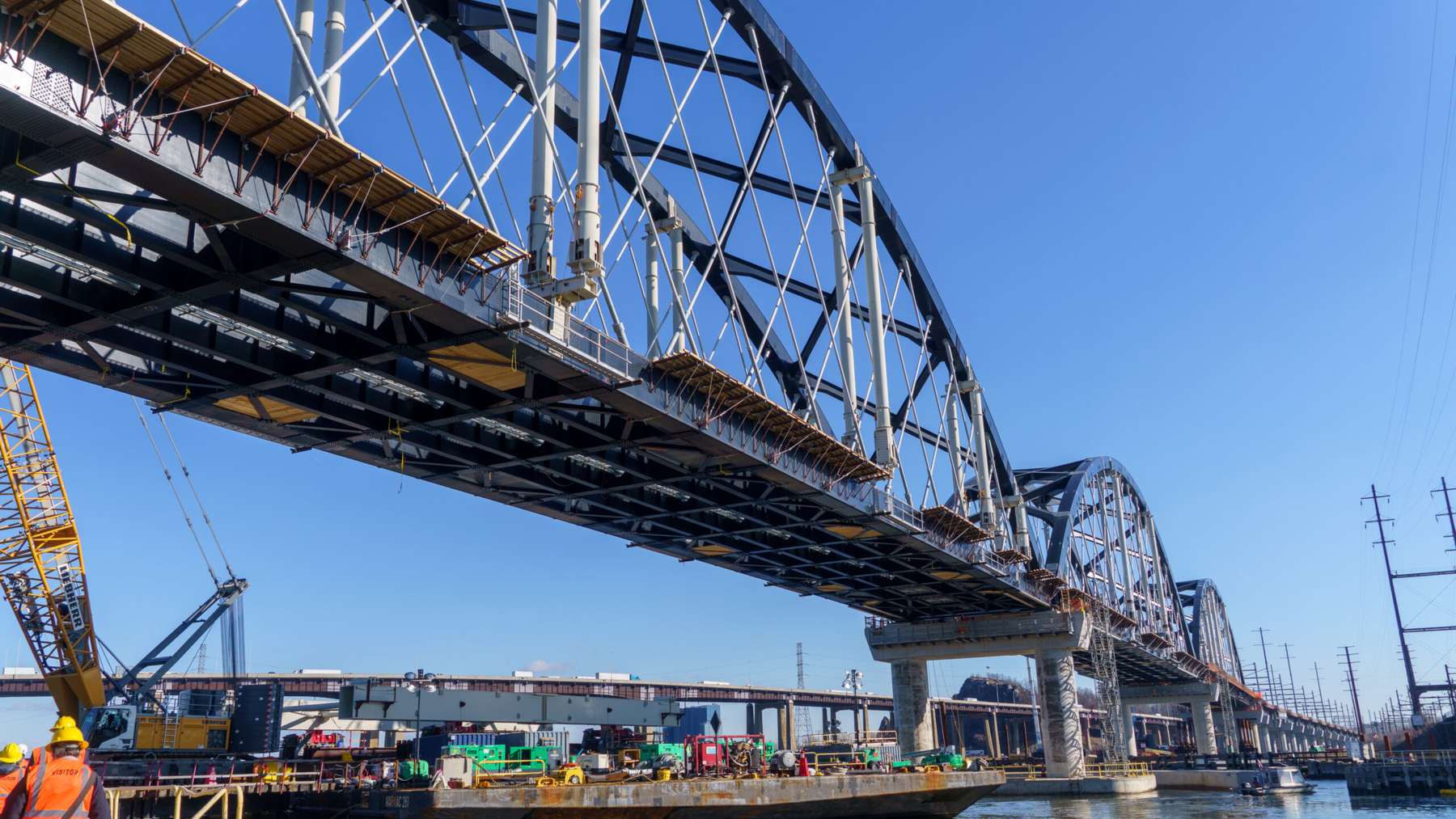
The Portal North Bridge doesn’t move at all, and frankly, that’s all most people want from a bridge. It’s a fixed, two-track span 50 feet above the Hackensack, more than twice the old bridge’s clearance, so boats can go under it without anyone stopping a train. The river crossing itself is three 400-foot steel arches, end to end.
So how do you stand something like that on Meadowlands mud?
You don’t, really. You go through it. “There’s a lot of muck and mud,” Chrissa Roessner, the project’s chief of construction management, told Construction Equipment Guide. That rules out a spread foundation, which is a wide concrete pad that spreads a structure’s weight over the soil under it. Instead, the bridge stands on piles, long steel pipes driven deep into the ground so the load goes down past the mud.
There are a lot of them, too. NJ Transit’s estimate for the job includes 185,000 linear feet of pipe piles, which works out to more than 35 miles, plus 20,000 feet of drilled shafts (concrete columns poured into deep holes). Above all that, there’s 45 million pounds of structural steel.
The old bridge had to let its replacement through
The arches weren’t built over the river. They were put together at the Port of Coeymans, near Albany, and floated down the Hudson one at a time. NJ Transit said the first one was 400 feet long and weighed 5 million pounds, and it made the trip on a heavy transport barge with three tugboats in about 30 hours.
Each arch stood about 86 feet tall, according to a superintendent on the job, and the trip took them under 18 bridges. Seven of those had to open. The last one was the old Portal Bridge, so the old swing span had to step aside and wave its own replacement through.
It wasn’t exactly roomy. Construction Equipment Guide reported that the barges had about two feet to spare under a fiber-optic line at the old bridge, and only at low tide. Once each arch was in place, hydraulic towers jacked it 60 feet up onto the piers, and the builders say the first lift alone took a full day.
It’s a pretty neat piece of logistics. Austria’s national railroad used a similar idea when it rolled a 1,400-ton railroad bridge into place without a crane: build the heavy thing somewhere easy, then move it.
Five weeks on one track is a lot to ask
Single-track running is exactly what it sounds like. Trains going both ways take turns on one track, so you can’t fit as many through in an hour. And that’s happening on what NJ Transit calls the busiest stretch of railroad in the country, which normally sees upward of 400 trains a weekday between Newark and New York, carrying 200,000 riders on NJ Transit and Amtrak.
Amtrak spelled out the cuts in its briefing. NJ Transit’s Northeast Corridor line drops from 133 weekday trains to 113, while Amtrak’s Keystone trains between Philadelphia and New York go from 24 to 10.
The crews aren’t taking weekends off. Amtrak says the job adds up to about 40,000 work hours, run in two shifts a day, seven days a week. They’re laying about 4,500 feet of new track and roughly as much new overhead wire, along with a new turnout (railroad speak for a switch) and five new signals.
Is that a pain? Sure. But I’d argue five weeks of detours through Hoboken is a fair trade for a bridge that won’t ever need a hammer to close.
The new bridge didn’t come cheap, either. NJ Transit’s board approved a $1,559,993,000 construction contract with a joint venture of Skanska and Traylor Bros., the biggest construction contract the agency has ever handed out, and the Federal Transit Administration put in $766.5 million. It’s also part of the Gateway Program, which NJ Transit says will eventually double capacity on the rail line between Newark and New York.
So when does the old bridge come down?
It won’t be right away. NJ Transit says the old Portal Bridge will be dismantled in 2027, and the Coast Guard expects construction at the crossing to wrap up early that year, with the old bridge demolished after that. As far as I can tell, nobody’s put an exact date on it.
Apparently the original plan was to move the old bridge somewhere else in one piece because of its historical significance, but Construction Equipment Guide reported that it wasn’t feasible. I couldn’t find anything from either railroad saying whether any part of the swing span gets saved.
NJ Transit and Amtrak both call the bridge 116 years old, and I’m not going to argue with the people who’ve been running trains over it. If you want to get technical, though, the Pennsylvania Railroad opened its tunnel line into Penn Station, Portal Bridge included, on Nov. 27, 1910, so its last train crossed about seven weeks short of that birthday.
NJ Transit says regular schedules should be back on Sunday, Nov. 15, as long as the new track passes its safety testing, and Amtrak’s expecting full normal service the next day.