
- 4 WEEKS AGO · INDUSTRYA 481-ton boring machine spent 17 months cutting 2 miles under a Welsh estuary and came up in a 187-foot shaft with 2,774 concrete rings bolted in behind it, so 10 steel towers carrying 400,000 volts across a national park can come down and the view go back to the way it was
- 3 WEEKS AGO · INDUSTRYA 2,535-ton boring machine is being cut to pieces half a mile under the Australian mountains after 5.3 miles of tunnel, with a 417-ton cutting wheel nobody needs anymore, while her sister is only halfway through a 9.3-mile drive
- 2 WEEKS AGO · INDUSTRYA 44-foot boring machine spent 25 months cutting a 2.8-mile tunnel that drops 213 feet below sea level to pass under the Panama Canal with ships still running overhead, and just came up on the far side with 2,295 concrete rings behind her, so a monorail can skip the two bridges jammed every morning
- 1 WEEK AGO · INDUSTRYA nearly 23-foot tunnel boring machine just broke through into its first station under downtown Toronto after cutting about 4,265 feet and lining the tunnel with roughly 780 concrete rings, and its twin is due to punch through right beside it in December
- TODAY · THIS ARTICLEA 2,535-ton German boring machine 2,300 feet under the French Alps spent months inching through about 200 feet of coal seam, water and mud, then hit up to five concrete rings a day, roughly 33 feet of tunnel, before parking for scheduled maintenance until the new year
Tunnel boring machines tend to get two big days in the news. There’s the launch, usually with a ribbon and a couple of government ministers, and there’s the breakthrough, when the cutterhead finally punches out of a rock wall and everybody claps. Everything in between is supposed to be, well, boring.
But one machine under the French Alps has had a pretty eventful year. She’s called Viviana, and she’s digging the north tube of the Lyon-Turin rail tunnel out of Saint-Martin-la-Porte, in Savoie.
For months, she crawled through a fault full of coal, water and mud. TELT, the French-Italian public company building the tunnel, says she made it out the other side in October. Right now she isn’t digging at all, because she’s parked for scheduled maintenance until the end of the year.
Tunnel builders traditionally give these machines women’s names. According to Il Post, the habit started as a bit of superstition, with names borrowed from protective saints. This one’s named after Viviana, the wife of Mario Virano, who was TELT’s first general director.
So what is she, exactly?
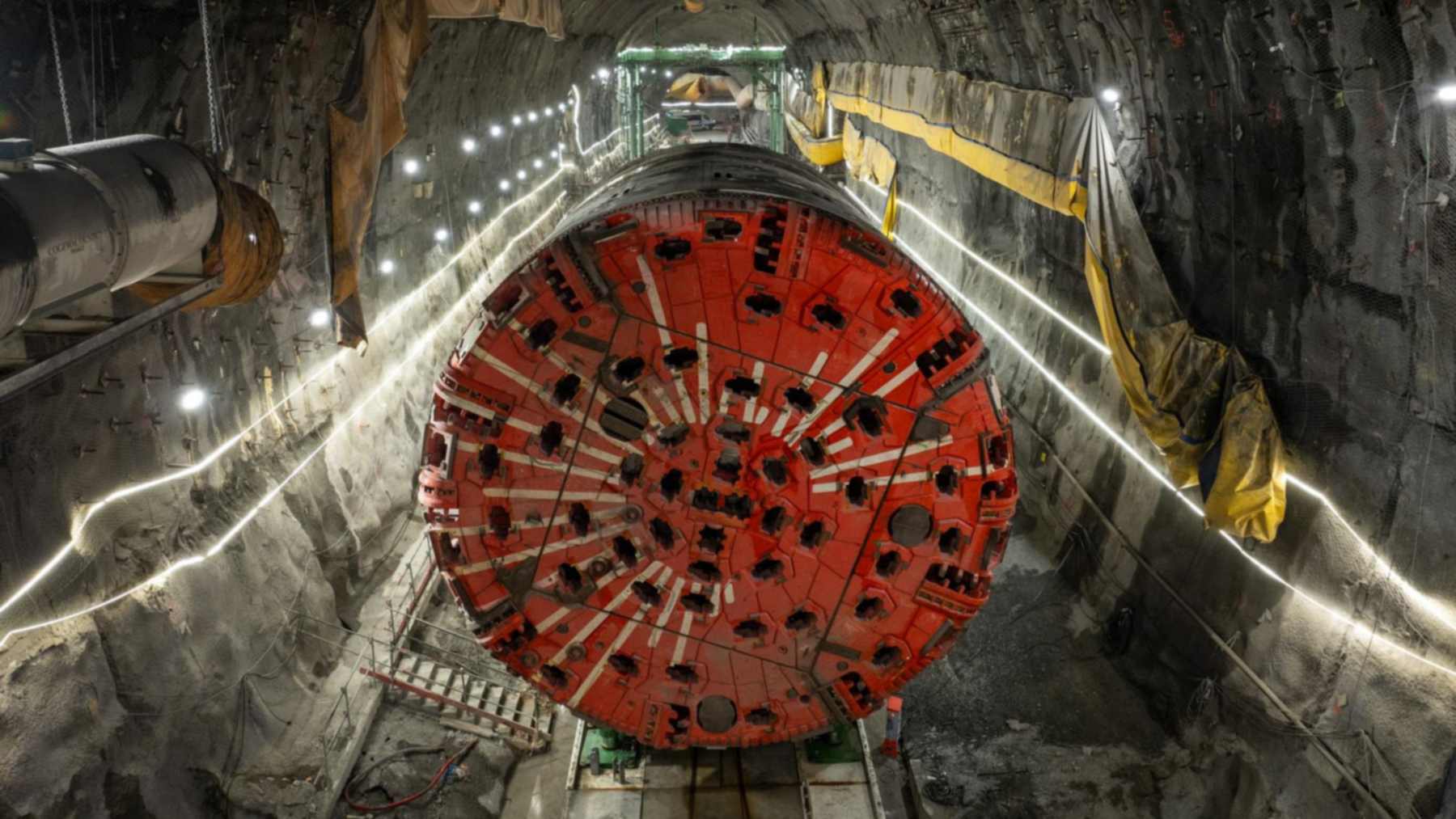
Viviana was built by Herrenknecht in Schwanau, Germany. TELT’s own numbers put her at about 2,535 tons. She’s 591 feet long once you count the string of trailers that follow her 34-foot cutterhead around like a rolling factory.
That cutterhead carries 61 disc cutters, backed by 8,100 kilowatts of installed power (roughly 10,900 horsepower). About 15 people work aboard her, and she’s running around the clock.
As she cuts, she lines the tunnel behind her with concrete rings. A ring is basically a full circle of curved, precast concrete slabs (eight of them in Viviana’s case) fitted together right behind the cutterhead, and from that moment on it’s the tunnel’s permanent wall. Each slab weighs about 11 tons, and the La Chapelle plant that casts them has already turned out more than 8,900. They reach the machine on a nonstop shuttle of wheeled trains.
In decent ground, TELT says she should manage roughly 1,000 to 1,500 feet a month. She’s also the first of seven new machines TELT has lined up for the base tunnel. We covered a 3,200-ton machine being assembled inside this same tunnel back in July, and at that point it hadn’t cut any rock yet.
Viviana’s been slow for a while
Her pace has been a story since the summer. In July, the Italian outlet Il Post ran the numbers. According to Il Post, the plan called for something like 33 to 49 feet a day, and by its own math Viviana had been averaging about 2.6 feet, with fewer than 820 feet covered in nearly 300 days.
TELT tells it a bit differently. Its version is that she covered about 650 feet in her first two months, then sat for five months while crews replaced machine parts and conveyor belts. Manuela Rocca, TELT’s deputy general director, told Il Post the machine was moving slowly but that this had been expected, and she put it down to complex geology.
Some French lawmakers weren’t buying it. Deputies from the left-wing France Insoumise party, including Savoie’s Jean-François Coulomme, showed up at the site over the summer and said the machine had stalled. A TELT spokesperson pushed back, saying Viviana was dealing with demanding geology at one of the most sensitive points on her route, and denying any unexplained breakdown or surprise stop.
Frankly, TELT’s explanation sounds plausible enough to me. According to Tunnelling Journal, geological surveys had marked this fault zone as one of the big construction risks on the job, and an earlier exploratory machine called Federica had already been through the same conditions on a roughly 5.6-mile drive. So the slow going probably wasn’t a shock to anyone on site, even if it doesn’t look great from the outside.
So why pump concrete into a mountain?
You’d think a 2,535-ton machine with 61 cutters could push through more or less anything.
So why did Viviana need help from a concrete pump?
It’s the ground. According to ODS Radio, the bad stretch was a fault zone of roughly 200 feet, about 2,300 feet underground, with a coal seam running through it and water seeping in.
A cutterhead needs ground that holds its shape long enough to cut a clean, round hole and get a ring in behind it. Coal is soft and crumbly, and once water gets into it you end up with mud, so crews injected large amounts of concrete into the ground to firm it up before the machine moved on. That also meant regular stops to clear out the mud that kept piling up. On some days, ODS says, progress was measured in inches. Étienne Bourdelle, the lead site manager, put it this way to the station (translated from French): “Neither we nor the machine set the pace. The ground does.”
If you read our piece on the 800-ton machine fighting toothpaste-like clay under Cleveland, you’ll know soft ground can be a lot more trouble for these machines than you’d expect. It’s a pretty unglamorous fix, but pumping concrete into a mountain is apparently what it takes.
I couldn’t find a figure for how long the fault alone took to cross. TELT has only said she got through it at some point in October.
She’s parked until the new year
Once she’d cleared it, things picked up fast. ODS reported on November 4 that her best days were hitting five rings, which is about 33 feet of finished tunnel, compared with the 2.6-foot daily average Il Post worked out in July. By then she’d placed 184 rings and lined a little more than 1,300 feet.
Then, on November 7, she reached a connecting bypass gallery and shut down for planned maintenance, Tunnelling Journal reports. As far as I can tell, TELT hasn’t said what’s being worked on during the break.
Viviana’s whole assignment is a 5.6-mile stretch of the north tube between Saint-Martin-la-Porte and La Praz. The base tunnel itself runs 35.7 miles, and Tunnelling Journal says more than 31 of the roughly 102 miles of tunnels and galleries planned for the project had been dug by mid-October, with 14 faces being worked at once. So she’s got plenty of mountain left to chew through.
TELT expects Viviana to start cutting again at the end of the year. According to ODS Radio, the next fault on her route has already been mapped, it doesn’t have any water pockets, and she should reach it in the first few weeks of the new year.
 A 400-ton generator at a South Dakota dam was taken apart for the first time in 70 years, its 275-ton rotor lifted out by two cranes working as one, and the first new turbine runner has now rolled into the powerhouse to take each unit up to 52 megawattsEnergy · 2 hours ago
 A 13,500-ton American icebreaker that turned 50 in the Antarctic towed a 4,200-ton pier made of frozen seawater out of a McMurdo bay, cut a 7-mile channel through ice up to 8 feet thick, escorted a 600-foot tanker, freed a cruise ship in six hours and is already being readied to go backIndustry · 4 hours ago
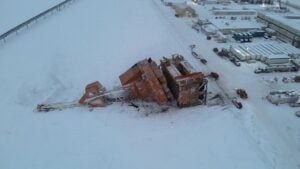 A nearly 10-million-pound drilling rig that once bored a record 6.7-mile well in Alaska was taken apart and hauled off the tundra after one of its six modules tipped over on a gravel road, and almost 10 months later the investigation into why is still openIndustry · 8 hours ago