
- 2 MONTHS AGO · MILITARYA 24-foot British navy drone boat put a gouge in the stern of a 55-foot racing yacht inside Portsmouth Harbour, and seven of them still run there day and night, driven from a control room on shore under a rule that says keep 650 feet clear where possible
- 2 MONTHS AGO · MILITARYA 65-foot drone ship that maps the seafloor partly under sail, with no engine room rumbling through the hull, returned soundings a university team rated as good as any survey ship’s, and the US Navy has now pointed it at the open Atlantic for a year
- 2 MONTHS AGO · MILITARYNineteen 154-pound underwater drone gliders with no propellers flew at once off Portugal in NATO’s biggest uncrewed naval exercise, hunting submarines by listening, and a bigger 377-pound glider dragged a line of hydrophones through the water behind it
- 1 WEEK AGO · MILITARYA 28-foot drone boat that hits 55 knots was steered around Portsmouth harbor from a control hub as the Royal Navy commissioned its first autonomous squadron, about 180 sailors split into two watches to keep uncrewed boats running around the clock
- TODAY · THIS ARTICLEA 2,583-ton ship that can be run from a control room on shore went through the Royal Navy’s trials early this year for a net to track Russian submarines between Greenland, Iceland and Britain, and its 8,100-square-foot open deck is rated for 1,050 tons
When most people picture a ship that hunts submarines, they picture something gray and pointy. A frigate with a helicopter on the back, a sonar array trailing behind it and a big crew on board. The Royal Navy still has plenty of those. But one of the ships it ran through trials in early 2026 for its new sub-hunting network looks a lot more like an offshore survey vessel, and that’s because it basically is one.
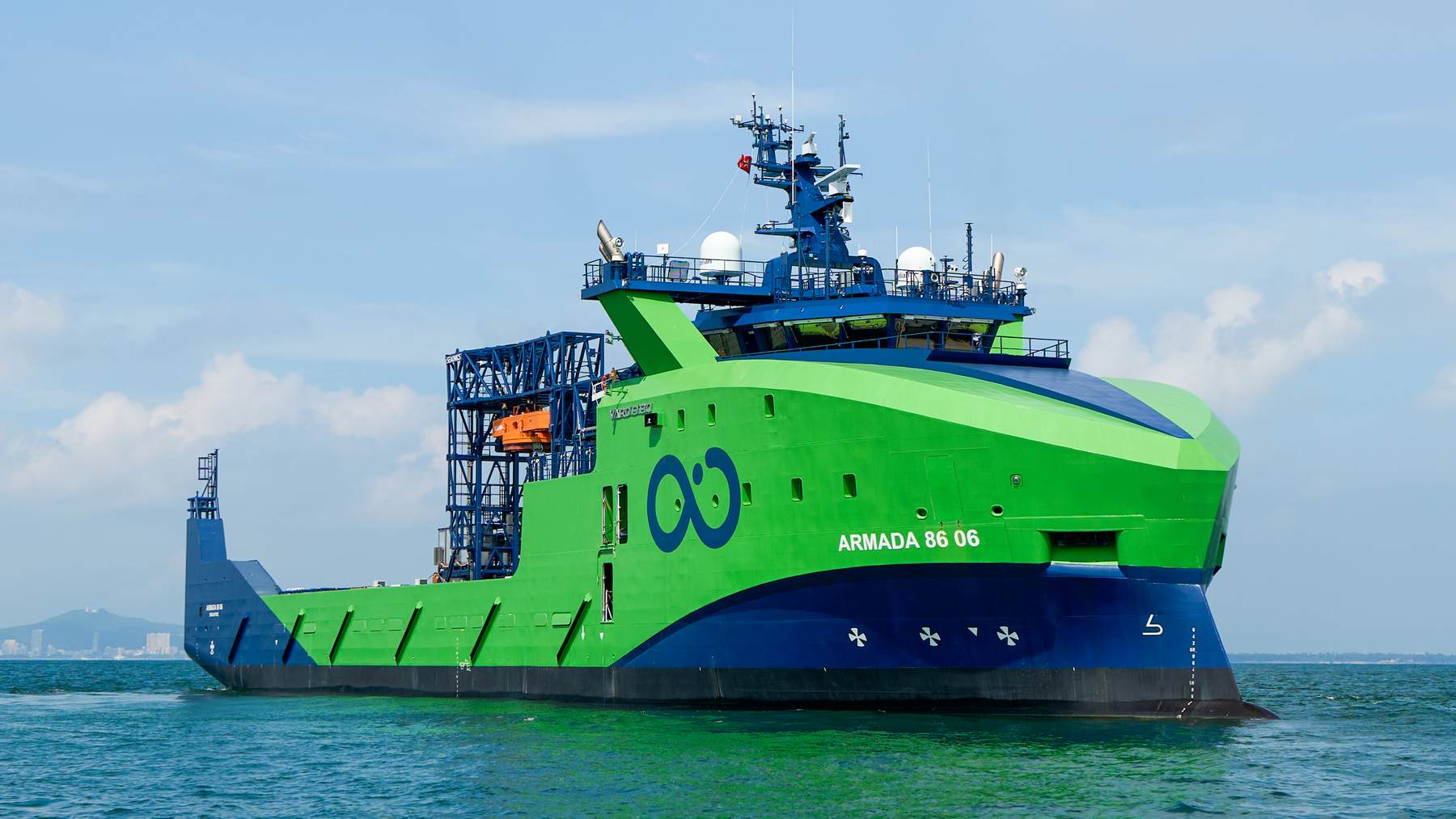
That ship is the Armada 86-06. It belongs to Ocean Infinity, a marine robotics company based in Hampshire, England, and according to The Defense Post and Janes, it took part in the Royal Navy’s Atlantic Net trials. It can carry a crew, but it doesn’t need one. Ocean Infinity designed it to be driven from a control room on shore.
Then on November 10, Britain’s Ministry of Defence announced a £90 million framework, about $120 million at current exchange rates, with Ocean Infinity’s UK defense arm to actually build the thing.
Britain is paying £90 million for a net under the North Atlantic
The MoD made the announcement at the International Sea Power Conference in Oslo, Norway. The program is called Atlantic Net, and it’s the first phase of a larger Royal Navy effort called Atlantic Bastion. According to the MoD’s release, it’ll tie sensors, uncrewed vessels and AI together into a single system that watches for Russian submarines and anything else that looks suspicious.
The idea is to give the Navy’s sub-hunting warships and its Astute-class attack submarines a heads-up sooner. And if you’re wondering why a navy cares so much about cables on the ocean floor, it’s because they carry most of the internet traffic between continents. USNI News says the network is meant to protect undersea energy links, too.
The setup is a little unusual, too. Ocean Infinity owns and runs the hardware, and the Royal Navy directs what it does. That’s basically a navy renting a capability rather than buying a fleet, which seems like a fairly sensible way to get something into the water quickly.
Luke Pollard, the UK’s Minister for Defence Readiness and Industry, put it this way: “The threats beneath the North Atlantic are changing, and we are changing with them.” The MoD says the deal will support almost 200 skilled jobs, counting Ocean Infinity’s direct suppliers.
So what’s the GIUK gap?
It’s the stretch of open ocean between Greenland, Iceland and the UK. Submarines leaving Russia’s northern bases for the wider Atlantic pretty much have to cross it, which is why navies have been listening to that water since the Cold War.
According to Submarine Networks, the GIUK gap is Atlantic Net’s first focus. If you’ve read our piece on RFA Proteus, you’ll know the UK has been nervous about its seabed for a while.
So where does a survey ship fit into all that?
Is the Armada 86-06 a drone?
Not quite. Baird Maritime describes the bigger Armada ships as optionally crewed, and that’s the honest way to put it. Its review of the first ship in the class, the Armada 86 01, says it has room for up to 16 crew and payload staff and can be run from shore through Ocean Infinity’s remote control centers.
Which means you can put people on it when a job needs hands on deck, or leave them at home when it doesn’t. A pure drone doesn’t give you that choice, and for a ship that’s meant to spend weeks in the North Atlantic, I’d argue that flexibility is worth a lot.
I have to be careful with the next part. The Defense Post says the specific systems for Atlantic Net haven’t been disclosed, and I can’t find anything from the MoD or Ocean Infinity that names this hull. According to USNI News, the Royal Navy illustrated the news with a photo of an Armada ship, which is a pretty strong hint about the family. It isn’t a contract for this particular ship.
How big is a 2,583-ton ship?
Tonnage gets a bit tricky. The 2,583 figure comes from the 86-06’s ship-tracking listing on MagicPort, and it’s gross tonnage. Gross tonnage isn’t a weight. It’s a measure of the enclosed volume inside the hull, and ports and regulators use it to set fees and rules. Displacement, the number navies usually quote for warships, is the actual weight of water a ship pushes aside. I haven’t found a published displacement figure for the 86-06.
The same listing gives a deadweight of 2,474 tons, which is roughly what the ship can carry in fuel, cargo, water and stores. Baird lists the sister ship 86 01 at 2,572 gross tons.
Baird Maritime puts the 86-06 at about 280 feet long and 53.8 feet wide, with a draft of at least 16 feet. At the back, there’s an open deck of about 8,100 square feet that’s rated for 1,050 tons of payload.
It runs on a hybrid system with 7,000 kilowatts of installed power and two 565 kWh lithium-ion batteries. Cruising speed is 8 to 10 knots (about 9 to 11.5 mph), and Baird says it can stay out for 21 to 35 days depending on the payload and the job. That’s slow, but you don’t need speed to sit in one stretch of ocean for weeks. You need endurance, and this thing arguably has plenty.
What’s on the back deck?
A big part of Ocean Infinity’s business is putting robots underwater. Some are ROVs, which stay connected to the ship by a cable and get flown by a pilot. Others are AUVs, which swim a preprogrammed route on their own and come back with data.
On the 86 01, Baird describes a removable aft bulwark, the solid railing at the back of the deck, so the crew can put those vehicles straight over the stern. It’s a pretty clever bit of design. I haven’t seen it spelled out for the 86-06, though, so that’s my assumption about a sister ship, not the company’s.
Other boats went through the same trials
According to Janes, Atlantic Net program director Captain Chris Hill said the early 2026 trials looked at automation, sensor performance and AI, and at whether suppliers could build fast and at scale.
Ocean Infinity wasn’t the only company in the water, either. Janes says ACUA Ocean’s 46-foot Pioneer, the drone boat that sat off Plymouth for more than 100 hours, went through the same trials. Ocean Infinity is the company that ended up with the commercial mission partner role.
It’s got plenty of hulls to draw on, too. Ocean Infinity runs a 14-ship Armada fleet in two size classes, and the 86-06 was the last of the larger ships, delivered in December 2025, according to Baird Maritime and Marine Technology News.
Submarine Networks reports that the first piece of Atlantic Net should be working within months of the November 10 announcement, with sustained watch over the GIUK gap following in 2027.
 A 17,500-ton British nuclear missile submarine just came home to its Scottish base after an estimated 217 days hidden underwater, about 12 days longer than any Royal Navy patrol before it, and the Ministry of Defense will not confirm how long the boat was at seaMilitary · 2 days ago
 A 1,526-ton World War II submarine with no propellers was towed 113 miles back across Lake Michigan in 15 hours by two tugboats and eased into her museum berth by 10 a.m., after a Wisconsin shipyard found only 10% of her hull steel had worn away in her first dry dock in 72 yearsMilitary · 2 hours ago
 A 97,000-ton nuclear aircraft carrier has now spent 2,022 days at the Virginia shipyard that built her, getting a new mast and work on over 600 tanks, and Navy documents point to one more year of it, with her sister ship already there for a five-year overhaulMilitary · 3 hours ago