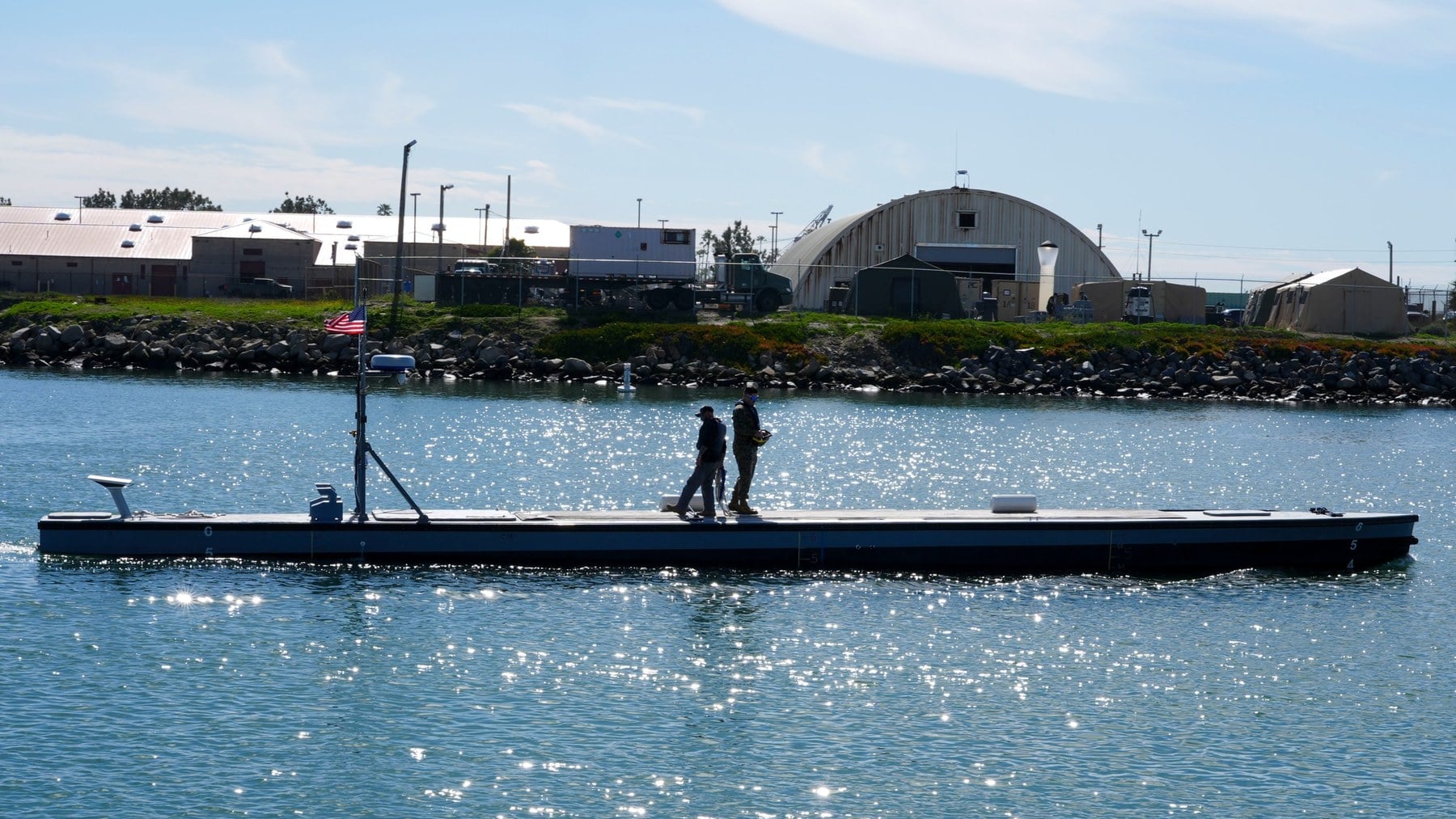

Every so often, the Coast Guard puts out a video of one of its cutters catching a homemade boat full of cocaine somewhere off Central or South America. And a lot of the time, you can barely see the boat. It’s mostly underwater, with a sliver of deck and maybe a stubby little cabin poking out of the waves.
Those are low-profile vessels, and people tend to call them narco subs. They aren’t true submarines, because they can’t dive. The hull just sits so low in the water that there’s very little for radar or a lookout to pick up, which is pretty much the whole point.
So it’s a bit funny that the U.S. Marine Corps liked the idea enough to copy it. Brig. Gen. Simon Doran, then the Corps’ director of strategy and plans, didn’t exactly hide where the design came from either. “Truth be told, this is just a narco boat,” he said a couple of years ago, in remarks DefenseScoop dug back up in March.
Now the Pentagon wants more of them, and it wants them faster and cheaper. On Monday, November 9, the Defense Innovation Unit (DIU) said it had awarded three prototype contracts under its Autonomous Low Profile Vessel project, or ALPV for short. The goal is crewless cargo boats that can keep Marine units supplied when they’re spread out along coastlines an enemy is fighting over.
So who got picked?
DIU named Saronic, Sea Machines Robotics and Rudder Industries in its announcement on X, and said all three came out of a competitive solicitation earlier this year. I also checked diu.mil for a press release, and as of Tuesday morning there isn’t one. So the X post is the official word for now.
Saronic is probably the name you’ll recognize. The Texas startup builds the 24-foot Corsair, which DIU’s own catalog lists with a 1,000-pound payload and more than 1,000 nautical miles of range. Three of those boats drove into an Iranian naval base in July, according to U.S. Central Command.
The company’s also had a pretty good fall. In September, the Navy picked Saronic as one of three builders for its medium drone ships, with 10 vessels each, Military Times reported.
Sea Machines has the most direct experience here. Its SM300 autonomy system already drives the Marine Corps’ current low-profile boat, according to WorkBoat. So it’s basically being asked to do a job it knows, just with a much bigger cargo target.
Then there’s Rudder Industries, which is frankly the most interesting name on the list. DIU describes it as “a first-time DoW partner,” DoW being the Department of War, which is what DIU calls the Pentagon these days. So Rudder hasn’t done work for the military before. Defense WarRoom reports it’s a marine manufacturer based in Portland, Maine. Beyond that, I couldn’t find much about Rudder at all. I’d guess that’s not unusual for a smaller builder that’s never chased a defense contract, but it does make it the wild card of the three.
DIU says it’ll work alongside the Marine Corps Warfighting Laboratory, NAVSEA’s Combatant Craft Division and a few other Navy and Marine Corps offices throughout development. It hasn’t put a dollar figure on any of the three contracts, though. It also hasn’t said how many boats each company is building, and there aren’t any renderings yet, so we don’t even know if the three designs will look alike.
What does DIU want these boats to do?
Quite a lot, as it turns out. The solicitation DIU posted in March spells out what the Marines are after, and these are requirements, not specs any of the winners have hit yet. The big one is cargo.
Each boat should carry at least 18,000 pounds of supplies. That’s about nine tons, and DIU wants the boat to handle any kind of supply, bulk liquids included (think fuel or water).
It has to fit either six of the military’s 3,000-pound JMIC containers or two longer 5,100-pound containers, plus standard pallets. A JMIC is basically a heavy-duty metal crate a little under four feet tall, so you can picture six of them lined up in a cargo hold. The longer containers stretch to almost 14 feet.
Then you’ve got the sea requirements. DIU wants the boat to cover 1,000 to 2,000 nautical miles fully loaded in sea state 5, hold at least 12 knots (about 14 mph) loaded in sea state 4, and survive sea state 6.
If those numbers don’t mean much to you, don’t worry. Sea state is just a scale for how rough the water is, and sea state 5 means waves of roughly 8 to 13 feet. Sea state 6 runs up to about 20 feet, which isn’t a fun day for any boat, let alone one that rides this low.
It should also be able to hang around for up to 96 hours at slower speeds. That’s four days of a drone boat more or less treading water, presumably until someone tells it where to go next.
My favorite line in the whole document is about transport, though. The boat has to come with a trailer that a regular commercial semi truck can pull. Whatever these companies build has to go down the highway behind the same kind of truck you’d pass on the interstate, so it’s safe to assume nobody’s designing a giant ship here.
Wait, it sinks itself?
Yes, on purpose. DIU wants the boats to be hard to tamper with while they’re at sea, and it wants operators to be able to scuttle them remotely. That basically means someone back at base can sink one if it’s about to end up in the wrong hands.
It’s a slightly grim thing to put on a spec sheet. But for a drone boat hauling military cargo with nobody aboard to defend it, I’d say it makes a lot of sense.
The navigation rules are arguably the hardest part. The boats need to drive themselves through busy waterways and ports, steering around hazards with the military’s M-Code GPS and active sensors. They also have to keep going under emissions control, which is military speak for going quiet and switching off anything that transmits, or when they lose their communications link altogether. In those cases they’re supposed to fall back on passive sensors that only watch and listen.
DIU also wants each company to prove its boat can still work out where it is when GPS is jammed or unavailable, and to show that before prototyping wraps up. Given how common GPS jamming has become, that’s a pretty sensible thing to insist on.
Humans don’t disappear entirely. An operator should be able to take over by remote control for the first and last mile of a trip, hand control off to someone else, and run several boats at once.
The Marines already have a low-profile boat
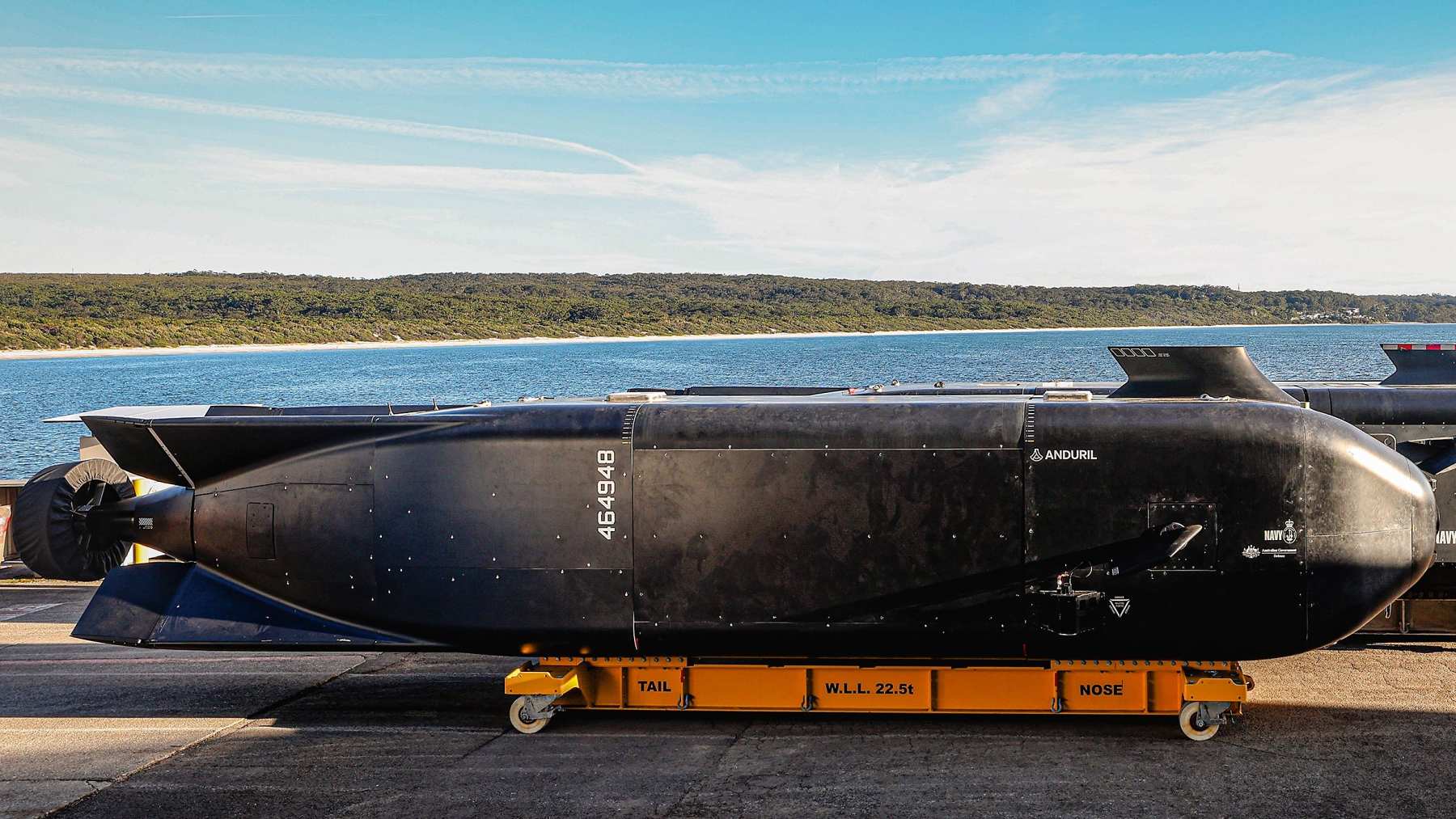
The current boat is the Sea Specter, a semi-submersible designed by Leidos and its Gibbs & Cox subsidiary. WorkBoat and Defense One both put it at 65 feet long, and WorkBoat lists a 230-hp Cummins diesel and a 29-foot cargo bay.
Leidos says the boat can carry up to five tons over 2,000 nautical miles, and Leidos delivered two prototypes to the Marine Corps Warfighting Laboratory a few years back. Marine units have since run it in exercises in Japan, North Carolina and California. I couldn’t find an official figure for how much the empty boat weighs, though.
Compare those figures with DIU’s wish list. The cargo target goes from the roughly 10,000 pounds the Sea Specter is rated for to 18,000 pounds. Minimum speed goes from the Sea Specter’s 8-knot cruise to 12 knots with a full load.
Is that why DIU went looking for new designs?
Partly, maybe. DIU’s own explanation is about speed and cost. Its post says the Marines have already prototyped several ALPV versions but need to move faster and spend less doing it, which is why it opened the door to commercial autonomy and boat designs.
The Marines aren’t the only ones shopping for crewless cargo boats, either. The Army has its own plans for much bigger drone cargo ships, but those are built to move stacks of shipping containers between ports rather than slip in low.
When will we see one?
The solicitation gives each company 180 days from its award to demonstrate a working boat. DIU hasn’t said exactly when that clock started for Saronic, Sea Machines and Rudder Industries. If it started with the November 9 announcement, the first demonstrations would land around early May.