
When a helicopter goes into the water, the thing that comes to get the crew is normally another helicopter, or a ship that puts a boat and a rescue swimmer over the side. That’s how it’s worked for the better part of 80 years, and it’s pretty much what you’d picture if I told you an Army Apache went down off the coast of Oman in June.
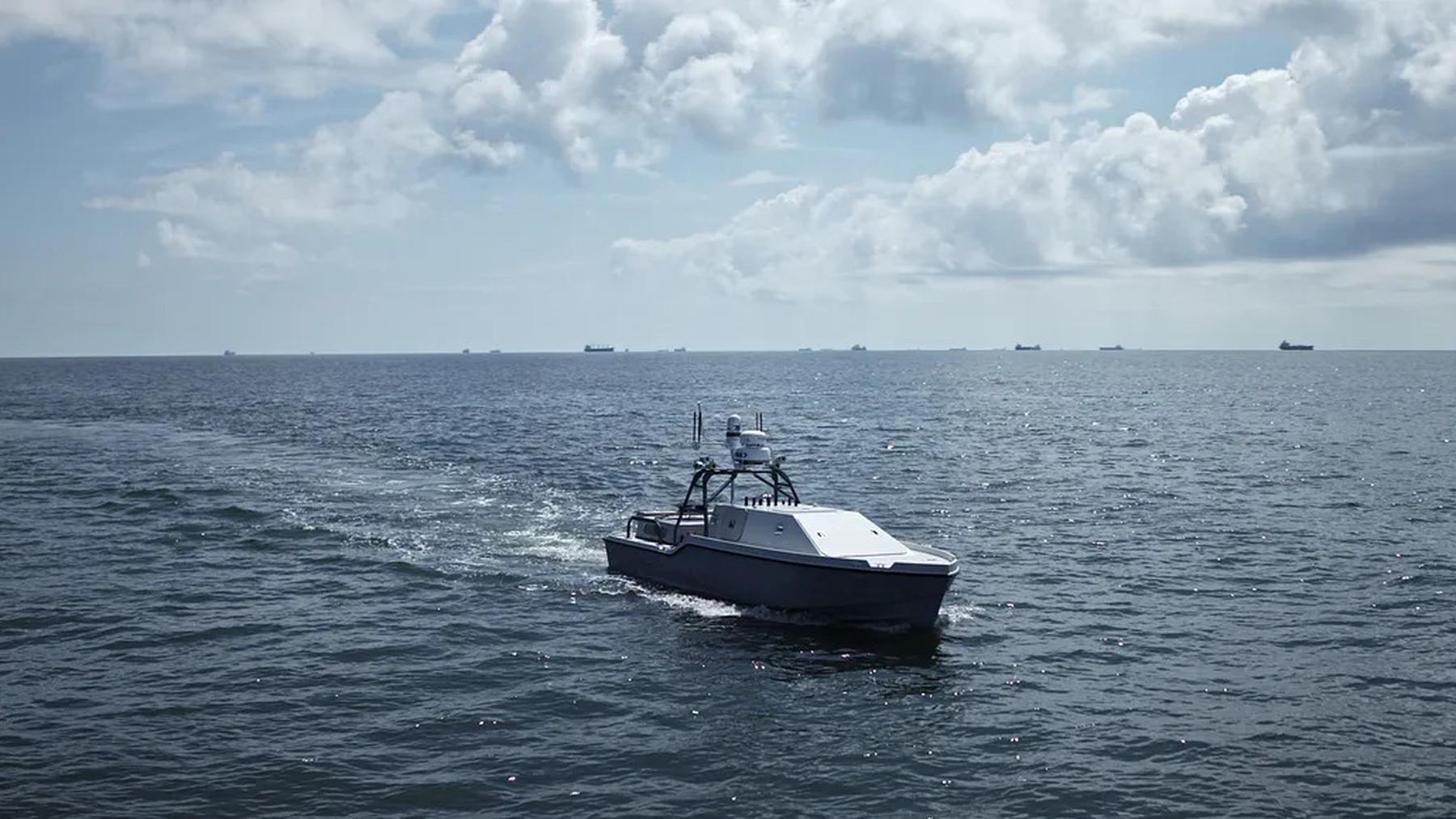
So it was a bit of a surprise when U.S. Central Command confirmed that one of the vessels that helped get those two pilots back was a 24-foot boat with nobody on it.
And now that same boat has turned up on the back of a Greek navy ship, and Athens wants to buy a few dozen of its own.
What happened off Oman
The timeline comes from CENTCOM’s own statement. On June 8, an Army AH-64 Apache went down near the Omani coast while patrolling regional waters. By 7:33 p.m. ET, roughly two hours later, both crew members had been picked up and were in stable condition. President Trump said Iran shot the helicopter down. CENTCOM said the cause was under investigation, and as far as I can find, it hasn’t said anything more since.
Naval Forces Central Command and the 82nd Airborne led the rescue, with help from the Air Force and from the Navy’s Task Force 59. That last name is the one that matters here. Task Force 59 is a Bahrain-based unit the Navy set up in 2021 to try out drones and AI in the Middle East and see what sticks. It’s basically the fleet’s test kitchen.
The next day, CENTCOM spokesman Capt. Tim Hawkins told The War Zone which drone it was: a Navy Corsair, run by Task Force 59, and the task force “began fielding these drones in theater in late March.” So the boat had been in the region for about ten weeks when the Apache went in.
How exactly did a boat with no crew help two people who were floating in the water?
No one has answered that in public, and I’d rather tell you so than make something up. CENTCOM has only said the Corsair “assisted” in the rescue. Hawkins told the Wall Street Journal the logic was simple: you send whatever’s closest and quickest, and that night it was the drone. Saronic says the boat carries cameras and sensors and can spot and track objects on its own, so my guess is it got eyes on the pilots fast and kept them there until something with a crew could close in. Whether it actually hauled anyone aboard, CENTCOM hasn’t said.
Saronic, the Austin company that builds it, put out a short statement a few days later. The company said the Corsair was used in a “first-of-its-kind rescue operation” and left it at that. Navy Leaders and others reported it as the first time the U.S. Navy has used a drone boat for search and rescue, and I can’t find an earlier case either.
So what is the Corsair?
Picture a 24-foot speedboat with no one at the wheel, because there isn’t one. That’s roughly the idea. Saronic rates it at more than 35 knots, call it 40 mph, with a payload of about 1,000 pounds and a range of more than 1,000 nautical miles on diesel. It’s built to be dropped off and picked up by a bigger ship at sea, and the company says it can loiter out there on its own for more than 50 days.
The Navy bought a batch of them in December under a $392 million production contract, with about $200 million obligated up front. Then-Navy Secretary John Phelan made a point of saying the boat went from prototype to production in under a year, which in Navy shipbuilding terms is about the speed of light. The deal was an Other Transaction Authority agreement, which is a procurement shortcut that lets the Pentagon skip most of the usual federal acquisition rules when it’s buying from companies that don’t normally sell to the government. The Navy hasn’t said how many hulls that money buys.
If the Corsair name rings a bell, it’s because the boat has had a busy year. A month after the rescue, in July, three of them drove into Bandar Abbas naval base and hit an Iranian submarine, in what Naval News called the first use of American sea drones in combat, and none of the three came back. Another one went to Panama for an 11-day exercise and simply stayed, patrolling for drug runners alongside Panama’s coast guard.
So that’s a rescue in June, a strike in July and police work by fall, which is a fairly wide résumé for a hull that was still a prototype at the start of 2025.
Now the Greek navy wants at least 30
On Tuesday, October 13, Greek Defense Minister Nikos Dendias opened a new training center for unmanned and autonomous maritime systems at the Skaramagas naval base, just west of Athens. The ministry put out a video from the event, and Naval News went through it frame by frame. At least two Corsairs are in Greece right now. The fleet support ship HS Perseas (A377) was carrying them on her open deck and launching them, and a second support ship, HS Aias, may have been doing the same.
The ministry said the boats went through extensive trials with several fleet units, including working tactically alongside warships, and that the Hellenic Navy evaluated them successfully. Dendias described what they can do as “surveillance, reconnaissance and collaborative autonomous action in swarms,” according to Baird Maritime.
Greece has since sent the United States a Letter of Request to buy the boats through Foreign Military Sales. Two bits of jargon there. FMS is the program where a foreign government buys American weapons through the U.S. government rather than straight from the manufacturer, and a Letter of Request is the formal “we’d like to buy some of these, what would it cost” that starts the process. The ministry didn’t say how many. George Sideris of Hellas Journal, citing military sources, reported the number is at least 30.
Thirty is a lot. The Navy’s own contract hasn’t come with a public hull count, and the Greek request, if it goes through, would arguably be the biggest Corsair order anyone’s put a number on.
There’s a slightly funny detail in the same ceremony. Right next to the Corsair on the pier sat the Pyrpolitis, a 16-foot drone boat the Hellenic Navy designed and built itself in six months, rated at 40 knots and meant for surveillance and for ramming ships. So Greece showed off its own homegrown sea drone and, on the same day, asked to buy 30 American ones. Those aren’t really competing boats. The Pyrpolitis is a small kamikaze craft, and the Corsair is a bigger, longer-legged surveillance boat you can hang things off, which from the looks of things is exactly the gap the Greeks are trying to fill.
The Greek defense ministry said on October 13 that the Corsairs had passed the navy’s evaluation, and Hellas Journal reports that Athens expects Washington’s answer to the request before the end of 2026.