
- 1 MONTH AGO · MILITARYA 1,526-ton submarine sat on blocks in a drained Wisconsin dry dock all summer, out of the water for the first time in 72 years, and gave up a flood valve stamped for her sister sub, lost with all hands in the war, before her tow back across Lake Michigan this month
- 3 WEEKS AGO · MILITARYA 27,000-ton battleship that fought in both world wars has spent four years in a Galveston shipyard taking 700 tons of new steel into her hull, fired her 14-inch guns again, and now points her bow at the pier across the channel where she’s supposed to tie up next
- 2 WEEKS AGO · MILITARYA 2,050-ton World War II destroyer just lost her fall tow to dry dock and will spend one more Buffalo winter stuck in a mud cradle nobody has dredged in 21 years, until an Army Corps permit lets tugboats pull her free and haul her to Erie for new steel down to the keel
- 2 WEEKS AGO · MILITARYA 2,200-ton destroyer that lost 32 sailors off Okinawa will be towed to the other side of her South Carolina pier, because every dry dock trip from the old berth means ripping out 60 feet of roadway and closing the museum for two weeks, and the move makes that a one-time job
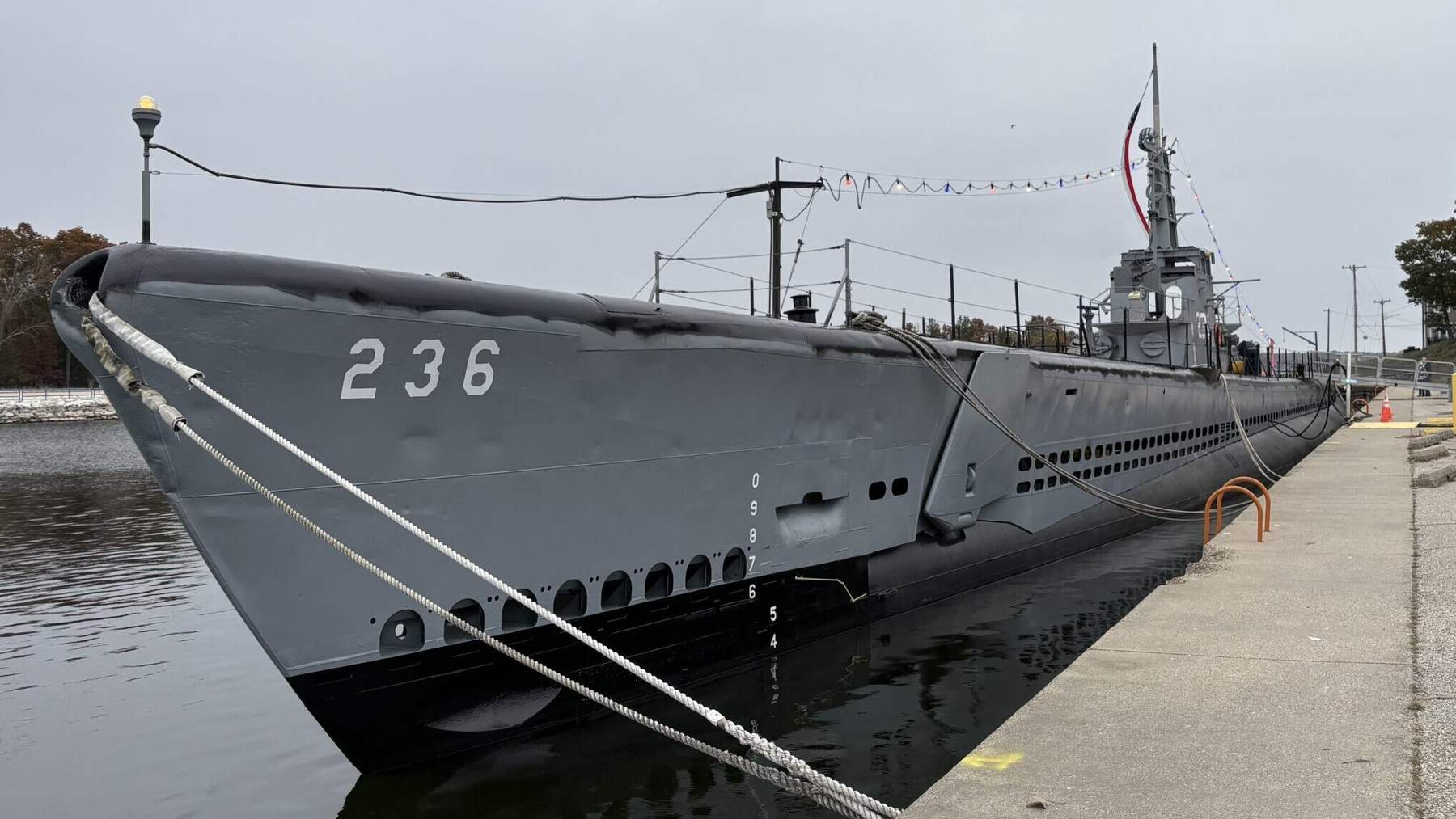
- TODAY · THIS ARTICLEA 1,526-ton World War II submarine with no propellers was towed 113 miles back across Lake Michigan in 15 hours by two tugboats and eased into her museum berth by 10 a.m., after a Wisconsin shipyard found only 10% of her hull steel had worn away in her first dry dock in 72 years
Pull a boat out of Lake Michigan after a season and you’ll probably find zebra mussels glued to the bottom. Leave it in the water a few years too long and you start to wonder what the steel looks like under them.
USS Silversides didn’t come out of the water for 72 years. The World War II submarine’s last dry dock visit was in 1954, according to MLive, and she’s been a museum ship in Muskegon, Michigan, since 1987. So when a Wisconsin shipyard finally lifted her out this summer, I think a lot of people were expecting a long list of bad news.
It didn’t really go that way. And since Nov. 7, you’ve been able to walk through her again.
She came home on Halloween morning
MLive says Silversides pulled away from Fincantieri Bay Shipbuilding at about 4:30 p.m. Wisconsin time on Friday, Oct. 30. She was in the Muskegon Channel by 8:30 a.m. Saturday.
If you just subtract one clock time from the other, you get 16 hours. But Wisconsin runs an hour behind Michigan, so the tow really took 15, which is the number MLive went with.
Two tugboats did all the work. The tugs Nickelena and Erika Kobasic are both longer than 100 feet and belong to Basic Towing out of Escanaba, Michigan. They’re the same pair that dragged her 113 miles to Wisconsin on July 13 and 14, a trip that took 16 hours. This time, they turned her inside Muskegon Lake and had her back at the museum’s dock before 10 a.m., while a little flotilla of local boats tagged along.
So why does a submarine need two tugboats in the first place?
Because Silversides hasn’t had propellers since 1947, when they were removed, according to MLive. By the Navy’s count she has a surface displacement of 1,526 tons, and without propellers all that steel is basically a barge that happens to be shaped like a submarine. One tug pulls, the other pushes, and the sub just goes along for the ride.
That’s also why the Coast Guard wanted to see some homework before it let her go. She had to clear five benchmarks, among them a float test and an incline test that checks her stability, plus ballasting, a few last touch-ups and getting the tow gear ready. MLive reported she cleared all five the week of the crossing. As far as I can tell, the Coast Guard hasn’t released the numbers behind any of those tests, so the only thing on record is a pass.
How much of her hull was actually left?
This is where the news got good. The shipyard’s inspection put her hull steel wastage at only about 10%, and museum executive director Veronica Campbell called that “incredible for a vessel of her age” in an interview with MLive.
If you’ve never run into the word, wastage is the yard’s term for metal a hull has lost to corrosion for good. It’s usually measured against a plate’s original thickness, so a 10% figure means the hull has given up something like a tenth of its metal since it was built. The museum hasn’t published plate-by-plate readings, so I can’t tell you where her thinnest spots turned out to be.
Campbell credits that mostly to fresh water, and that tracks. Corrosion is chemistry with a bit of electricity mixed in, since steel gives up electrons and the surrounding water has to carry that current for the reaction to keep going. Ocean water carries it easily because of all the dissolved salt. Lake water doesn’t, so in a freshwater channel the whole process slows way down.
That doesn’t mean the yard had an easy summer. Vessel curator Scott Hardin told MLive that plenty of fresh steel got welded to her underside, and workers also welded over flood valves down there to strengthen the openings that lead into her ballast tanks.
Those tanks were their own little adventure. Nobody had opened them in 72 years, and Campbell said they were full of silt, assorted debris and worms. Once they were cleaned out, though, the tanks looked healthy enough that the museum could skip some of the coatings it had lined up for them.
Then there are the time capsules. Workers found a pair of propeller nuts still threaded onto her shafts, and they came off easily, according to MLive. The museum plans to put them on display. The strangest find of the summer, a flood valve stamped for her sister sub, already got its own story when we covered what turned up in the Wisconsin dry dock.
She also left with a fresh coat of paint. MLive says she’s black below and two-tone gray up top again, the way she looked in 1945.
So why not stop early?
The museum’s new 20-to-30-year estimate came out of a choice Campbell described to MLive. Costs climbed partway through the job, so the museum could either stop there and buy itself eight to 10 years of breathing room, or finish everything and push her next dry dock out 20 to 30 years. It chose to finish, since Campbell said coming back later would’ve roughly doubled the bill.
I’d have made the same choice, frankly. Each round trip means two tugs, a Coast Guard inspection and a slot at a Great Lakes shipyard, and I doubt any of that gets cheaper.
The whole project ran $3.5 million, helped along by a $750,000 Save America’s Treasures grant from the National Park Service. WLUK in Green Bay reported on Oct. 30 that the museum was still about $215,000 away from its fundraising goal, and I haven’t been able to find an updated figure since. Any money that comes in past the $3.5 million mark will be set aside in an endowment for her next dry dock, according to MLive.
Moving a museum ship isn’t always this straightforward, by the way. When we wrote about the USS Kidd, the destroyer could only float back into her riverbank cradle once the Mississippi reached 32 feet in Baton Rouge. Silversides just had to wait on a Coast Guard OK and a couple of tugs. And over on the Wisconsin side of the lake, her sister sub USS Cobia spent six weeks in dry dock last year at the Wisconsin Maritime Museum in Manitowoc, according to WLUK.
You can go aboard again
The museum kept the sub closed for a week after the tow so crews could deep-clean her interior, and WOOD TV8 reported visitors were stepping back inside on Saturday, Nov. 7.
Just check the calendar before you drive out. The museum switched to winter hours on Nov. 1, so it’s open Thursday through Monday and closed on Tuesdays and Wednesdays, with doors open from 10 a.m. until 4 p.m. Ticket sales stop 30 minutes before closing, and adult admission is $18, according to the museum’s visit page. That winter schedule runs through March 31.
 A 97,000-ton nuclear aircraft carrier has now spent 2,022 days at the Virginia shipyard that built her, getting a new mast and work on over 600 tanks, and Navy documents point to one more year of it, with her sister ship already there for a five-year overhaulMilitary · 2 hours ago
 A 24,900-ton Navy warship built in Mississippi has come back from its shipyard sea trials as the first of a redesign with some 200 changes from the ships before it, a rotating radar and plain steel masts among them, and the yard expects to hand it over before the year is outMilitary · 2 hours ago
 A 6,500-nautical-mile drone submarine built to lay mines with nobody aboard is about to reach the Navy as the third of three prototypes, nine years after the program began, and the officer running it says the plan now is to find out what it really does well and what it doesn’tMilitary · 22 hours ago
 @harryjohn ROOKIE2 weeks ago