
- 5 MONTHS AGO · INDUSTRYBoeing’s biggest drone submarine is a 51-foot hull that stretches to 85 with a mission bay bolted in the middle, swims 6,500 miles with nobody aboard, and the Navy just committed to buying 16 of them after nearly killing the program
- 4 MONTHS AGO · INDUSTRYA Canadian drone boat just launched its own sonar off Istanbul, ran a full seabed scan and hauled it back aboard with nobody on deck, reading the bottom down to 3 centimeters across a 400-meter strip, sharp enough to tell a mine from a rock and keep sailors off the minefield entirely
- 4 MONTHS AGO · INDUSTRYMichigan just cleared the way to bury a 73-year-old oil pipeline under the Great Lakes in a four-mile tunnel, dug by a machine 500 feet long, nearly two football fields, tended by divers who live in pressurized chambers for weeks 270 feet down
- 3 WEEKS AGO · INDUSTRYA 679-foot container ship that won’t float has been dragged 557 feet toward a Newfoundland beach in pieces on the high tides, its stern now on the chains and moving too, and two thirds of the ship’s weight has already been cut away for scrap
- TODAY · THIS ARTICLEA 98-foot steam tug that blew apart 152 years ago when its boiler exploded, killing all five of its crew and a sailor on a schooner some 300 feet away, has been found 225 feet down in Lake Huron off Harbor Beach, Michigan, its bow and stern intact and the middle of the hull simply gone
Every November 10, the Great Lakes get a little extra attention. That’s the anniversary of the Edmund Fitzgerald going down in Lake Superior, and if you live anywhere near the lakes, you’ve probably heard Gordon Lightfoot on the radio at least once that week.
This year, a volunteer dive group in Michigan announced a find of its own on that same date, this time in Lake Huron. Whether the timing was deliberate, I honestly couldn’t tell you.
The group is called Undersea Research Associates, or URA, and what it found is the Tawas, a steam tug that blew up off Harbor Beach, Michigan, in May 1874 and took six people with it. It’s been lying about 225 feet down ever since.
So what was the Tawas, exactly?
She was a 98-foot steam tug built in Vicksburg, Michigan, and launched in 1864. That town goes by Marysville these days (and no, it has nothing to do with the Vicksburg in Mississippi). The Maritime Executive names the builder as Myron Williams, and URA says the Tawas was one of the biggest tugs working the lakes by the time she sank.
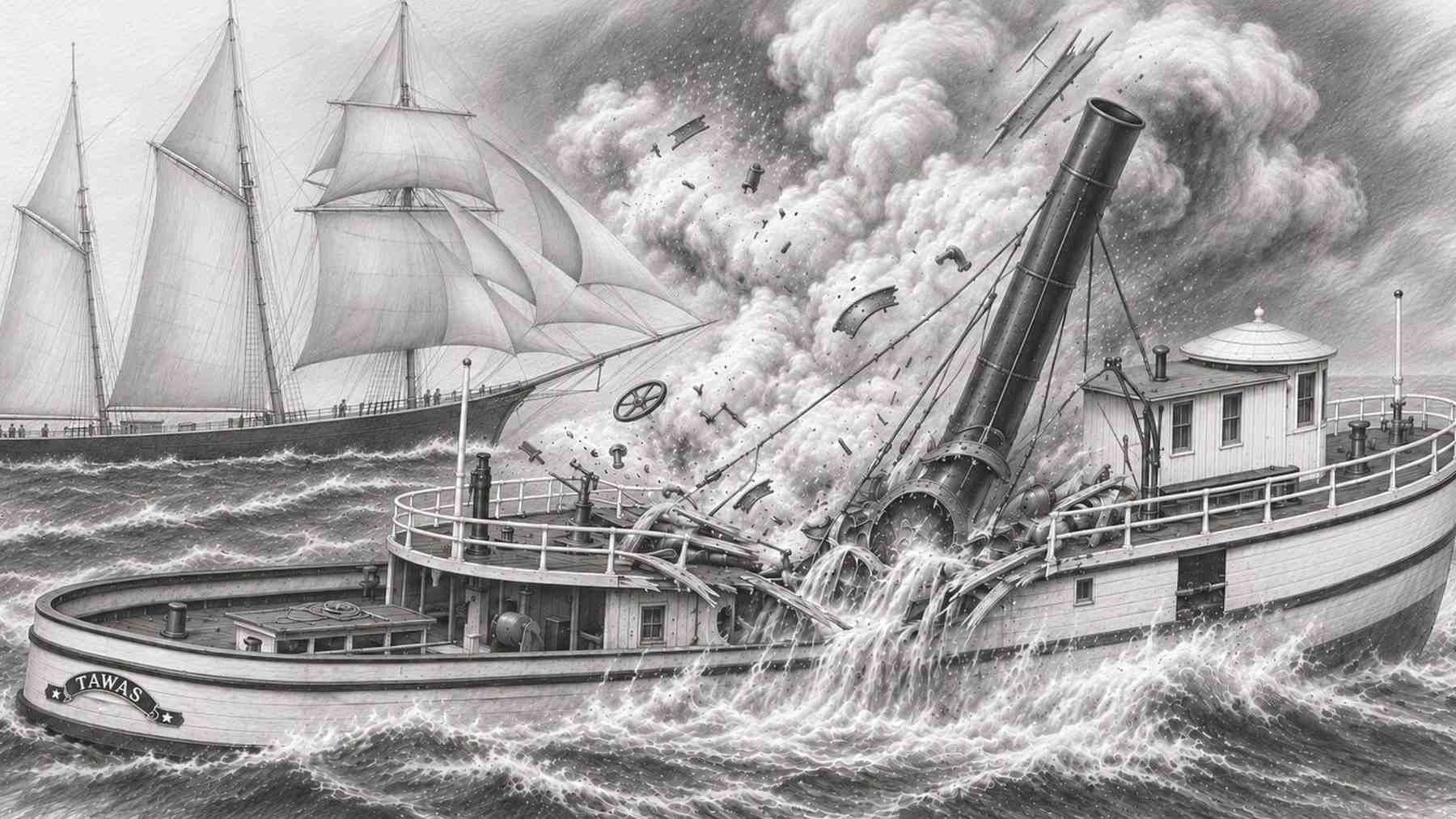
A tug’s whole job is towing other vessels, and that’s exactly what the Tawas was doing when things went wrong. Sometime in the early morning of May 14, 1874, she was about 25 miles out, southeast of Sand Beach, which is what Harbor Beach was called back then. She’d come alongside a schooner called the Zach Chandler to tow it, and that’s when her boiler exploded.
All five of the tug’s crew were killed. The Chandler’s second mate died too. According to The Maritime Executive, flying debris hit him in the head, and URA puts him some 300 feet from the blast. The explosion also tore up the schooner’s sails and rigging. The Tawas went straight down.
So how does a boiler take out a whole boat?
If the only steam you deal with comes out of a kettle, it’s a fair thing to wonder. A steam boiler is basically a big iron tank of water with a fire under it, and the steam trapped inside is under pressure and packing a lot of energy. If the iron gives way, all of that energy comes out at once instead of going through the engine.
What made the Tawas’s boiler give out, then? Honestly, we don’t know. URA’s release doesn’t get into the cause, and neither does The Maritime Executive’s write-up, so I’m not going to start guessing from 152 years away.
Both ends of the hull are still there
The wreck makes the explosion pretty easy to picture, though. URA ran its Klein side-scan sonar over the site and got back a hull about 100 feet long, which is close enough to a 98-foot tug. The bow and stern both showed up intact. In between, URA says, “the mid-ship was completely obliterated.”
If you haven’t come across side-scan sonar before, it sends pulses of sound out to either side of a boat and turns the echoes into a picture of the lakebed. That’s how a small team can sweep a big stretch of water without anyone getting wet.
After seeing that image, the team says it felt confident it had the Tawas. I’m not a marine archaeologist, but a boat with both ends in one piece and nothing left in the middle is pretty much what I’d expect a boiler explosion to leave behind.
Then why did it take so long to find?
A 98-foot boat in 225 feet of water isn’t exactly tucked away in a cave, so you’d think someone would’ve run into it by now. It turns out people were looking in the wrong place.
The Tawas was one of the missing wrecks people knew were somewhere off Harbor Beach, but the early reports put the sinking a lot nearer the shoreline, off Rock Falls, just south of town. URA says that may be why earlier searches missed her. Frankly, if every account you’ve got points you at the wrong patch of lake, it’s not hard to see how a wreck stays lost.
URA’s sonar first flagged the target on June 8, 2025, roughly two weeks after the same group turned up the James Carruthers, a steel steamer. By then, the tug had gone 151 years without anyone finding it. By spring 2026, the team had confirmed the target was a wreck, and on September 7, it got a mooring line in place so divers could finally go down.
Cindy and Mike Lynch and Chris Roth made that first dive, while the others worked the wreck from above with the group’s ROV. That’s a remotely operated vehicle, which is basically an underwater camera on a tether that someone steers from up top.
I’d love to know what the divers saw down there, but URA’s release doesn’t describe it. It doesn’t name the tug’s five crew or the Chandler’s mate, either.
Who’s behind the find?
If you’re wondering, URA is a bunch of volunteers, some of them divers, some historians and some just really into shipwrecks, which sounds like a pretty great way to spend your weekends if you ask me. The group’s been surveying four of the Great Lakes for about 40 years. In that time, it’s found more than 100 shipwrecks, and its Lake Huron surveys add up to almost 3,000 square miles.
That makes the identification URA’s own, based on its sonar work, and the group says it’s confident. If old Great Lakes hulls are your thing, we also covered a WWII submarine that got towed back across Lake Michigan to its museum berth earlier this month.
URA says it’s planning more dives so it can fully document the site. The group went public with the Tawas on November 10, a little over two months after Cindy and Mike Lynch and Chris Roth first went down the line to her.
 An American seabed drone went more than 13,000 feet down in the Pacific, deeper than the Titanic, and picked potato-sized metal nodules off the seafloor one at a time, skipping any with life on them, then floated about a pound back up with no pipe to its shipIndustry · 2 days ago
 A 400,000-square-foot nuclear building left unfinished in South Carolina has been stripped of its ducts, piping, tanks and gloveboxes to be rebuilt as a factory for at least 50 plutonium cores a year, and a structure first due a decade ago now won’t be done for another 12 yearsIndustry · 2 days ago
 A 591-foot bulk carrier that can load about 40,000 tons struck a 97-year-old drawbridge on the Delaware River while its span stood open for ships, and the bridge then stayed stuck in the air, backing up cars on both banks between Philadelphia and New Jersey, with no one hurtIndustry · 2 days ago